
Most advice about bad contractors stops at the point of hiring. But plenty of jobs start well and go wrong later: the start date holds, the first week goes fine, and then the extras begin, the days on site get fewer, and the final invoice looks nothing like the quote.
This guide is about that stage: the red flags once a contract is signed and work is under way, and how to deal with each before you make the final payment. If you have not hired yet, start with how to avoid cowboy builders and the ten questions to ask at the first visit.
What you are entitled to
Under the Consumer Rights Act 2015, which applies to contracts between a business and a consumer, a trader must carry out the work with reasonable care and skill. What the trader told you about the work, orally or in writing, can become part of the contract if you relied on it. If no time was fixed, the work must be done within a reasonable time, and if no price was fixed, you pay a reasonable price. If the work falls short, you can ask for it to be done again properly at the trader's cost, and if that is impossible or does not happen within a reasonable time, you may be entitled to a price reduction.
Those rights are real, but they are easier to use when you have kept records and spotted problems early. Every red flag below is easier to fix in week two than at the final invoice.
Red flags while the work is under way
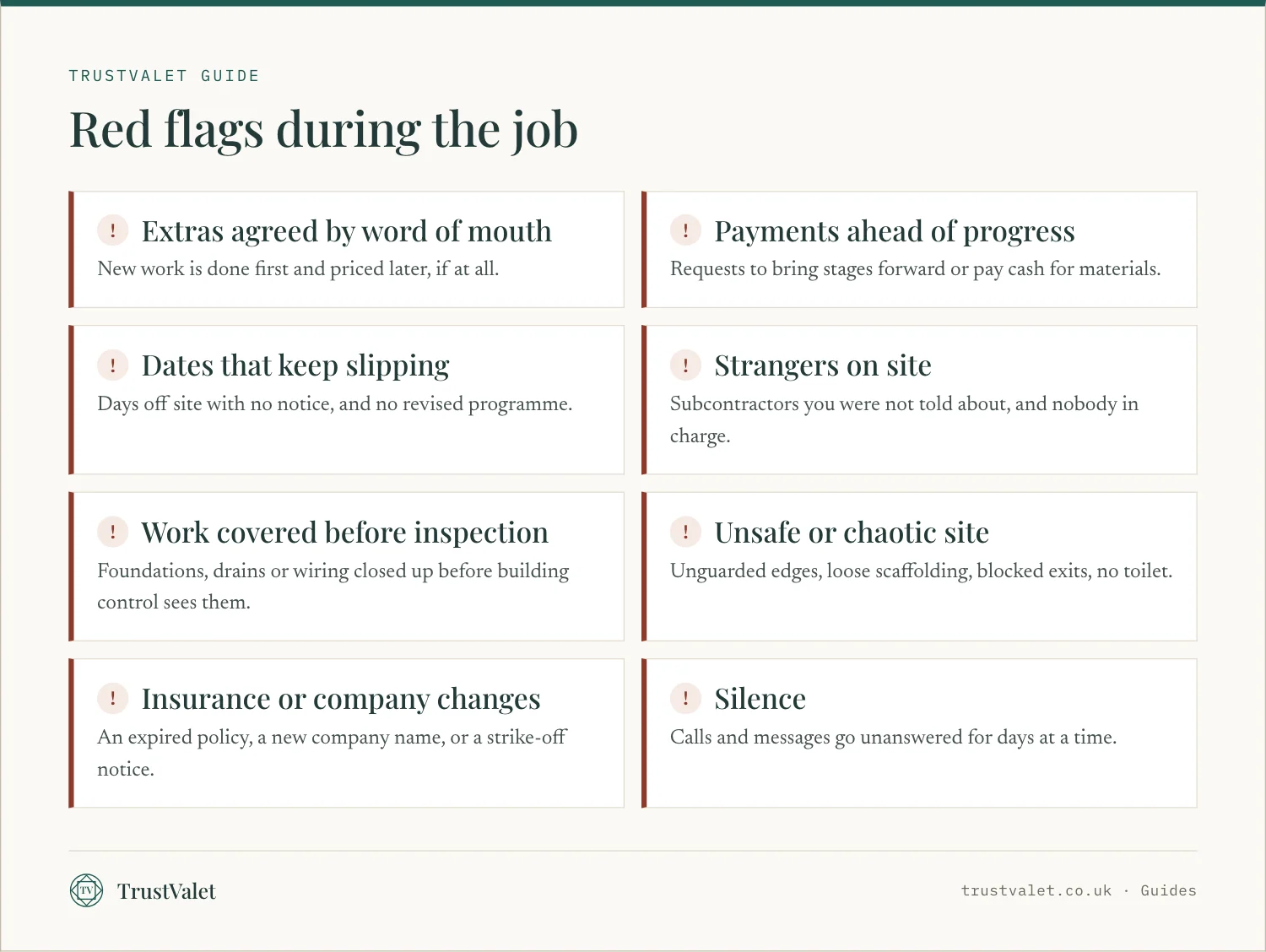
Extras agreed by word of mouth
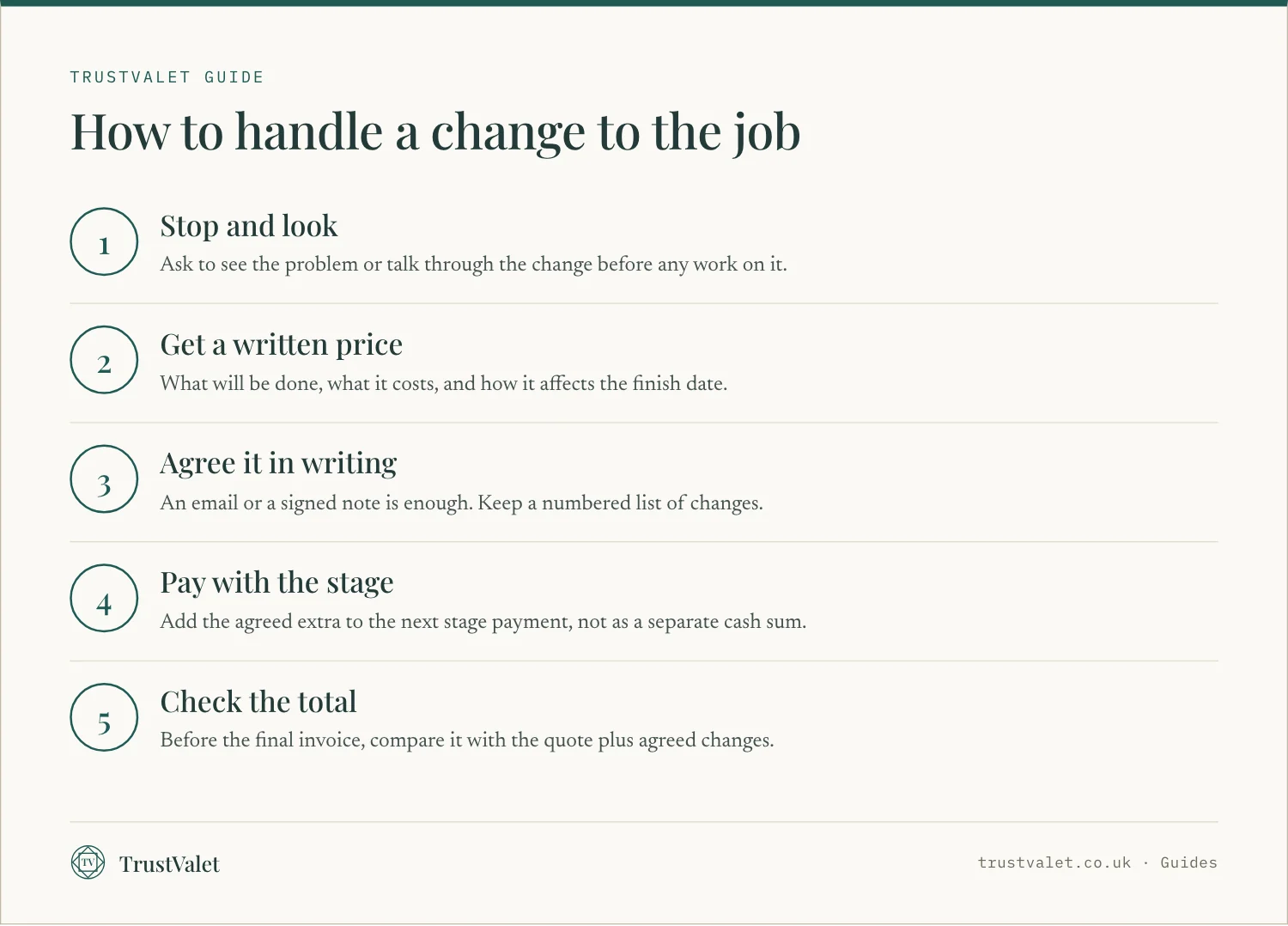
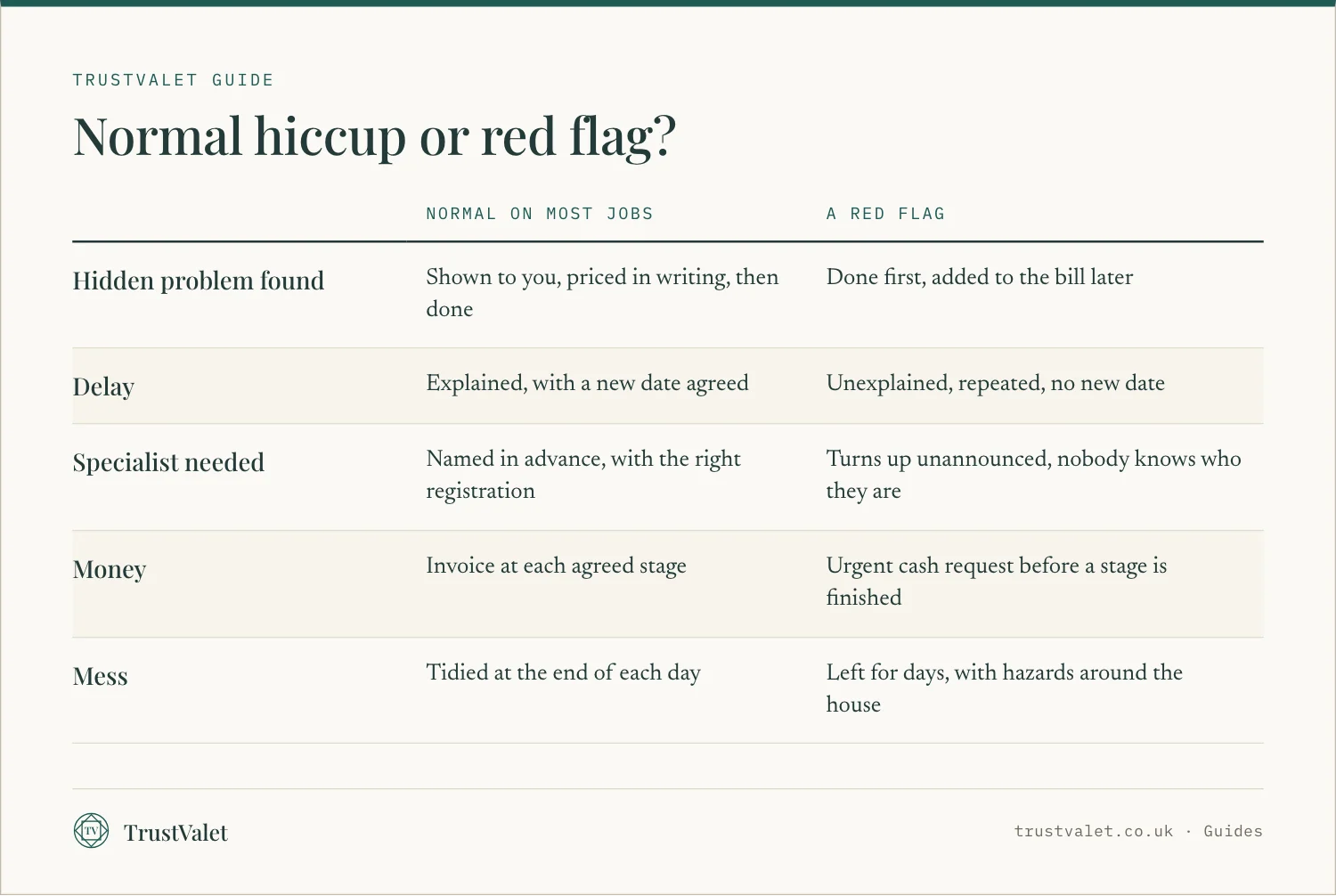
Scope creep is one of the commonest sources of disputes. Some changes are unavoidable: a rotten joist under the floor, a drain in the wrong place, a wall that turns out not to be where the drawings put it. A professional stops, shows you, gives you a written price and waits for your agreement. A bad contractor carries on and mentions it later, or asks "while we are here, shall we also do the...?" without a figure.
Each change, called a variation, should be agreed in writing with its price and its effect on the finish date. An email is enough. Keep a numbered list. If extras are piling up with no paperwork, stop agreeing to new ones until the list is written down.
Payments that run ahead of progress
Payment should follow work you can see. Warning signs include requests to bring a stage payment forward, a sudden need for cash to "release materials", or an invoice for a stage that is not finished. Your leverage is the money you have not yet paid. Once payments are ahead of progress, you have lost it.
For homeowners, the statutory payment rules in the Housing Grants, Construction and Regeneration Act 1996 do not apply to contracts with a residential occupier, so the payment terms are whatever your contract says. That is one more reason to have stages written into it.
Dates that keep slipping
One delay with a clear reason is normal: weather, a late delivery, an illness. A pattern is different: days with nobody on site, a crew that arrives at eleven and leaves at two, and no revised date. It often means your job is being fitted around others.
Ask for a revised programme in writing. If a finish date was agreed in the contract, missing it may be a breach. If none was agreed, the work must still be done within a reasonable time, and repeated unexplained delays count against the trader.
People on site you were not told about
Subcontracting is normal for specialist work such as electrics, plastering or scaffolding. The red flag is when you do not know who is in your house, nobody is in charge, and the contractor you hired is rarely there. The business you signed with remains responsible to you for the whole job, including the work of any subcontractors.
Where the subcontracted work needs a registration, check that person's registration, not the main contractor's. A Gas Safe number or an electrician's scheme membership belongs to an individual or business, and it does not transfer. Our guide on how to check if a tradesperson is qualified explains which trades need what.
Work covered up before it is inspected
When a job is under building control, the inspector needs to see certain stages, such as foundations, drains and structural steel, before they are covered. If trenches are filled, floors laid or walls boarded before an inspection you were told about, ask whether building control has been. Work covered too early may have to be opened up again.
An unsafe or chaotic site
On a domestic job, the Construction (Design and Management) Regulations 2015 pass the client's health and safety duties to the contractor, or to the principal contractor where there is more than one. That means planning the work safely, keeping the site in order and providing basic welfare such as a toilet and washing facilities. Unguarded openings, loose scaffolding, blocked exits and tools left where children can reach them are signs the job is not being managed. If scaffolding is involved, ask who erected it and whether it has been inspected. Browse scaffolders in the register.
Insurance that lapses or a company that changes
Policies expire. If the certificate you saw at the start runs out during a long job, ask for the renewal. Keep an eye on the company itself too: a new company name on invoices, a proposal to strike the company off the register, or a notice of insolvency in The Gazette all change who you would be claiming against if something went wrong. Our register shows the company's status and filing deadlines from Companies House, with the date we read them.
Silence
A contractor who stops answering is a contractor with a problem, and it may soon be yours. Put your questions in writing, give a date for a reply, and keep copies. If silence goes on for more than a few days with nobody on site, treat it as serious.
At the end of the job
Snagging
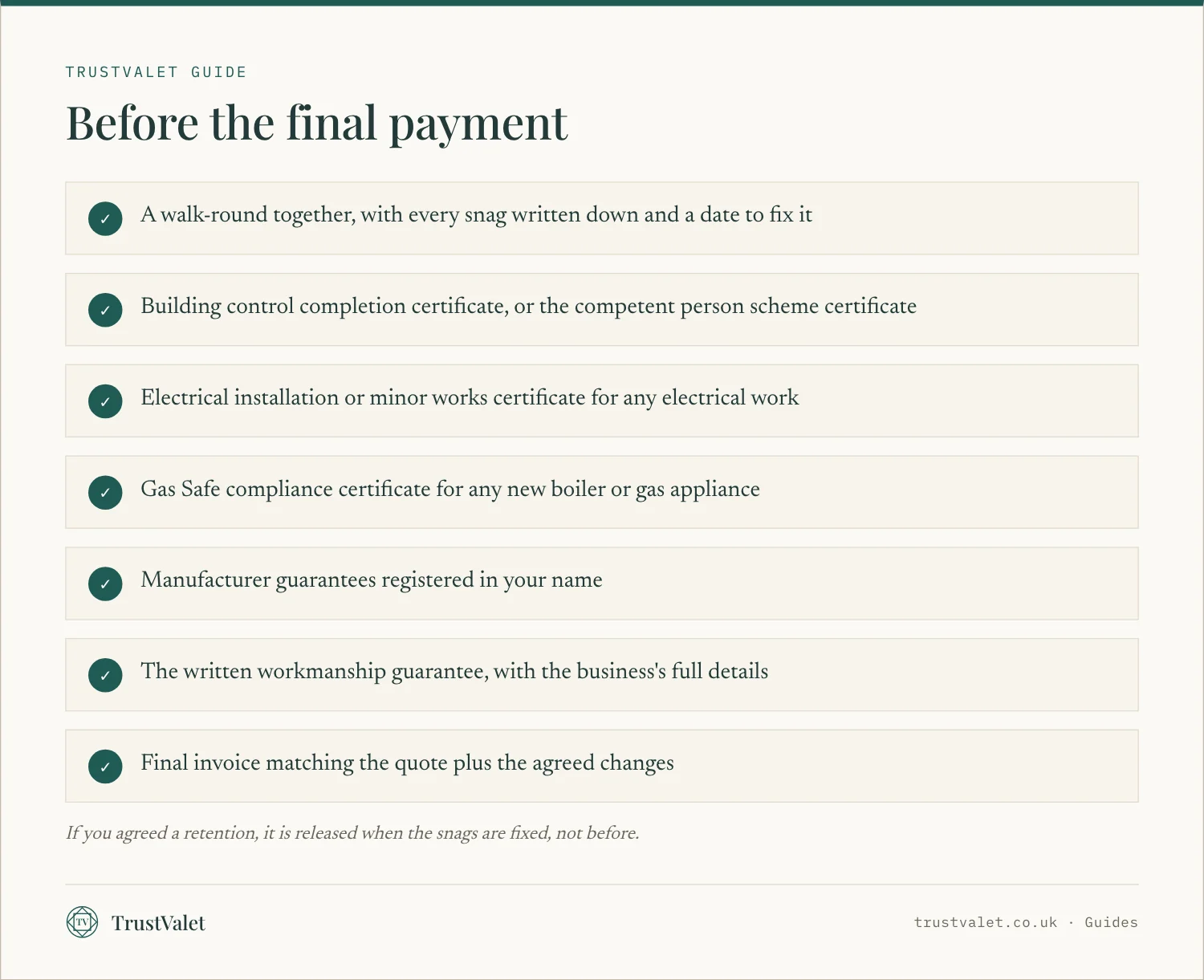
Before the final payment, walk round the finished work together and write down every defect, however small: cracked plaster, a door that sticks, a missing socket cover. Agree a date to fix each one. Take dated photos.
Retention
On larger jobs, some homeowners agree in the contract to hold back a small part of the price for an agreed period after completion, to cover defects that only appear once the house is lived in. This is called a retention. It works only if it was agreed at the start. If there was no retention clause, and there are genuine unfinished items or defects at the end, withhold only an amount that fairly reflects them, and explain in writing what it is for and what will release it.
Sign-off certificates
Notifiable work is not finished until it is signed off. Depending on the job, that means a completion certificate from building control, or a certificate issued through the installer's competent person scheme for electrics, gas, windows or heating. These documents matter when you sell. A contractor who promises they will "follow in the post" after the final payment is asking you to give up your leverage.
If the red flags are adding up
- Write down the problems with dates, and gather photos, messages and invoices.
- Raise them in writing with the business at its address, and ask for a response by a set date.
- Stop agreeing to new variations and pause payments that are not yet due.
- If the trader belongs to a trade association or a scheme such as TrustMark, use its complaints process.
- Contact the Citizens Advice consumer helpline for advice on your options.
- As a last resort, in England and Wales you can claim up to £10,000 through the small claims track.
Do not take matters into your own hands by changing the locks or hiring someone else to finish without first taking advice: ending a contract early can leave you in breach yourself if it is not done properly.
How TrustValet can help
TrustValet cannot tell you whether a job is being done well. We do not inspect work, handle complaints or rate contractors. What we do is keep a register built from public records. For each company you can see its status, when it was incorporated, how many directors have verified their identity, who controls it and by what kind of control, its filing deadlines and any registered charges, each with its source and the date we read it. During a long job, that is a quick way to spot a company whose status has changed.
A company can claim its page and add its website and phone number, and it can pay to be verified: a person runs fourteen checks against public registers, including Companies House, VAT records, domain records and insolvency notices in The Gazette, and issues a dated certificate you can check. Featured listings are advertising and are labelled that way. Browse builders, plumbing and heating or building finishing firms in London, look by city, for example Leeds, or read how we verify.
Questions
What are the signs a contractor is going to walk off the job?
Fewer days on site, unanswered messages, requests for money ahead of progress and a crew that changes without explanation. None proves it alone, but together they are a reason to put your concerns in writing and pause payments that are not yet due.
Can a builder charge for extra work I did not agree to?
Extra work should be agreed and priced before it is done. If a builder does work you never agreed to, you are not automatically bound to pay the price they name. Agree every change in writing to avoid the argument.
Can I withhold money for snagging?
If there are genuine defects or unfinished items, you can hold back an amount that fairly reflects them. Explain in writing what it covers and what will release it. Withholding far more than the defects are worth can put you in breach yourself.
What certificates should I get when building work is finished?
For notifiable work, a building control completion certificate or a certificate from the installer's competent person scheme. Electrical work should come with an electrical installation or minor works certificate, and a new gas boiler with a compliance certificate.
Who is responsible for subcontractors on my job?
The business you contracted with remains responsible to you for the whole job, including work it subcontracts. For gas or notifiable electrical work, check the registration of whoever actually does it.
Check the company first
Before you pay anyone, look the company up. Every page in the register shows what Companies House says, with the date we read it.
Ala Ciobanu · Ala Ciobanu edits the TrustValet guides. Every guide names its sources.
- Consumer Rights Act 2015, services (legislation.gov.uk)
- Housing Grants, Construction and Regeneration Act 1996, section 106 (legislation.gov.uk)
- CDM 2015: domestic clients (HSE)
- Building regulations approval (GOV.UK)
- Make a court claim for money (GOV.UK)
- Getting help with a consumer problem (Citizens Advice)
- Consumer protection rights (GOV.UK)