
Most people meet a tradesperson for the first time at their own front door, with the job in front of them and no plan for what to ask. The conversation drifts to the work itself, a price is mentioned, and the questions that would have told you who you are dealing with never come up.
This guide is a script for that first visit. It works for any trade: a builder pricing an extension, an electrician quoting for a rewire, a plumbing and heating engineer replacing a boiler, or a tiler doing one bathroom floor. For each question you will find what a good answer sounds like and why it matters. If you want the warning signs to walk away from, read our guide on how to avoid cowboy builders first.
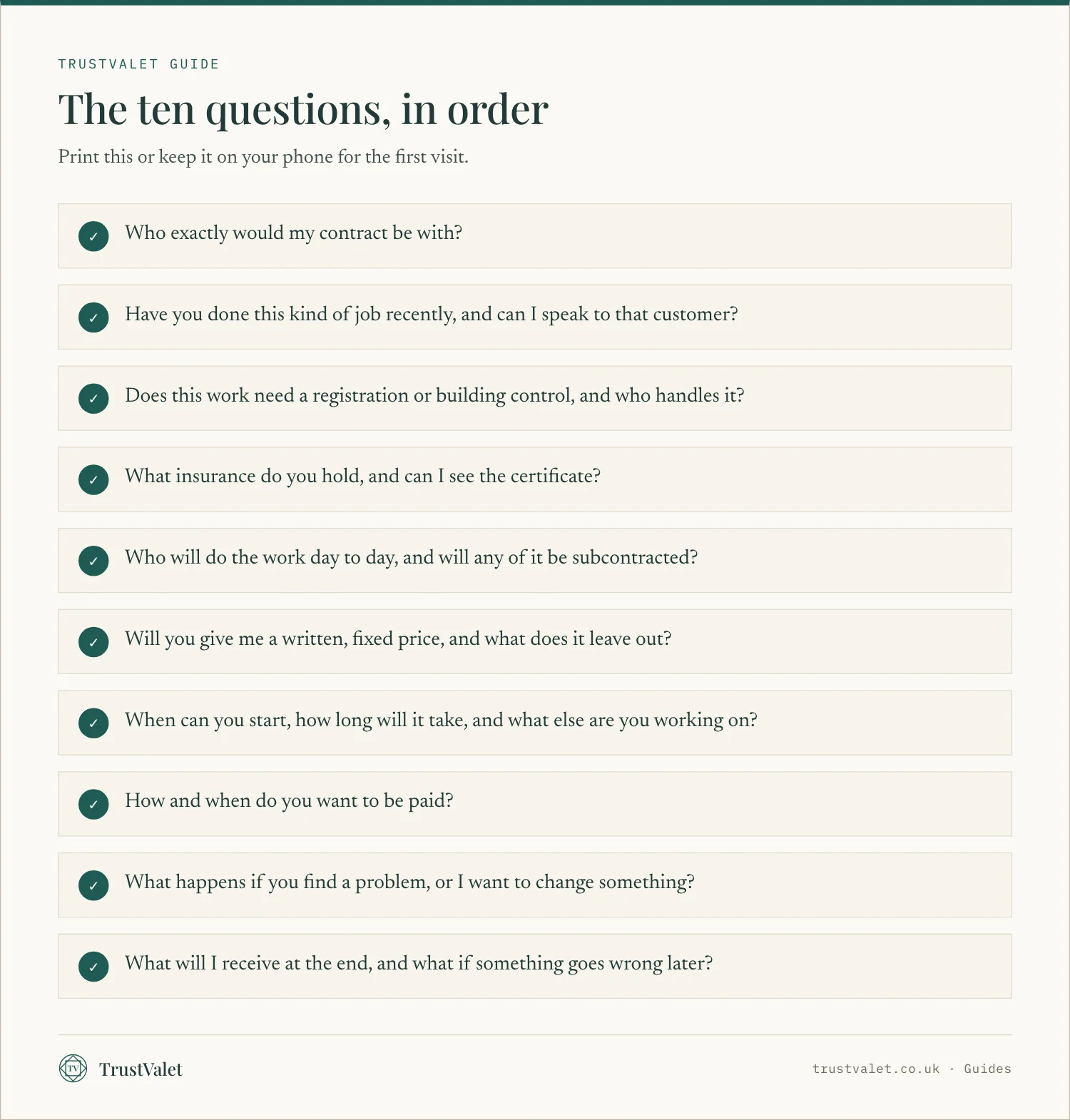
Before they arrive
Have three things ready: a short written description of the job, so every trader prices the same thing; a notebook or your phone for the answers; and time. A good tradesperson expects questions and will not mind twenty minutes of them. One who does mind has told you something useful.
The ten questions
1. Who exactly would my contract be with?
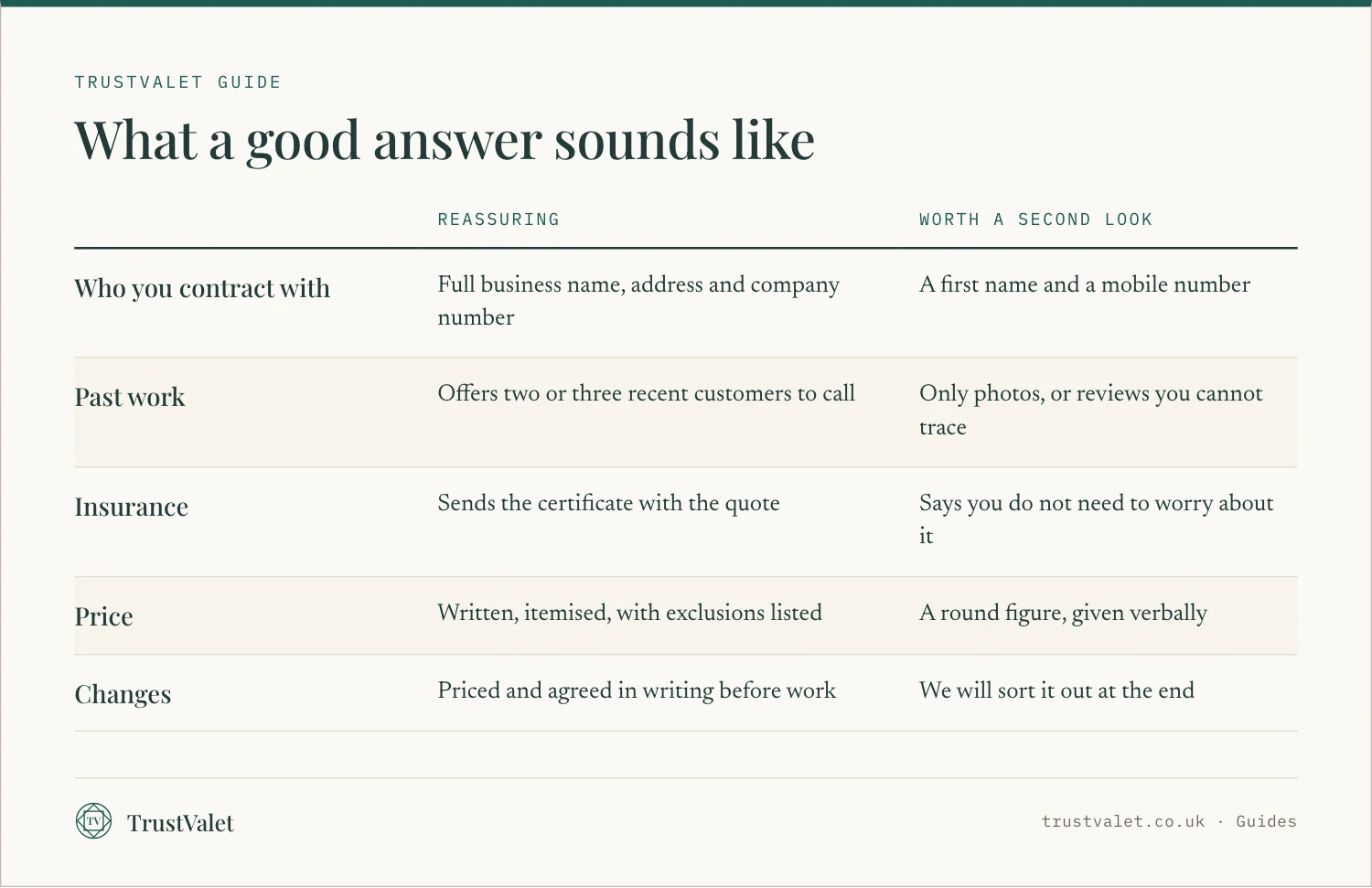
A good answer: the full business name, a trading address, and a company number if it is a limited company. A sole trader should give you their full name and a fixed address.
Why it matters: if something goes wrong, this is who you write to, claim against or take to court. A limited company is a separate legal person from the people who run it, so the name on the quote should match a real company, and the company should be active. You can look it up in our register of companies, which shows what Companies House holds and when we read it.
2. Have you done this kind of job recently, and can I speak to that customer?
A good answer: yes, with two or three customers from the last year or so who are happy to take a call, ideally for similar work.
Why it matters: photographs show the finished result, not how the job went. A past customer can tell you whether the trader turned up when promised, kept the site tidy and dealt with problems honestly. Ask them one direct question: what went wrong, and how was it handled? Something always goes wrong. The answer tells you more than praise does.
3. Does this work need a registration or building control, and who handles it?
A good answer: a clear statement of what the job needs and who will deal with it. For example: "Replacing the consumer unit is notifiable. I am registered with a competent person scheme, so I will notify it and you will get a certificate." Or: "This needs building control. We apply, and the fee is in the quote."
Why it matters: some work can legally be done only by a registered person, and gas work is the clearest case. Other work, such as new circuits, replacement windows, heating systems and roof coverings, must meet the building regulations and be signed off, either through a competent person scheme or by building control. Without that sign-off you may struggle when you sell. Our guide on how to check if a tradesperson is qualified goes through what each trade needs.
4. What insurance do you hold, and can I see the certificate?
A good answer: public liability insurance, with the certificate sent along with the quote. If they employ staff, they should also mention employers' liability insurance.
Why it matters: public liability cover pays if the trader damages your property or injures someone. It is not a legal requirement, but working without it is a risk you would be sharing. Employers' liability insurance is a legal requirement for most businesses with employees. Check the dates on the certificate, the name of the insured business, and that the trade described matches the work.
5. Who will do the work day to day, and will any of it be subcontracted?
A good answer: the names of the people who will be on site, who is in charge when the owner is not there, and which parts, if any, go to specialists.
Why it matters: the person who quotes is not always the person who does the work. Subcontracting is normal for specialist tasks such as electrics or plastering, but you should know about it, and the business you contract with stays responsible to you for the whole job. If gas or notifiable electrical work is subcontracted, the registration you need to check is the subcontractor's.
6. Will you give me a written, fixed price, and what does it leave out?
A good answer: yes, an itemised quote within a week or two, with exclusions listed plainly: skip hire, making good after the work, decorating, building control fees, or anything they cannot see until the job starts.
Why it matters: the total only means something once you know what it covers. Two quotes can differ by thousands simply because one leaves out the plastering. The exclusions are where later disputes start. The cowboy builders guide lists what a written quote should contain.
7. When can you start, how long will it take, and what else are you working on?
A good answer: a realistic start date, a duration in days or weeks, and honesty about other jobs running at the same time.
Why it matters: good trades are often booked ahead, so a start next Monday is not always a good sign. Knowing their other commitments tells you whether they will be on your job every day or dropping in between others. Under the Consumer Rights Act 2015, if no time is agreed the work must be done within a reasonable time, which is far harder to rely on than a date written into the contract.
8. How and when do you want to be paid?
A good answer: a small deposit or none, then payments tied to stages you can see, such as "foundations complete" or "first fix done", by bank transfer or card, with an invoice each time.
Why it matters: payment should follow progress, not run ahead of it. If you are always ahead on payments, you have lost your leverage. A trader who wants cash, or a large sum before any materials arrive, is asking you to carry their risk.
9. What happens if you find a problem, or I want to change something?
A good answer: "I stop, show you, give you a written price for the change, and only carry on once you agree."
Why it matters: changes to the work, called variations, are a frequent source of disputes. Opening up a wall or a floor can reveal problems nobody could see at the quote stage. That is normal. What matters is that each change is priced and agreed before it is done. Our guide to red flags once a job is under way covers what to do when changes start to pile up.
10. What will I receive at the end, and what if something goes wrong later?
A good answer: a specific list: the building control completion certificate or the competent person scheme certificate, any electrical or gas paperwork, manufacturer guarantees, their own workmanship guarantee in writing, and how to contact them if a fault appears.
Why it matters: the paperwork is part of what you are paying for. Certificates prove the work met the building regulations, and you will be asked for them when you sell. A workmanship guarantee is only worth something if the business still exists, which is one reason to check how long it has been trading.
Checking the answers
Answers given in person are a starting point. Almost everything a trader tells you about who they are can be checked for free online, in a few minutes.
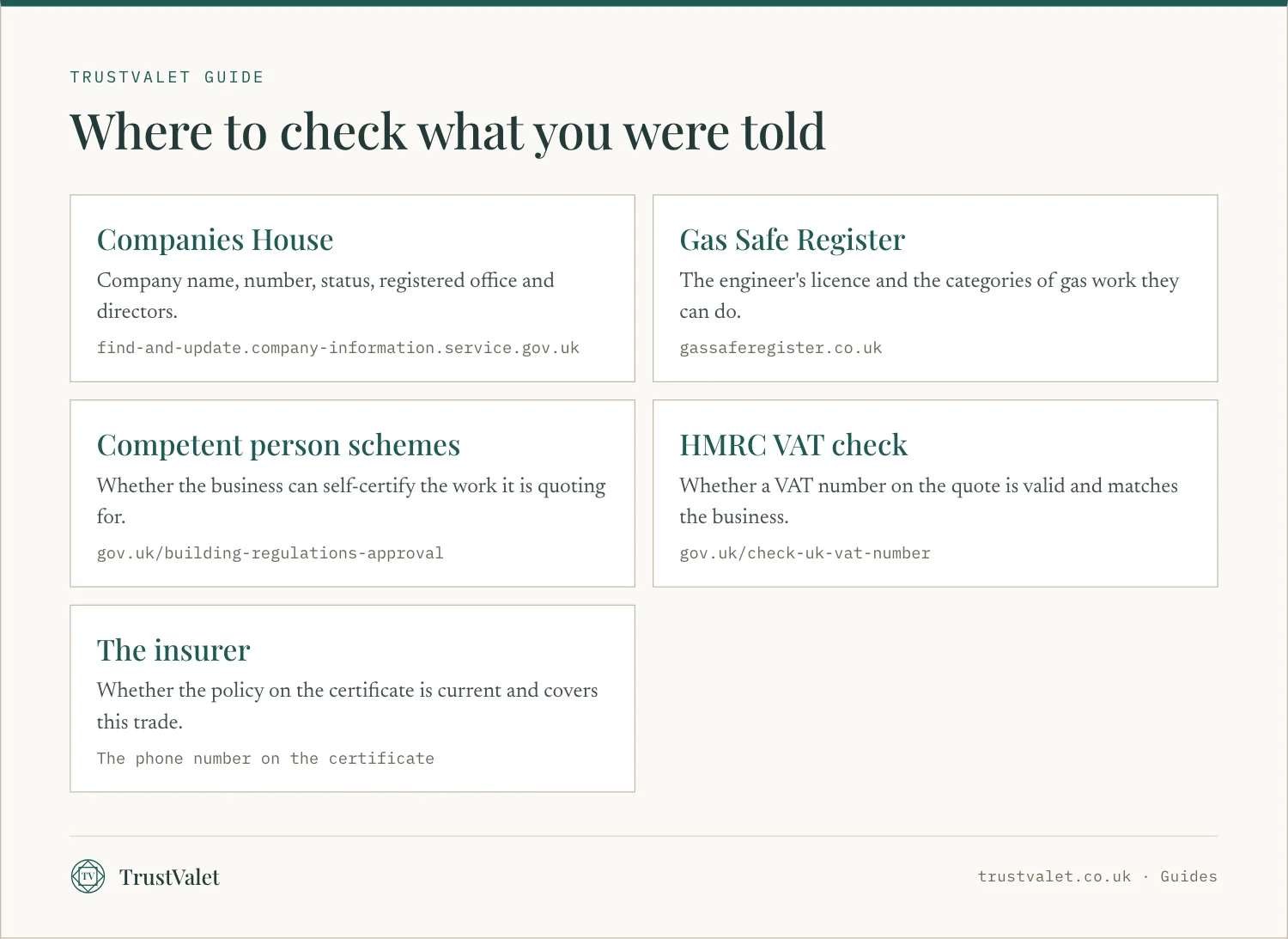
A few things to look for:
- Does the company name match? The name on the van, the quote and the Companies House record should agree.
- Is the company active? A company in liquidation or with a proposal to strike it off may not be around to honour a guarantee.
- Does the registration cover this work? A Gas Safe engineer's card lists the categories of work they can do. Being registered for gas cookers does not cover boilers.
- Does the VAT number check out? If VAT is added to the price, the number should be valid and belong to the business that quoted.
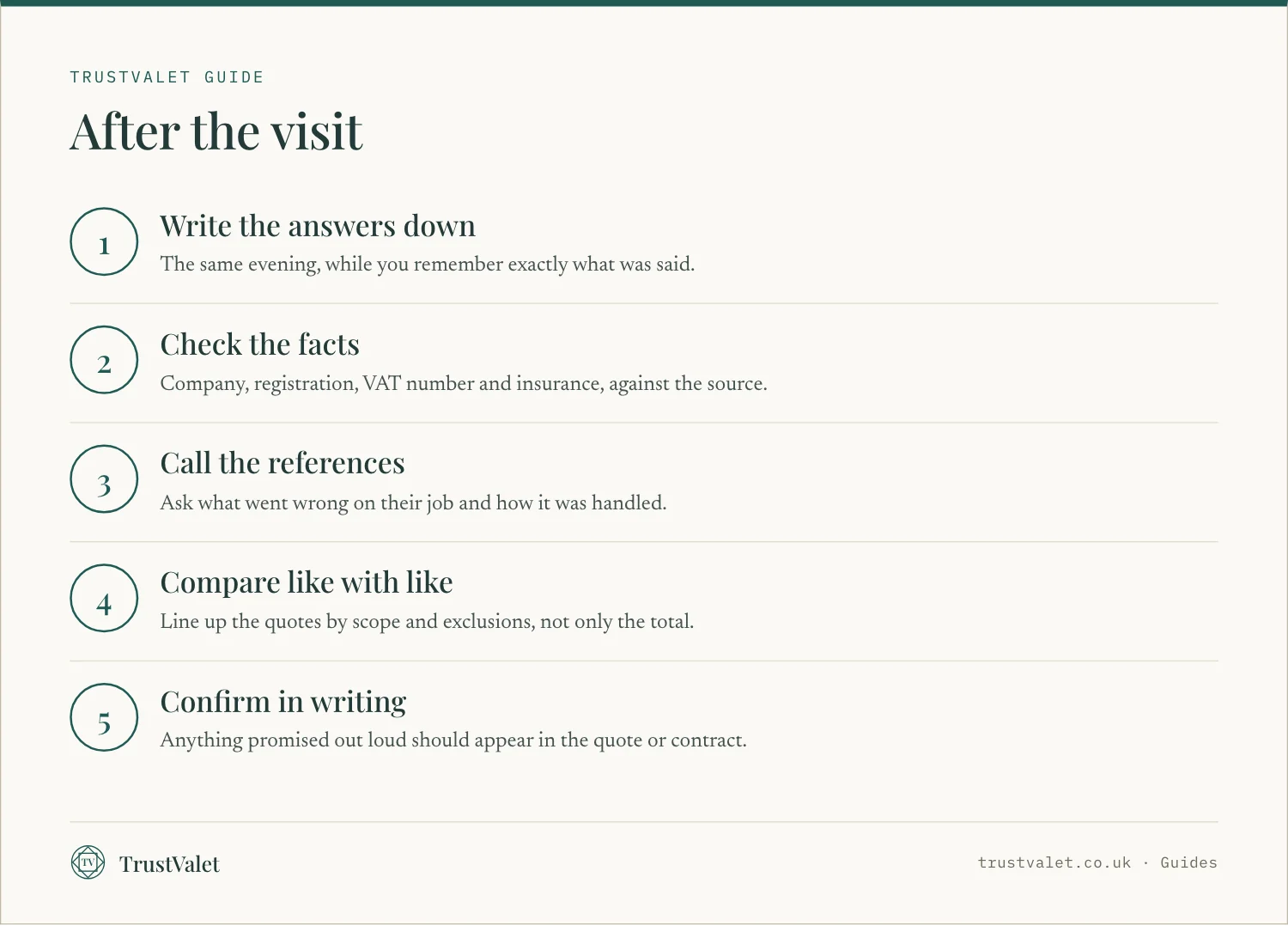
Putting it together
No single answer decides it. A new business can be excellent, and an established one can do poor work. What you are looking for is a trader who answers plainly, puts things in writing without being asked twice, and whose details match the public record. Ask the same ten questions of every trader who quotes, and the differences between them will be easy to see.
If you are comparing firms in a particular area, you can browse companies by city, for example in London or Manchester, and look at trades such as roofing contractors or painters and decorators.
How TrustValet can help
TrustValet is a register built from public records. For each company we show whether it is active, when it was incorporated, how many of its directors have verified their identity with Companies House, who controls it and by what kind of control, whether its filings are on time, and any registered charges, each with its source and the date we read it. That answers question one and part of question ten before the trader arrives.
We do not inspect work, collect reviews or recommend anyone. A company can claim its page and add its website and phone number, and it can choose to pay for verification: a person runs fourteen checks against public registers, such as Companies House, HMRC and VIES VAT records, domain records and insolvency notices in The Gazette, and the result is a dated certificate you can check yourself. Featured placements on the site are advertising and are labelled as such. Read how we verify for the detail.
Questions
What should I ask a tradesperson before hiring them?
Ask who your contract would be with, for recent customers you can call, whether the work needs a registration or building control, what insurance they hold, who will do the work, for a written fixed price with exclusions, the timescale, the payment schedule, how changes are handled and what paperwork you get at the end.
Is a tradesperson legally required to have insurance?
Public liability insurance is not a legal requirement, although most established trades carry it. Employers' liability insurance is a legal requirement for most businesses that employ staff, with limited exceptions such as employing only close family members.
Should I ask a tradesperson for references?
Yes. Ask for two or three recent customers who had similar work done and are willing to take a call. Ask them what went wrong during the job and how the trader dealt with it, as well as whether they were happy with the result.
What if the tradesperson finds extra work once the job has started?
Ask them to stop, show you the problem and give you a written price for the extra work before carrying on. Agreeing each change in writing is the simplest way to avoid a dispute over the final bill.
What paperwork should I get when the job is finished?
Depending on the work: a building control completion certificate or a competent person scheme certificate, electrical or gas certificates, manufacturer guarantees and a written workmanship guarantee. Keep them, as you will be asked for them when you sell.
Check the company first
Before you pay anyone, look the company up. Every page in the register shows what Companies House says, with the date we read it.
Ala Ciobanu · Ala Ciobanu edits the TrustValet guides. Every guide names its sources.
- Consumer Rights Act 2015, services (legislation.gov.uk)
- Building regulations approval (GOV.UK)
- Employers' liability insurance (GOV.UK)
- Check a UK VAT number (GOV.UK)
- Find and update company information (Companies House)
- Check an engineer (Gas Safe Register)
- Getting help with a consumer problem (Citizens Advice)