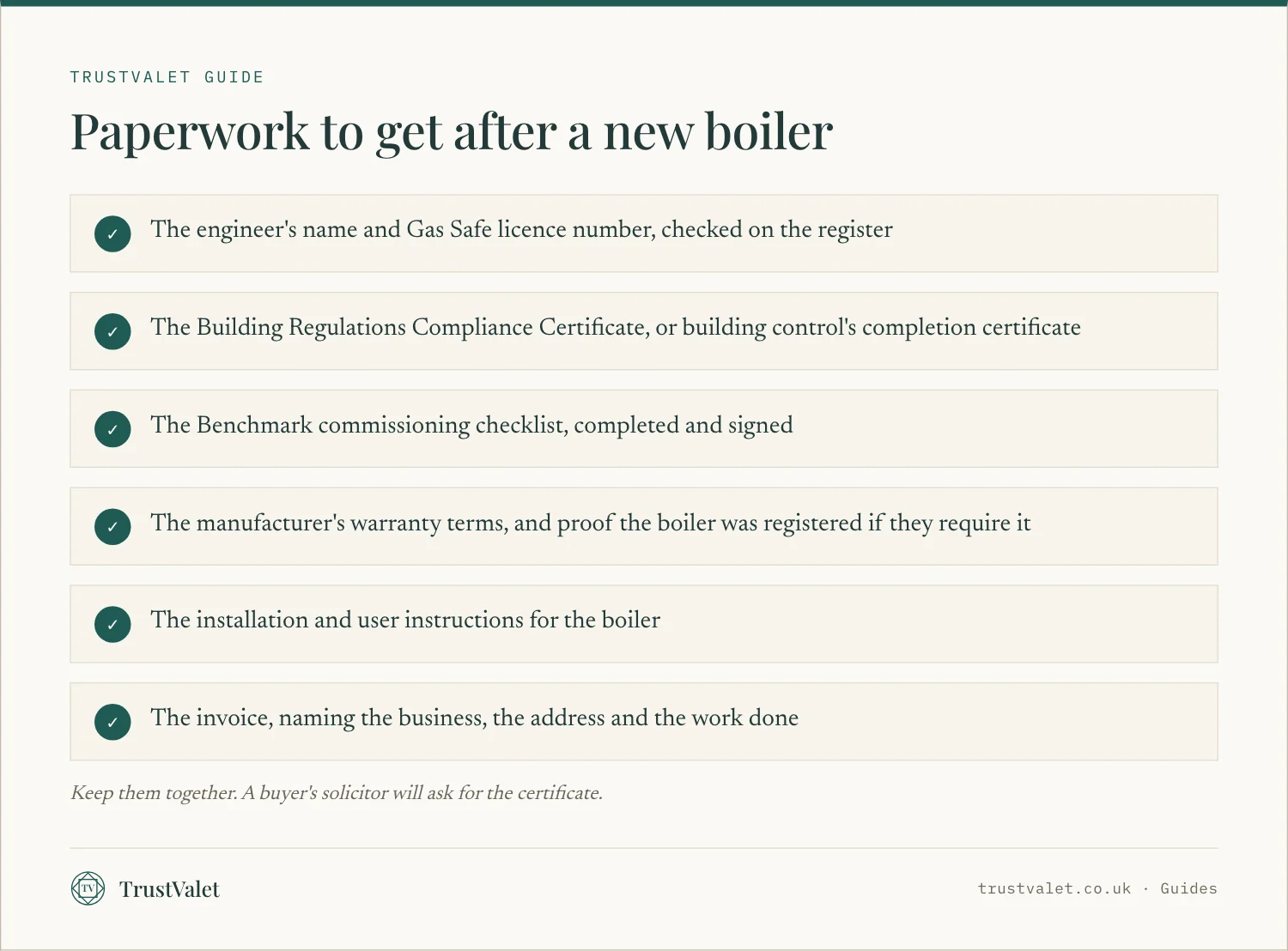
When a new gas boiler is fitted, the engineer must be on the Gas Safe Register, and the installation must be notified under the building regulations. You should end up with three things: a Building Regulations Compliance Certificate, a completed Benchmark commissioning checklist, and the manufacturer's warranty details. Check the engineer before work starts, check the paperwork after, and keep it all for when you sell the house.
This guide covers England and Wales and stays specific to boilers. For other trades, see how to check if a tradesperson is qualified. You can browse plumbing and heating companies in our register.
Gas Safe registration is the law
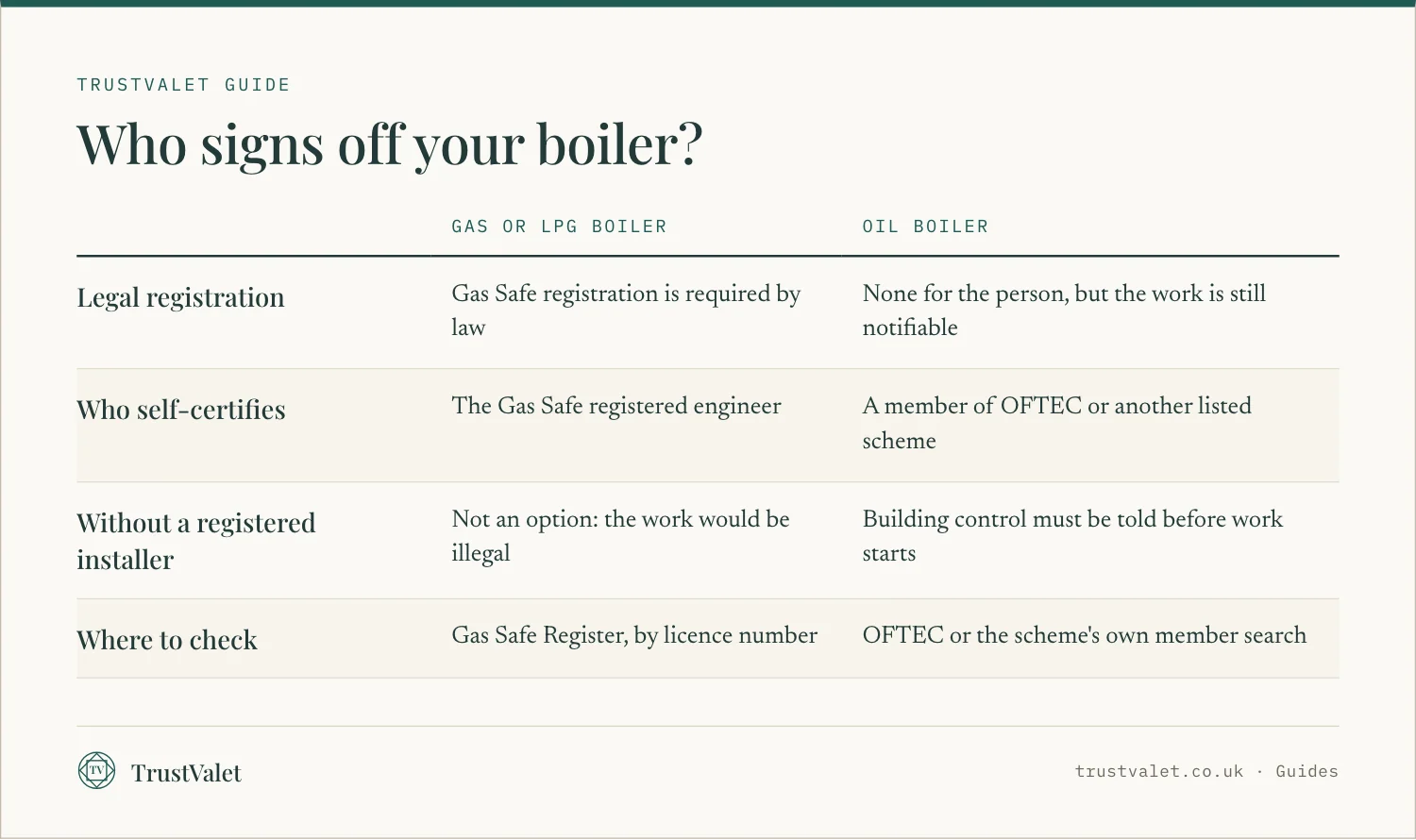
The Gas Safety (Installation and Use) Regulations 1998 say no one may do gas work for pay unless they belong to a class of persons approved by the Health and Safety Executive. Today that means the Gas Safe Register. There is no exception for a boiler swap.
The rule also covers LPG. The Health and Safety Executive says LPG appliances need a Gas Safe registered engineer in the same way as mains gas. So an LPG boiler is gas work, not oil work.
Check the engineer and the category
Registration alone is not enough. The Health and Safety Executive says an engineer must be registered and competent in the area of gas work they are doing, and that these competencies are marked on the back of the Gas Safe ID card. An engineer registered for cookers is not, by that alone, registered for boilers.
The Health and Safety Executive also points to the Check an Engineer service on the Gas Safe Register website. You enter the licence number from the card and can see the engineer's photo and qualifications. Do this yourself, and do not rely on a link sent by the installer.
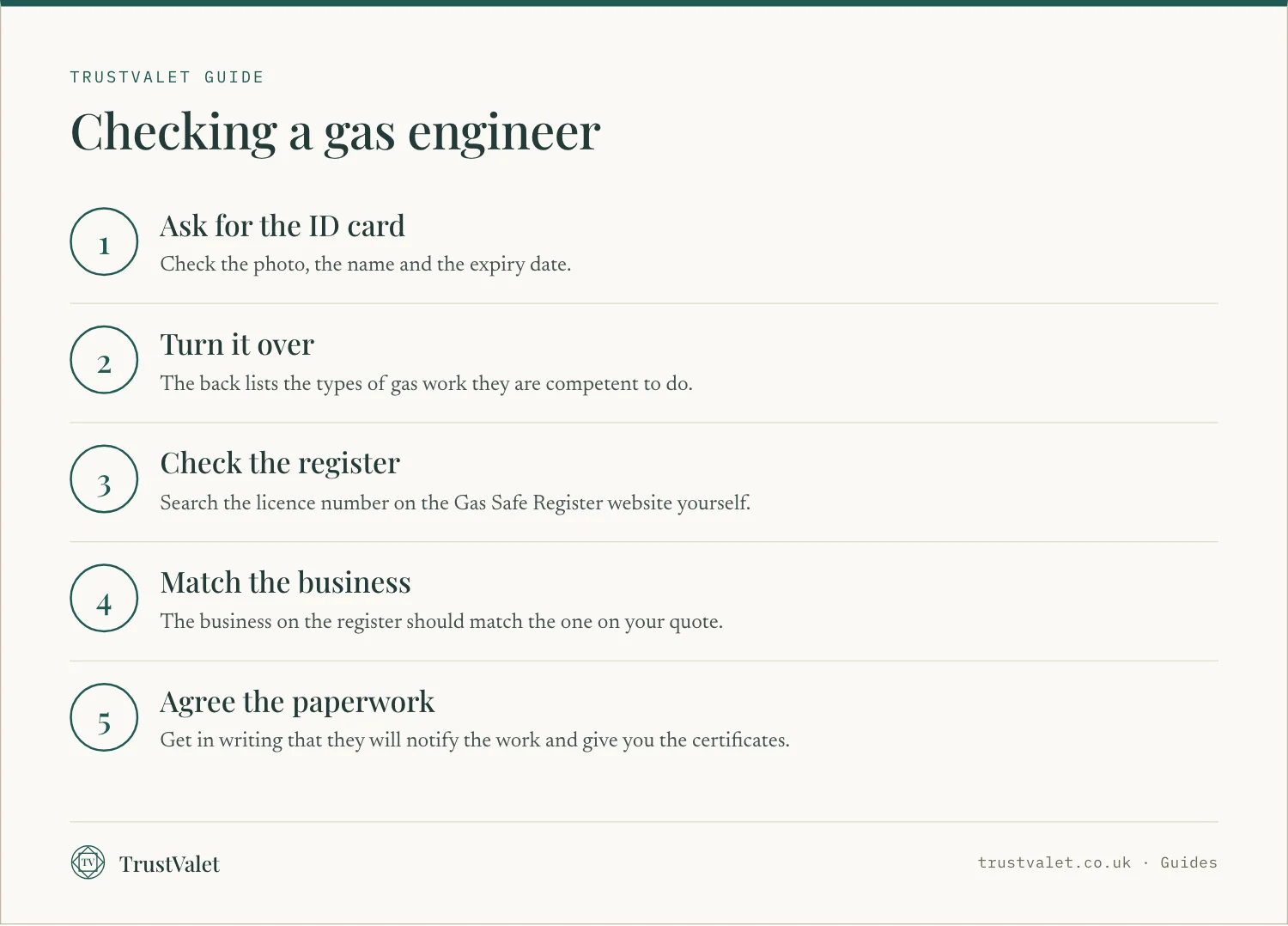
If a subcontractor does the fitting, it is their card and categories that matter. Ask who will be on site, and check that person.
The Building Regulations Compliance Certificate
Installing a new boiler is building work. GOV.UK lists installing or replacing a heating system among the jobs that need building regulations approval. The Planning Portal says a new boiler needs approval because of safety and energy efficiency, and that this is usually met by using an installer registered under an approved scheme.
For gas, that installer is the Gas Safe engineer. GOV.UK notes that Gas Safe is not technically a competent person scheme, but its installers have the same responsibilities for meeting the building regulations. The engineer self-certifies the work, and it is notified to building control on your behalf.
When it should arrive
The Building Regulations 2010 give the person doing self-certified work 30 days from completion to give the occupier a copy of the certificate and to notify building control. GOV.UK says a registered installer's certificate can be used as evidence of compliance, and that it will show up in solicitors' searches when you sell.
If nothing has arrived after a month, ask the installer first. If they do not help, contact Gas Safe Register with the engineer's licence number.
Emergency replacements
GOV.UK says you do not need approval in advance for emergency repairs to a boiler or heating system, but there are still rules to follow. The Planning Portal says the work must still comply, and approval is then sought after the event. The certificate still matters.
The Benchmark commissioning checklist
Commissioning is the setting up and testing of the boiler once it is fitted. The gas regulations require an engineer who has worked on an appliance to examine the flue, the air supply, the operating pressure or heat input, and whether it works safely. Any defect must be reported to you.
The Benchmark scheme records this. Benchmark says the engineer should fully complete the Benchmark Checklist on installation, found in the back of the installation instructions or in its app. It also says the engineer is required to complete a commissioning checklist to comply with the building regulations in England and Wales. You sign it to confirm the boiler's operation was explained to you, so ask the engineer to show you the controls, the pressure gauge and how to reset the boiler before they leave. Do not sign a blank or half-filled checklist.
The same checklist has service records. Benchmark says servicing should be recorded there after each service, and that regular servicing keeps appliances within warranty.
The manufacturer's warranty
Warranty terms are set by each boiler manufacturer, so read them rather than relying on the installer's summary. Benchmark says installers are required to install, commission and service in line with the Benchmark checklist for warranty purposes.
Before you pay, ask:
- whether the boiler must be registered with the manufacturer, and by when;
- who will register it, you or the installer;
- how often it must be serviced for the warranty to stay valid.
Keep proof of registration with the other papers. If the warranty depends on annual servicing, the Benchmark service records are your evidence.
Oil boilers
Oil is not gas work, so Gas Safe does not apply. There is no legal registration for the person, but installing an oil boiler is still notifiable building work.
GOV.UK lists several competent person schemes for oil appliances, including OFTEC. OFTEC says its registered technicians in England and Wales can self-certify their installations without a building control notice. If your installer is not in a scheme, the Planning Portal says you or the firm must tell building control before work starts and pay a fee. Building control then issues a completion certificate.
Heat pumps
A heat pump is not a boiler, and Gas Safe does not cover it. What matters most is MCS certification. The Boiler Upgrade Scheme grant is claimed through an MCS certified installer, who applies on your behalf. A heat pump usually needs electrical work too, which may be notifiable in its own right. Our guide on MCS certified installers explains what the certification means, and you can browse energy companies.
What to keep for selling the house
A buyer's solicitor will usually ask for evidence that notifiable work was signed off. For a boiler, that means the Building Regulations Compliance Certificate, or building control's completion certificate if it went that way.
Keep the certificate, the Benchmark checklist with its service records, the warranty papers and the invoice in one folder. If you rent the property out, you have a further duty. The Health and Safety Executive says landlords must have a Gas Safe registered engineer carry out a gas safety check every 12 months, keep the record for 2 years, and give existing tenants a copy within 28 days of the check. New tenants get a copy before they move in. A new boiler's certificate does not replace that annual check.
Your letting agent will want all of these papers. Browse landlords and letting agents or estate agents in the register.
If the certificate is missing and the work was never notified, GOV.UK says a local authority can give retrospective approval through a regularisation certificate. You may have to put work right first.
If the engineer is not registered
Stop the work. Gas work by someone who is not registered is illegal, and it can be dangerous. The Health and Safety Executive says that if you suspect someone is working on gas appliances without being registered, you can report them to Gas Safe Register through its website. Gas Safe Register works with the Health and Safety Executive on enforcement.
Then get a registered engineer to check what was done before you use the boiler.
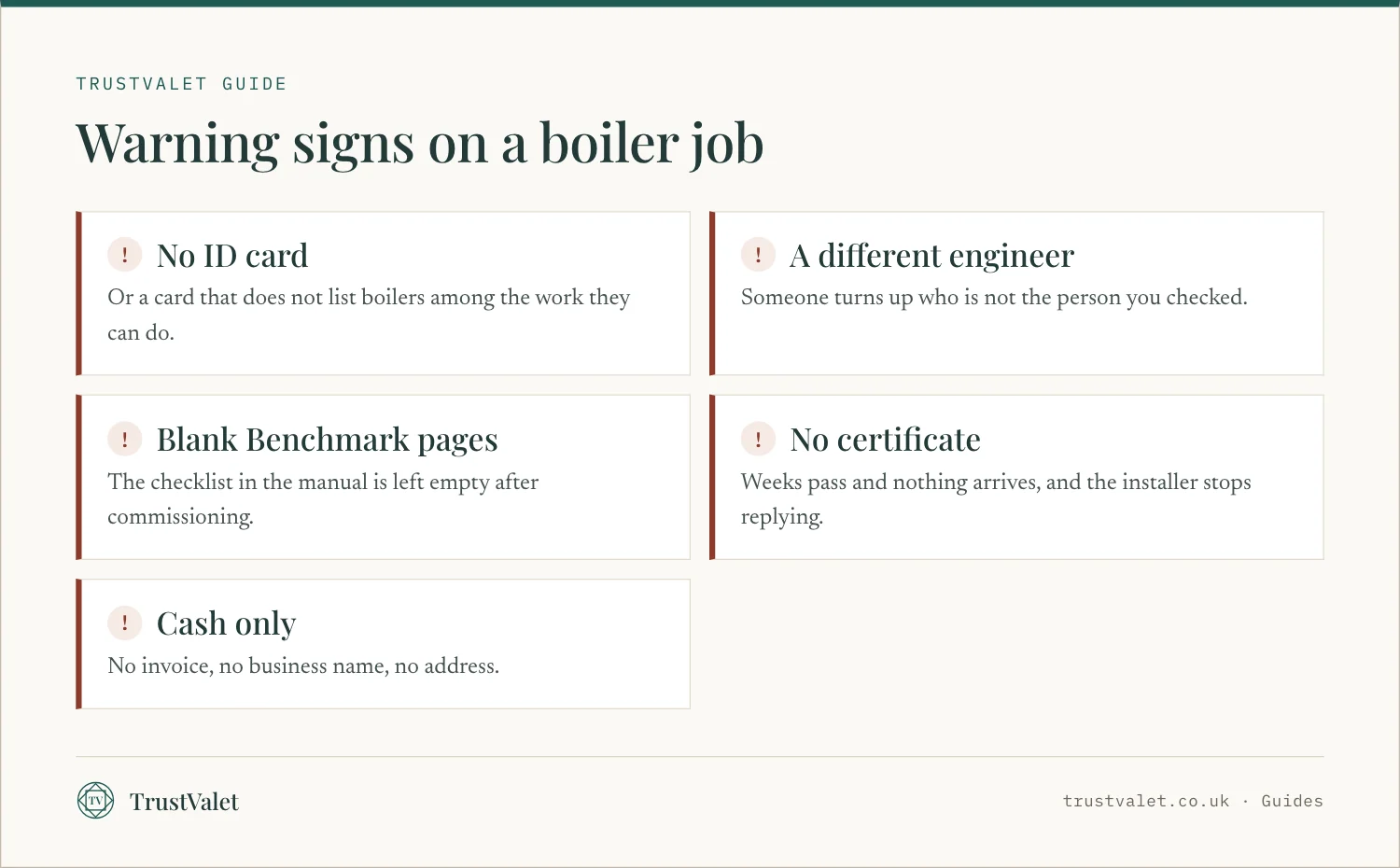
For the questions to ask at the first visit, see ten questions to ask before hiring any tradesperson, and for signs trouble is coming, read red flags of a bad contractor.
How TrustValet can help
TrustValet does not check Gas Safe registration, OFTEC or MCS membership, insurance or the quality of anyone's work. For those, go to the registers above.
What we show is the business behind the quote. TrustValet is a register built from public records. A company page shows what Companies House holds: its status, incorporation date, filing deadlines and whether any are overdue, how many directors have verified their identity, who controls it, any charges and its filing history, each with its source and the date we read it. See how to check if a UK company is legit for what to look for.
A company can also choose to be verified: a person runs 14 checks against public registers and issues a dated certificate. Search the register of companies, browse trades, look by city, for example Manchester or Bristol, or read how we verify.
Questions
What certificate should I get after a boiler installation?
A Building Regulations Compliance Certificate showing the installation was notified, plus a completed Benchmark commissioning checklist. If the work went through building control instead, you get a completion certificate from building control.
How long does the boiler certificate take to arrive?
The Building Regulations 2010 give the person doing self-certified work 30 days from completion to give you a copy of the certificate and notify building control. If nothing arrives, ask the installer, then Gas Safe Register.
How do I check a Gas Safe engineer can fit boilers?
Look at the back of their Gas Safe ID card, which lists the types of gas work they are competent to do, then search the licence number on the Gas Safe Register website to see their photo and qualifications.
Does an oil boiler need a Gas Safe engineer?
No. Oil is not gas work. The installation is still notifiable, so use an installer in a scheme such as OFTEC, who can self-certify, or tell building control before work starts. LPG boilers do need a Gas Safe engineer.
What if my boiler was fitted by someone not on the Gas Safe Register?
Do not use it until a registered engineer has checked it. You can report the person to Gas Safe Register through its website, and ask your council about retrospective approval if the work was never notified.
Check the company first
Before you pay anyone, look the company up. Every page in the register shows what Companies House says, with the date we read it.
Ala Ciobanu · Ala Ciobanu edits the TrustValet guides. Every guide names its sources.
- Gas Safety (Installation and Use) Regulations 1998, regulation 3 (legislation.gov.uk)
- Gas Safety (Installation and Use) Regulations 1998, regulation 26 (legislation.gov.uk)
- Domestic gas: frequently asked questions (HSE)
- Building Regulations 2010, regulation 20 (legislation.gov.uk)
- Building regulations approval (GOV.UK)
- Boilers and heating: building regulations (Planning Portal)
- What is Benchmark? (Benchmark scheme)
- Why choose an OFTEC registered competent person (OFTEC)