In the UK, most trades do not need a licence. Anyone can call themselves a builder, a roofer or a plasterer. A small number of jobs can legally be done only by someone on a specific register, and a wider group of jobs must be signed off under the building regulations, either by a registered installer or by building control. Everything else depends on training, experience and voluntary schemes.
This guide goes trade by trade: what is a legal requirement, what is voluntary, and how to check each one online. It covers England and Wales. Scotland and Northern Ireland have their own building control systems, although Gas Safe registration applies across Great Britain and Northern Ireland. For the questions to ask at the first visit, see our ten questions to ask before hiring any tradesperson.
Two kinds of requirement
It helps to separate two things that are often mixed up.
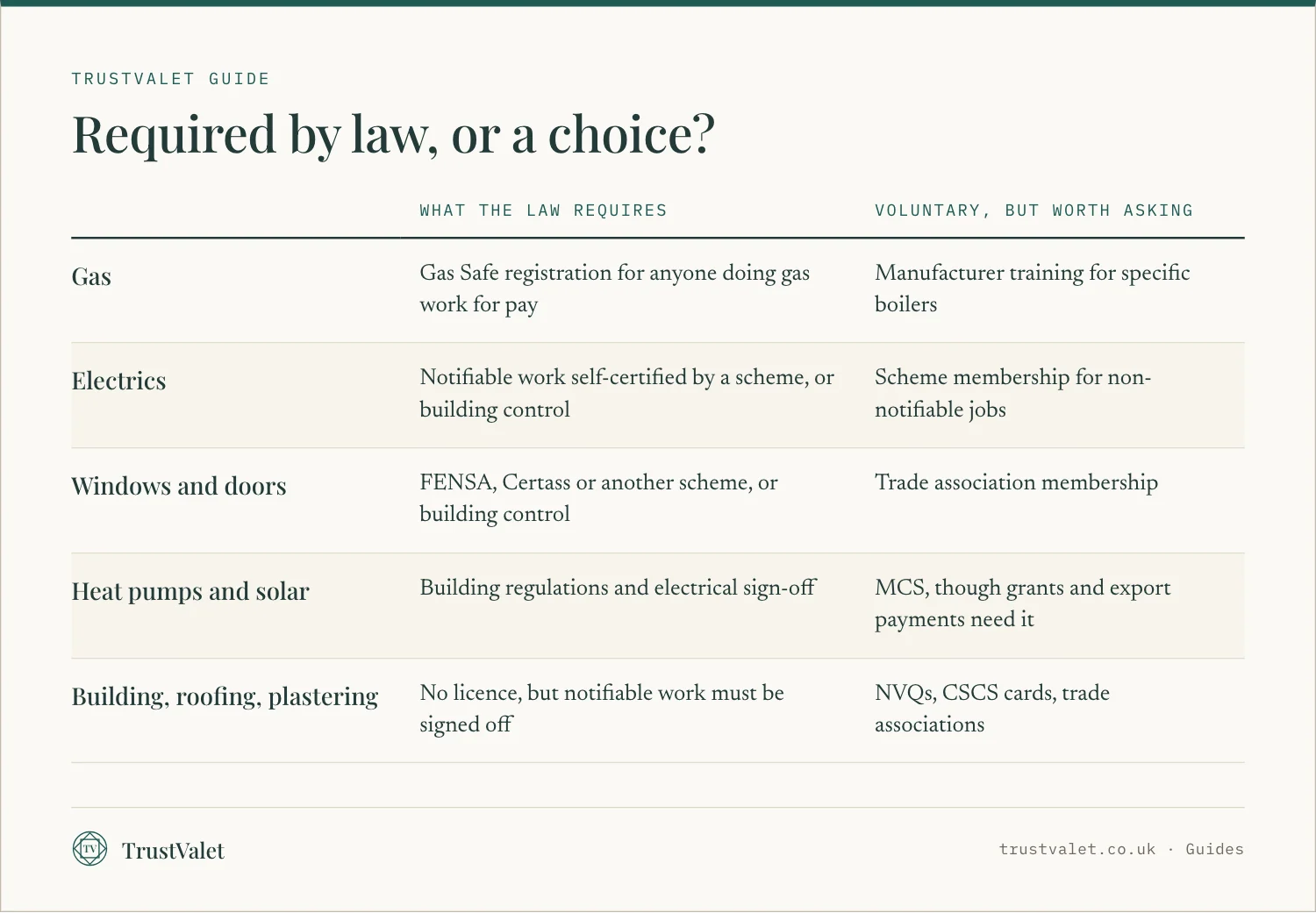
A legal registration for the person. Gas is the main example. Under the Gas Safety (Installation and Use) Regulations 1998, anyone doing gas work for payment must be a member of a class of persons approved by the Health and Safety Executive, which today means the Gas Safe Register.
Sign-off for the work. Many jobs count as building work under the Building Regulations 2010: replacing a consumer unit, fitting replacement windows, installing a heating system, replacing a roof covering. That work must comply with the regulations and be signed off in one of two ways. Either the installer is registered with a government-authorised competent person scheme and self-certifies it, or someone applies to building control before work starts and an inspector checks it. Using an unregistered installer is not illegal in itself, but then building control must be involved, and someone must apply and pay for it.
If notifiable work is not signed off, the person who did it can be prosecuted, the local authority can require faulty work to be put right, and you will not have the certificates buyers and their solicitors ask for when you sell.
Gas: a legal requirement
Anyone who installs, services or repairs a gas boiler, fire, cooker or gas pipework for payment must be on the Gas Safe Register. There are no exceptions for small jobs.
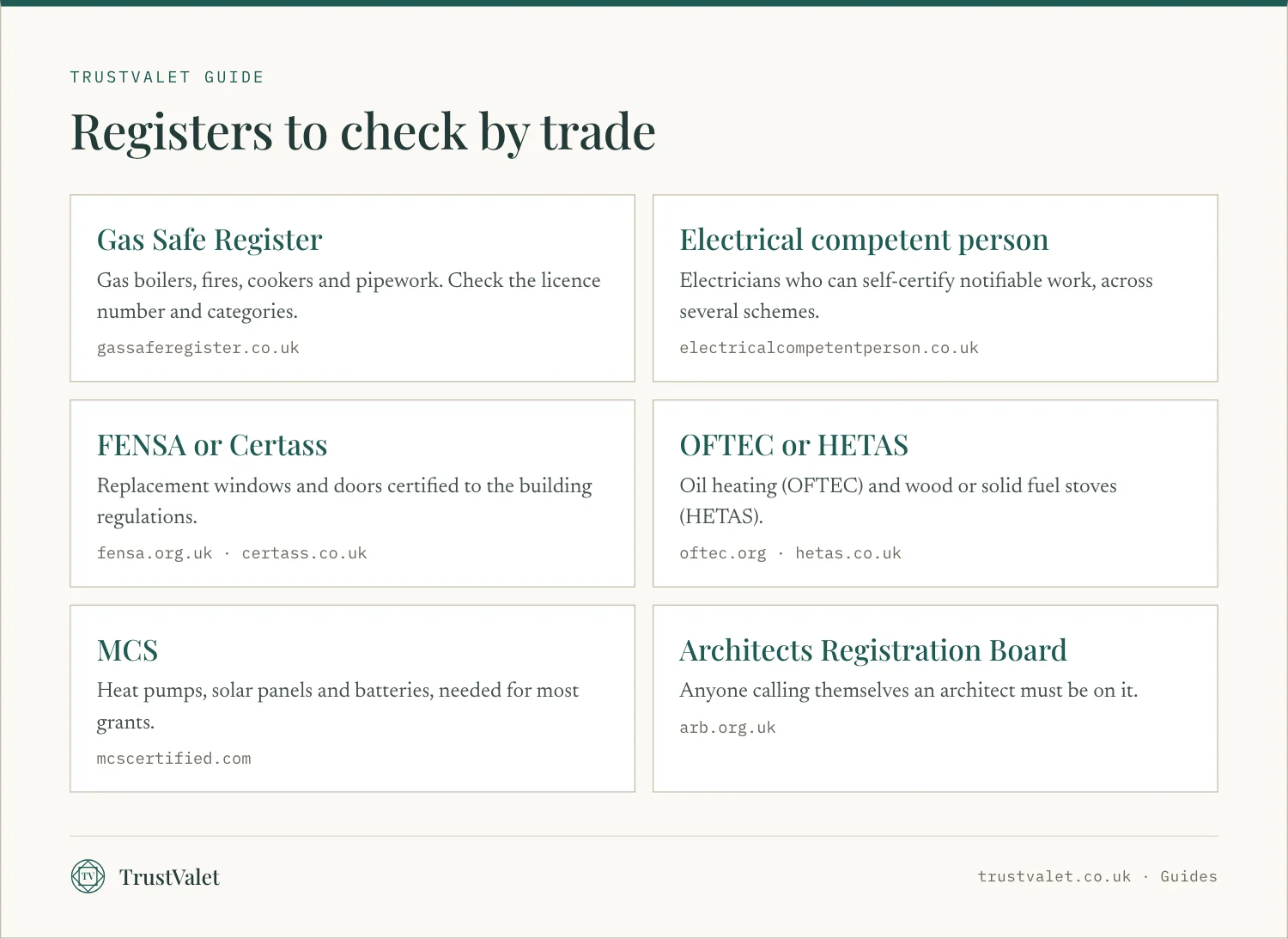
Every registered engineer carries a Gas Safe ID card with their photo, licence number and expiry date. The back of the card lists the categories of work they are qualified for, such as boilers, cookers or gas fires. Check the category, not only the card: an engineer registered for cookers is not registered to fit your boiler. You can check the licence number on the Gas Safe Register website.
When a gas boiler is installed or replaced, the engineer notifies the work through Gas Safe, and you should receive a Building Regulations Compliance Certificate. Browse plumbing and heating companies in our register.
Electrics: notifiable work and Part P
Electrical safety in homes is covered by Part P of the building regulations. In England, the work that must be notified is:
- installing a new circuit, including one from the consumer unit to a new socket or light;
- replacing a consumer unit (fuse box);
- adding to or altering a circuit in a special location, such as a room with a bath or shower.
Smaller jobs, such as replacing a socket or a light fitting like for like, are not notifiable, although they must still be done safely. In Wales, the list of notifiable electrical work is wider, so check with building control if you are unsure.
For notifiable work, choose an electrician registered with a competent person scheme. Several scheme operators exist, including NICEIC and NAPIT, and the Electrical Competent Person register lets you search across them. At the end you should receive an electrical installation certificate or a minor works certificate, and for notifiable work a building regulations compliance certificate from the scheme. Browse electricians in the register.
Windows and doors
Replacing windows and external doors is building work: the new units must meet standards on energy efficiency, safety glazing, ventilation and fire escape. An installer registered with a competent person scheme such as FENSA or Certass can self-certify, and you should receive a certificate once the installation is registered. If your installer is not in a scheme, building control must approve the work. Browse glaziers in the register.
Heating, hot water and stoves
Installing or replacing a heating system counts as building work. For gas, the Gas Safe engineer self-certifies. For oil boilers and tanks, the competent person scheme is run by OFTEC. For wood burners and other solid fuel appliances, it is HETAS. Neither OFTEC nor HETAS registration is a legal requirement for the person, but without it the installation must go through building control.
Unvented hot water cylinders are also notifiable. Installers usually hold a specific qualification for them and self-certify through a scheme.
Heat pumps, solar panels and batteries
No law requires a heat pump or solar installer to hold a particular certification. In practice, MCS certification matters a great deal. The Boiler Upgrade Scheme grant in England and Wales can only be claimed through an MCS certified installer, who applies on your behalf. Payments for exported electricity under the Smart Export Guarantee generally require the installation to be MCS certified or equivalent. The electrical connection is also notifiable under Part P. Our guide on MCS certified solar installers covers this in detail, and you can browse energy companies in the register.
Building, roofing, plastering and finishing trades
Builders, roofers, plasterers, joiners, tilers and decorators need no licence. What you can check instead:
- Qualifications. NVQ or SVQ awards at level 2 or 3 show formal training in a trade. Ask which one and when it was gained.
- CSCS cards. The Construction Skills Certification Scheme card shows the holder has passed a health and safety test and holds a relevant qualification for their occupation. It is not a legal requirement, but many main contractors require it on site.
- Trade associations. Bodies such as the Federation of Master Builders, or the National Federation of Roofing Contractors for roofers, have entry checks and codes of practice. Each runs its own member search, so check the directory rather than the logo.
- TrustMark. A government-endorsed quality scheme covering many trades that work in and around the home.
Some of this work still needs sign-off. Replacing roof coverings on pitched and flat roofs normally needs building regulations approval, and so do structural changes, extensions and new bathrooms involving plumbing. Browse builders, roofing contractors and plasterers in the register.
Specialists with their own rules
- Scaffolding. Scaffolders commonly hold a CISRS card showing their training level. Scaffolding on a public road or pavement needs a licence from the highway authority, which the scaffolder normally obtains. Browse scaffolders.
- Asbestos. Most higher-risk work with asbestos must be done by a contractor licensed by the Health and Safety Executive. If an older property may contain asbestos, ask about it before work starts.
- Architects. The title "architect" is protected by law. Anyone using it in business must be on the register kept by the Architects Registration Board. Browse architects.
- Surveyors. Anyone can offer surveys, but "chartered surveyor" indicates membership of RICS. Browse surveyors.
How to check, step by step
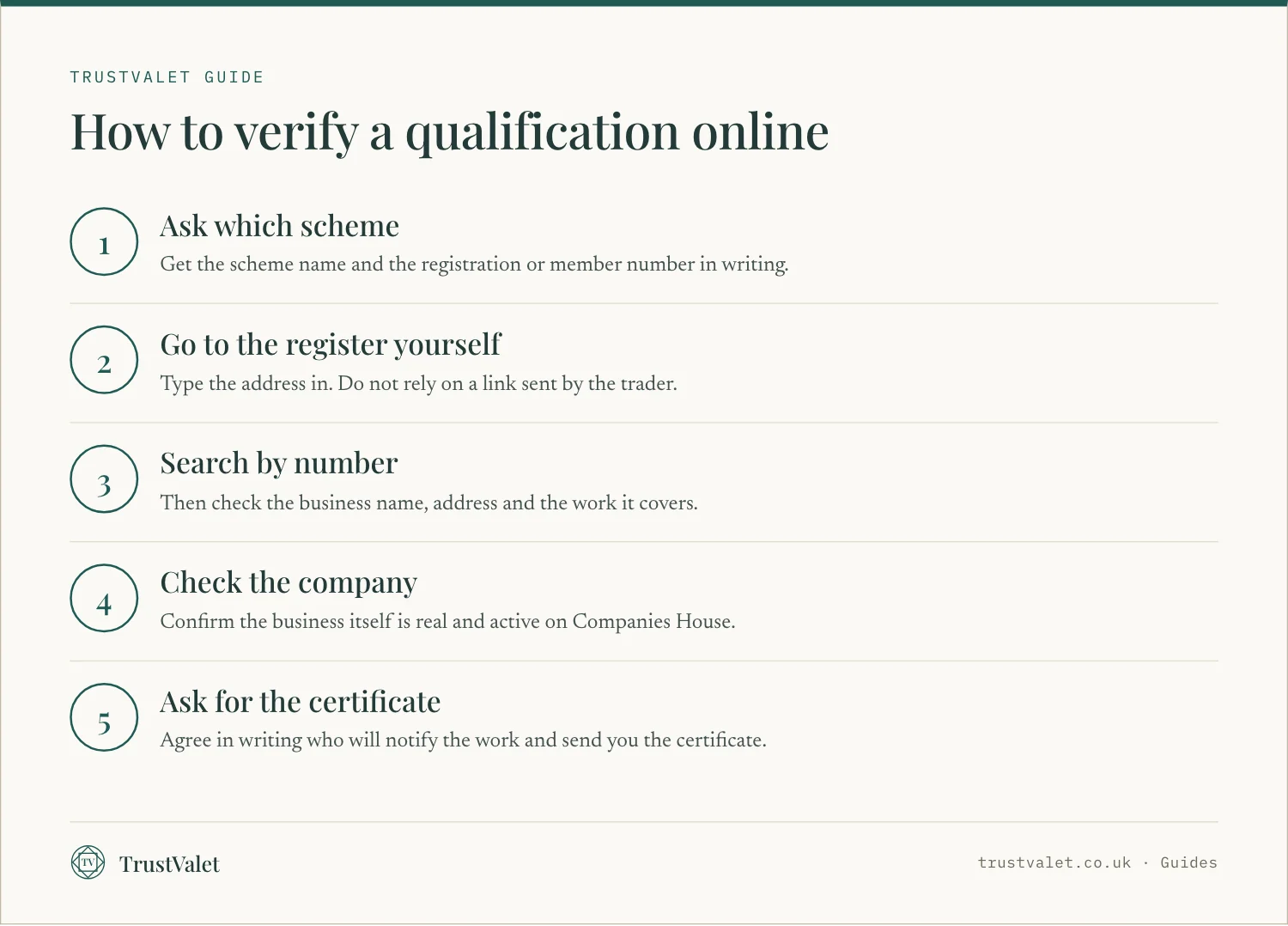
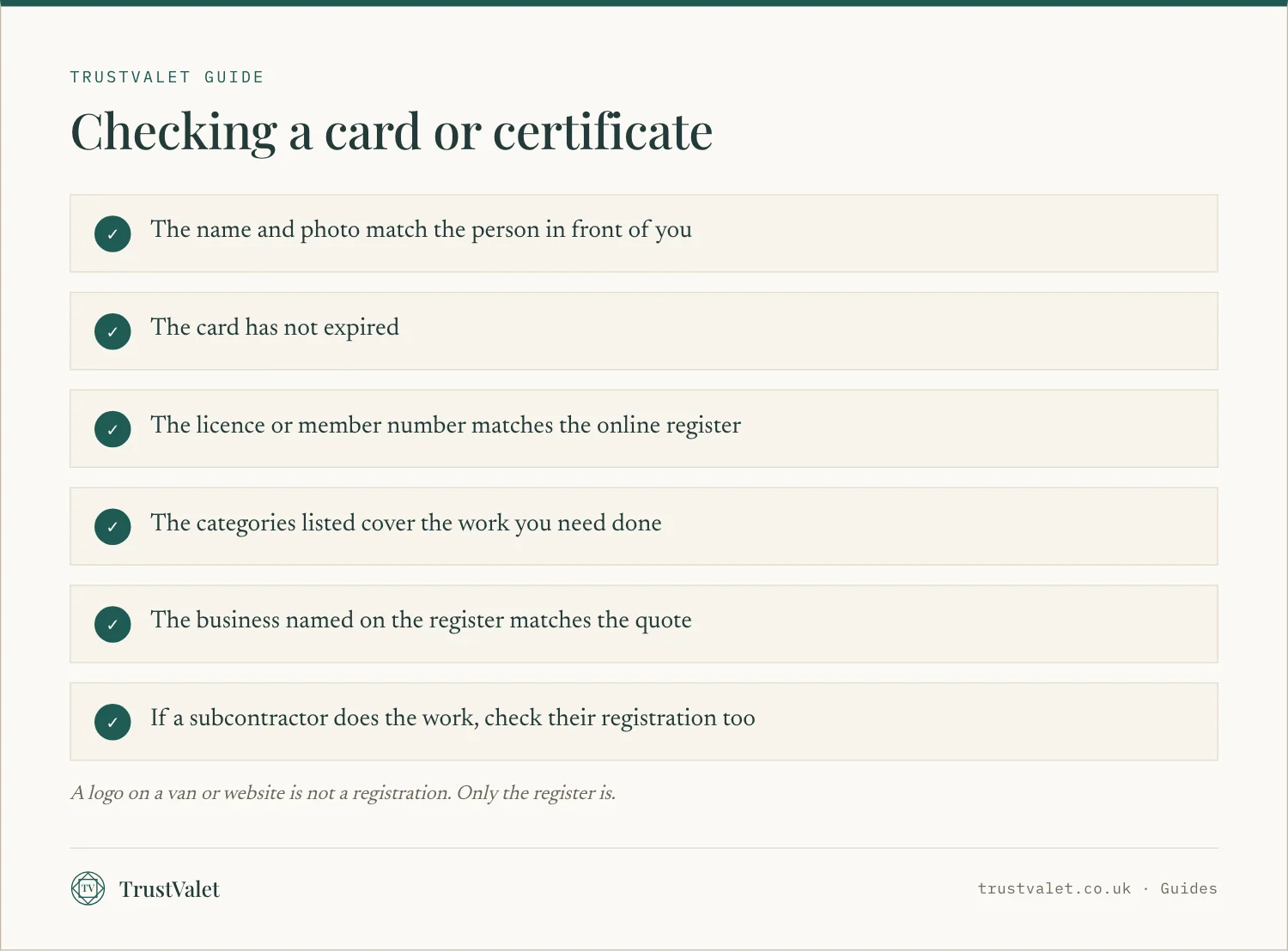
Always go to the register yourself rather than following a link from the trader, and search by the registration number as well as the name. Businesses with similar names are common, and a number removes the doubt. If the work will be done by a subcontractor, it is their registration that matters for the job.
A qualification tells you someone has been trained. It does not tell you how they run their business, which is where our guides on cowboy builders and red flags once a job is under way come in.
How TrustValet can help
TrustValet does not check qualifications or inspect work, and it does not rate or recommend anyone. It is a register built from public records. For each company you can see what Companies House holds: whether it is active, when it was incorporated, how many of its directors have verified their identity, who controls it and by what kind of control, filing deadlines and any registered charges, each with its source and the date we read it.
Use it alongside the trade registers above: the scheme tells you about the person's registration, and our page tells you about the business behind the quote. A company can also choose to be verified: a person runs fourteen checks against public registers, including Companies House, VAT records, domain records and insolvency notices in The Gazette, and issues a dated certificate you can check. Search the register of companies, browse by city, for example Birmingham, or read how we verify.
Questions
Which trades need a licence in the UK?
Very few. Gas work for payment legally requires Gas Safe registration. Other trades need no licence, but some of their work, such as new electrical circuits, replacement windows, heating systems and roof coverings, must be signed off through a competent person scheme or by building control.
Does an electrician have to be registered?
Not by law. In England, notifiable electrical work such as a new circuit or consumer unit must either be done by an electrician registered with a competent person scheme, who self-certifies it, or be approved by building control before work starts.
How do I check a Gas Safe engineer?
Ask to see their Gas Safe ID card, check the photo and expiry date, and look at the back to see which categories of gas work they can do. Then check the licence number on the Gas Safe Register website.
Do builders need any qualifications?
No licence is required to work as a builder. You can ask about NVQs, CSCS cards and membership of trade associations such as the Federation of Master Builders, and check any membership on the association's own directory.
Is MCS certification a legal requirement?
No. But the Boiler Upgrade Scheme grant must be claimed through an MCS certified installer, and Smart Export Guarantee payments generally require an MCS certified installation or equivalent, so it matters for heat pumps and solar panels.
Check the company first
Before you pay anyone, look the company up. Every page in the register shows what Companies House says, with the date we read it.
Ala Ciobanu · Ala Ciobanu edits the TrustValet guides. Every guide names its sources.
- Gas Safety (Installation and Use) Regulations 1998, regulation 3 (legislation.gov.uk)
- Check an engineer (Gas Safe Register)
- Building regulations approval (GOV.UK)
- Competent person schemes: current schemes (GOV.UK)
- Electrical safety: Approved Document P (GOV.UK)
- Boiler Upgrade Scheme: how to apply (GOV.UK)
- Find an installer (MCS)
- Architects Act 1997, section 20 (legislation.gov.uk)