To hire a good roofer, get at least three written quotes that describe the same job, check the company on Companies House, and ask who will deal with building regulations. A re-roof usually needs building control approval or a roofer registered with a competent person scheme. Agree the scaffolding, the guarantee and the payment stages in writing, and never hire someone who knocked on your door.
This guide stays specific to roofing. For the general warning signs, see how to avoid cowboy builders, and for your rights on deposits and cancelling, that guide covers them too.
Know which roofing job you are buying
Roofers quote for very different jobs. Naming the job clearly is the first step to quotes you can compare.
- Repair: a few slipped tiles, a flashing, a small leak. The quote should say how much of the roof is touched.
- Re-roof: stripping and re-covering a whole roof or slope. This is where building regulations usually come in.
- Flat roof: felt, single ply, liquid or other systems. The quote should name the system and what happens to the insulation.
- Chimney: repointing, new flashings, or removal. Removing a chimney from a party wall may need a party wall notice.
- Guttering: replacing gutters and downpipes, often done alongside other roof work.
Ask each roofer how they inspected the roof. A good quote comes after someone has looked closely, from a ladder, a scaffold tower or the loft, and can show you photos of what they found.
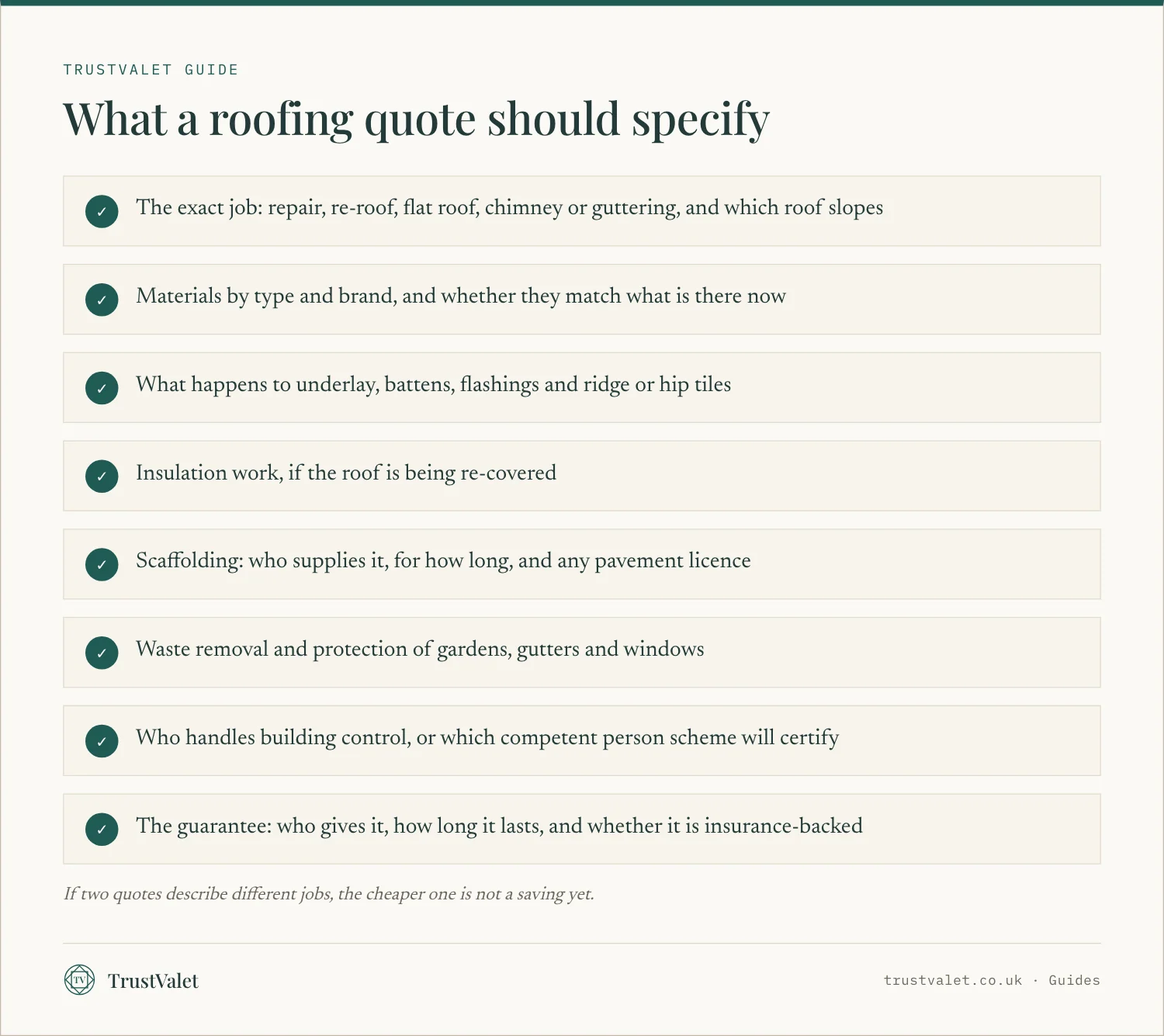
Ask each roofer to quote against the same list. If one includes new battens and underlay and another does not, the prices are for different roofs.
Do you need building regulations approval?
Many homeowners assume a roof is just repair work. The rules are more precise than that, and they sit with building control, not planning.
When you normally do not need to apply
The Planning Portal says you will not normally need a building control application to repair or re-cover a pitched or flat roof if less than 25 per cent of the total building envelope is affected and less than 50 per cent of the roof is affected. Replacing gutters or downpipes is listed on GOV.UK as exempt.
When you do need approval
You will need approval if the work goes past those limits, or if:
- there are structural alterations,
- the new covering would perform significantly differently in a fire, or
- the new covering increases the weight of the roof covering by 15 per cent or more.
A change of material, such as slate to tiles, is likely to need approval. Because a roof counts as a thermal element, re-covering it should also improve its insulation.
Competent person schemes
You do not need to apply yourself if the roofer is registered with a competent person scheme for this work. GOV.UK lists two schemes authorised for replacing roof coverings on pitched and flat roofs: CompetentRoofer, run by the National Federation of Roofing Contractors, and NAPIT. A registered roofer can self-certify, and GOV.UK says you should get a certificate within 8 weeks of completion.
If the roofer is not registered, someone must apply to your council's building control or a registered building control approver. Agree in writing who that is.
Planning permission
Re-roofing that does not materially change how the house looks will usually not need planning permission, according to the Planning Portal. Changes to the roof's shape or appearance may. If you live in a flat, a conservation area or a listed building, check with your council first.
Scaffolding: who arranges it
Most roof work needs scaffolding. The Health and Safety Executive says the law requires all roof work to be planned so it is carried out safely, and that almost one in five deaths in construction work involve roof work.
Usually the roofer hires a scaffolder and includes the cost in the quote. Ask whether the price is fixed or charged by the week, because weather delays can stretch hire periods.
If the scaffold stands on the pavement, GOV.UK says it is the builder or scaffolding company's responsibility to get a licence from the council. It is your responsibility to check they have it and that it does not run out before the work is finished. GOV.UK also says scaffolding must be checked before first use, every 7 days while it is up, and after alterations, damage or extreme weather.
Trade bodies and registers
A logo on a van proves nothing until you check it. Ask for a membership or registration number and look it up.
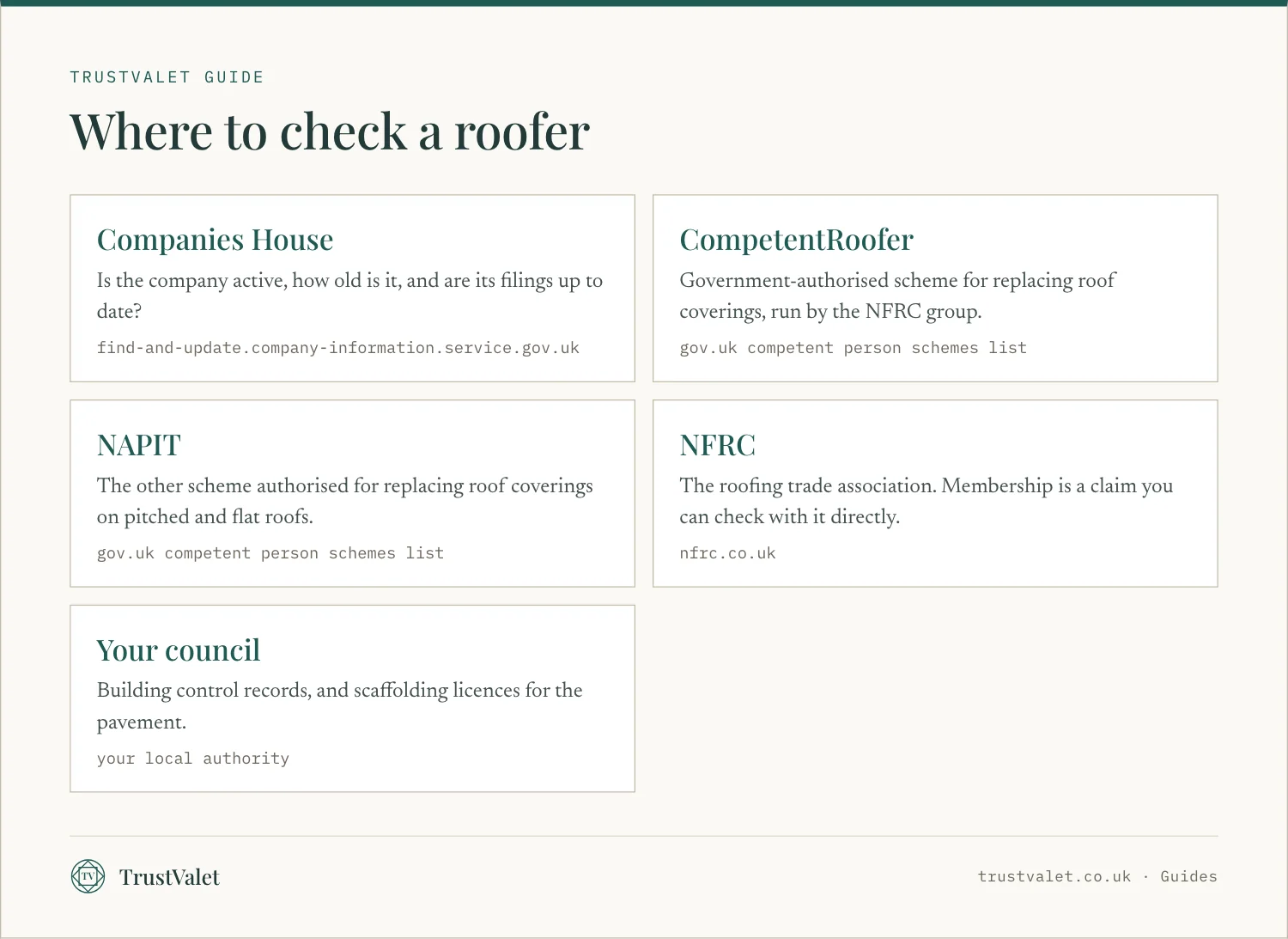
The National Federation of Roofing Contractors (NFRC) describes itself as the UK's largest roofing trade association. Membership tells you the firm has joined a trade body. It does not replace your own checks on the company and the quote.
For a wider look at trade qualifications, read how to check if a tradesperson is qualified.
Guarantees: read who stands behind them
A guarantee is only as good as whoever pays out on it. That matters on a roof, where a problem may show up years later.
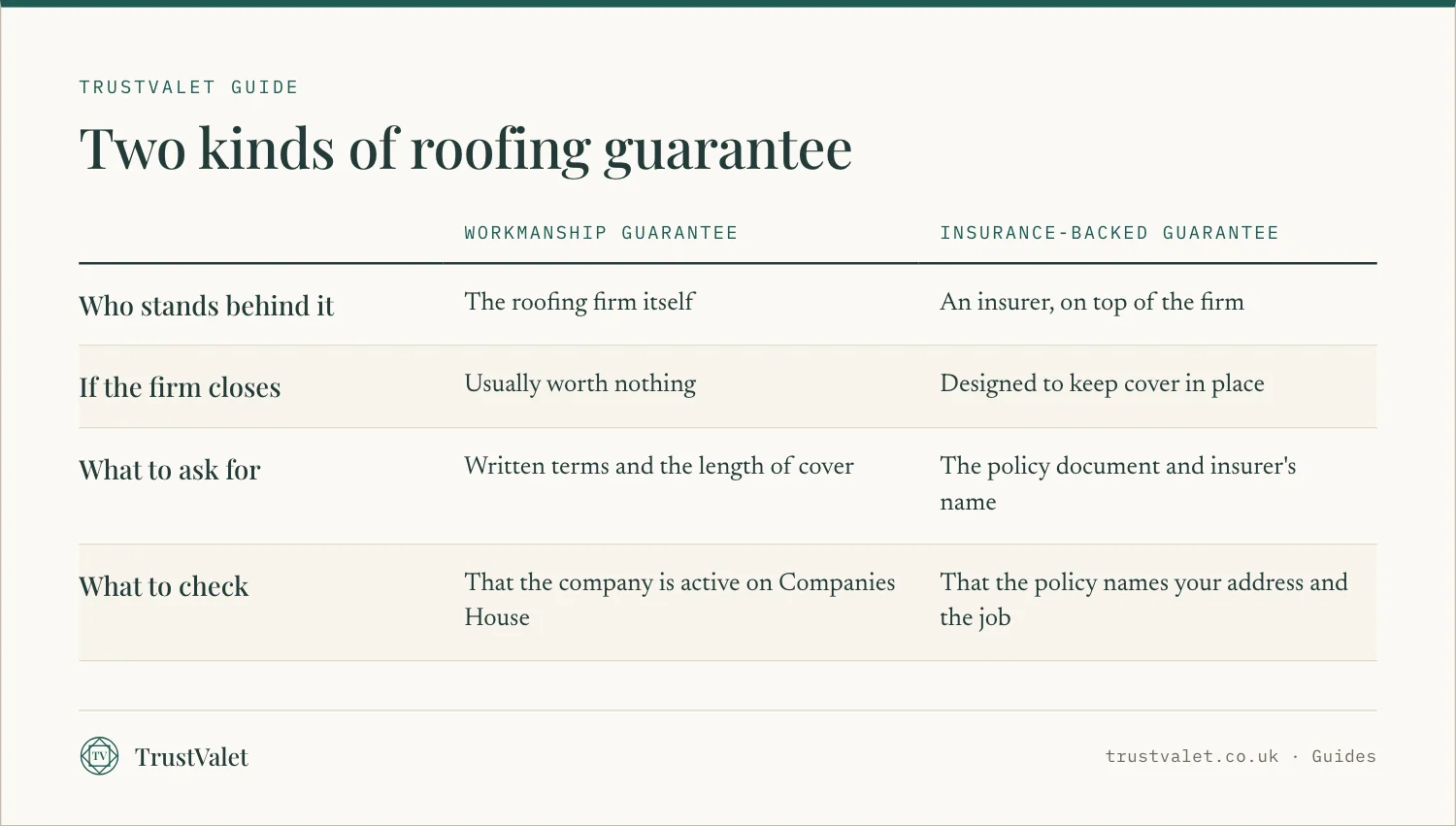
GOV.UK notes that competent person schemes have insurance-backed warranties and complaints procedures. Ask what the guarantee covers: materials, workmanship, or both, and for how long. Get it in writing before you pay the final stage.
Weather and timing
Roofers work outside, so dates move. A good roofer tells you how they will protect an open roof overnight and in rain, and who pays if water gets in during the job.
Ask how long the roof will be open at any one time. On a re-roof, a careful roofer strips only what can be covered again the same day, or has a plan for temporary cover.
Put a start date and an expected finish in writing. Ask what happens to the scaffold if the job pauses, and whether hire charges continue.
Doorstep roofing scams
The classic approach is a knock at the door: "Some of your tiles are loose, we can fix them today." Trading Standards teams warn that roofing scams often start with a low price, then grow after the trader claims to find more problems.
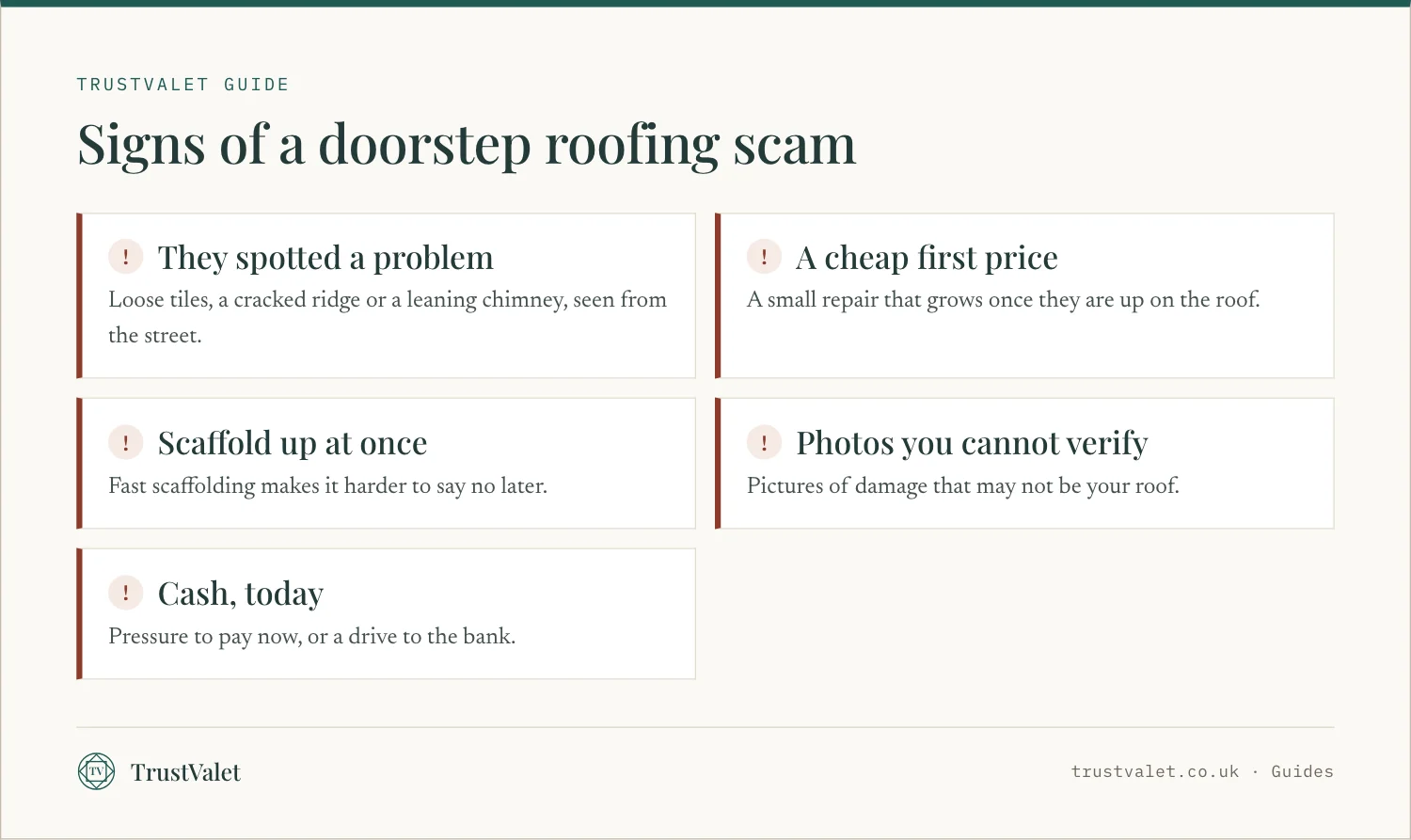
Bromley Council's Trading Standards team notes that scaffolding is sometimes put up quickly, which makes it harder to back out. Their advice is simple: do not accept roofing work from uninvited callers, and check the company on the Companies House register.
If you think a tile really has slipped, thank them, close the door and get your own quotes. Our guide to red flags once work has started covers what to do if a job is already under way.
Paying in stages
Tie payments to stages you can see, such as scaffold up and roof stripped, new covering on, and job signed off. Keep the largest share until the roof is finished and inspected.
If building control is involved, make sure the stage payment for the finished roof comes after their inspection or the competent person certificate is confirmed. That way the roofer has a reason to finish the paperwork.
Pay by card or bank transfer and get an invoice each time. Never pay for materials in cash to someone you met at the door.
What to check after the job
Before the final payment, walk round with the roofer and ask for evidence.
- Photos: of the stripped roof, the underlay and battens, and the finished covering. These show work you cannot see from the ground.
- Building control paperwork: a completion certificate from building control, or a competent person scheme certificate, if the job needed approval.
- Guarantee documents: the written terms, and the insurer's policy if it is insurance-backed.
- A clean site: gutters cleared, debris gone, scaffold removed on time.
Keep all of it with your house papers. GOV.UK notes that without approval you may not have the certificates you need when you sell.
How TrustValet can help
TrustValet is a register built from public records. Each company page shows what Companies House holds: status, incorporation date, filing deadlines and whether any are overdue, how many directors have verified their identity, who controls the company, charges and filing history, each with its source and the date we read it.
Search any roofer by name in our company register, or browse roofing contractors and builders. You can also look by town, for example London, Manchester or Bristol.
Some companies choose to be verified: 14 checks against public registers, decided by a person, with a dated certificate. We never vet workmanship or rate roofers, and a listed company is not an endorsed one. Read how we verify, and ask any roofer the ten questions to ask before hiring.
Questions
Does re-roofing need building regulations approval?
Usually, yes. The Planning Portal says you will not normally need a building control application only if less than 25 per cent of the building envelope and less than 50 per cent of the roof is affected. A roofer registered with CompetentRoofer or NAPIT can self-certify instead.
Who arranges scaffolding for a roof job?
Normally the roofer, who includes it in the quote. If it goes on the pavement, GOV.UK says the builder or scaffolding company must get a council licence, and you should check they have one that lasts until the work is finished.
What is the difference between a workmanship and an insurance-backed guarantee?
A workmanship guarantee is a promise from the roofing firm, so it depends on the firm still trading. An insurance-backed guarantee adds an insurer and is designed to keep cover in place if the firm closes. Ask for the written terms either way.
Someone knocked and said my tiles are loose. What should I do?
Do not agree to anything at the door. Trading Standards warn that roofing scams often start this way. Take no action on the day, then get written quotes from roofers you have chosen and checked yourself.
What paperwork should I get after a new roof?
Photos of the work in progress, a building control completion certificate or competent person scheme certificate if the job needed approval, the written guarantee, and an invoice for every payment.
Check the company first
Before you pay anyone, look the company up. Every page in the register shows what Companies House says, with the date we read it.
Ala Ciobanu · Ala Ciobanu edits the TrustValet guides. Every guide names its sources.
- Building regulations: work to an existing roof (Planning Portal)
- Building regulations: re-roofing (Planning Portal)
- Building regulations approval (GOV.UK)
- Competent person schemes: current schemes (GOV.UK)
- Scaffolding rules (GOV.UK)
- Roof work (Health and Safety Executive)
- Beware of rogue roofers (London Borough of Bromley Trading Standards)
- National Federation of Roofing Contractors