Most mechanics are honest people doing a skilled job. The few who are not rely on one thing: most drivers cannot tell a worn brake disc from a good one, and will pay rather than argue. You do not need to become a mechanic to protect yourself. You need to recognise a handful of tactics, and know what to ask for when you see one.
This guide sets out eight signs that a garage is not being straight with you, and what to do about each. If you are choosing a garage from scratch, start with our guide on how to choose a trustworthy car repair garage, which covers the checks to make before you book.
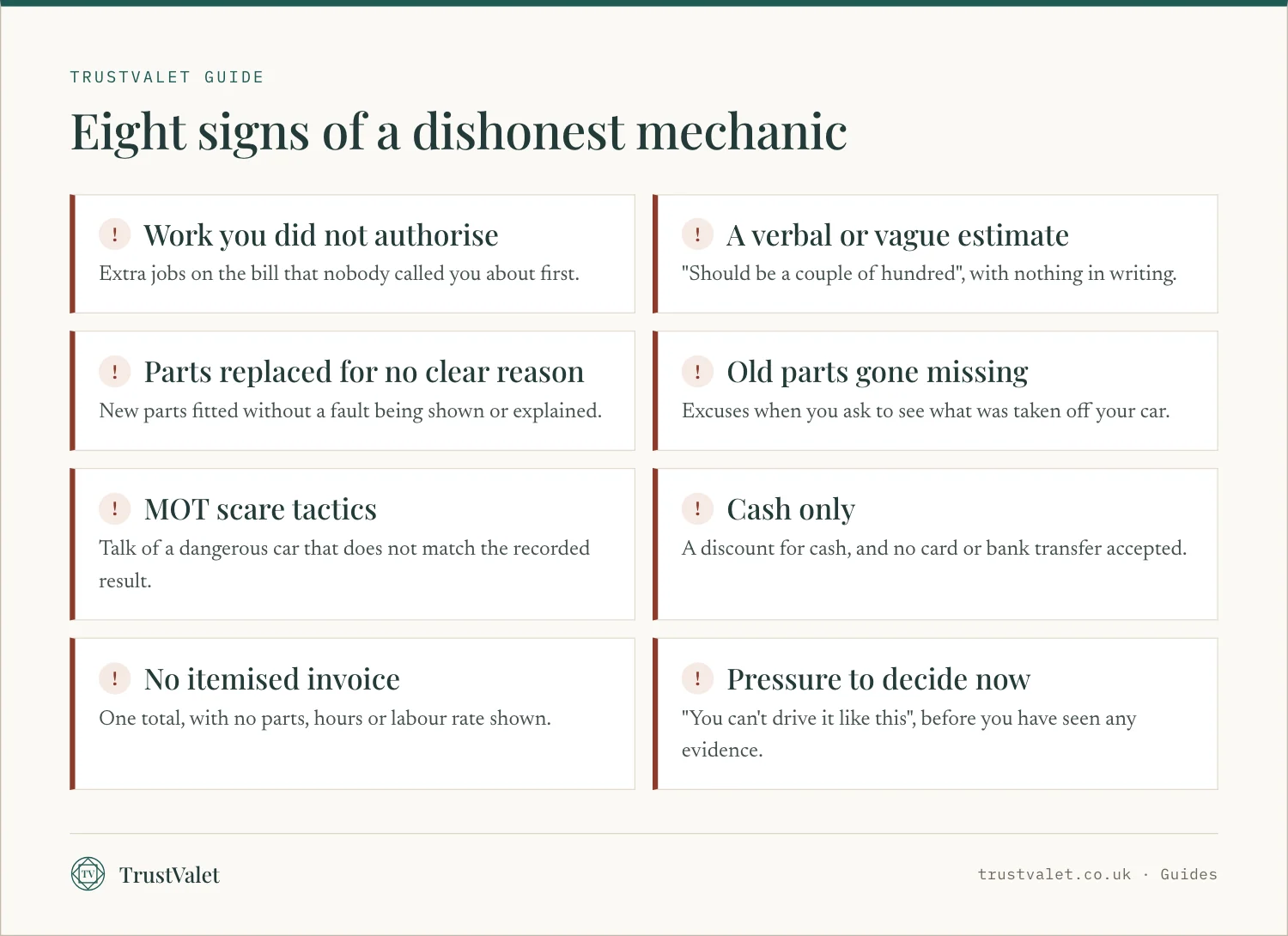
The eight signs
1. Work you did not authorise
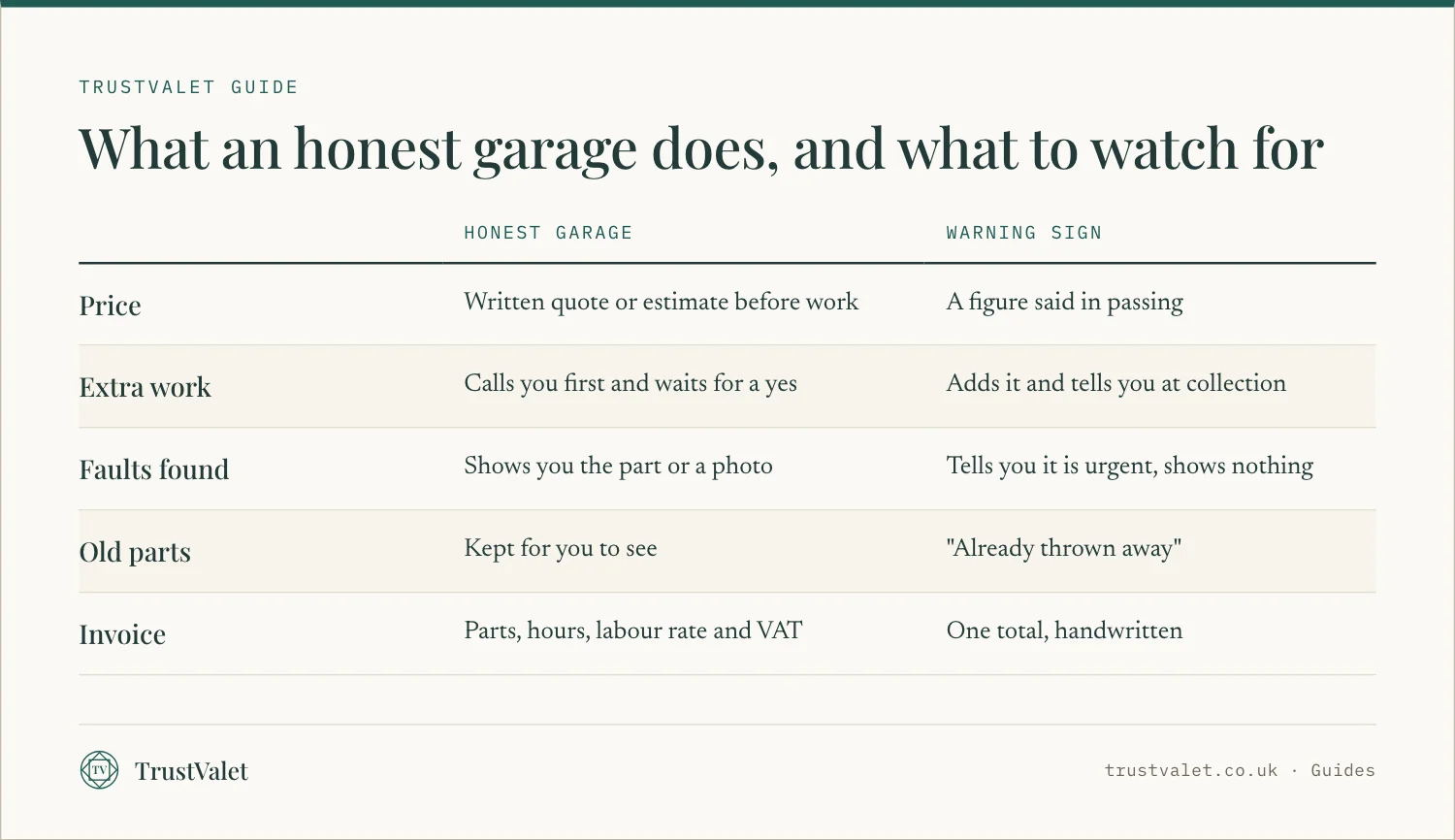
You book the car in for a service and collect it with a bill for a service, two tyres and a set of wiper blades. Nobody called. Here the position is fairly clear. Citizens Advice says that if you asked for a specific job and the garage did extra work you did not ask for, you can ask it to undo the work, and if that is not possible, insist on paying only for the work you agreed.
The exception is if you told the garage to "do whatever needs doing". Then you gave it the right to decide, and you will have to pay for work that was necessary at a reasonable price. So never give an open instruction. Name the job, set a limit, and ask to be called before anything else is done. Garages accredited to The Motor Ombudsman's Service and Repair Code commit to asking for your authorisation before starting extra work.
2. A verbal or vague estimate
"Should be a couple of hundred, depending." A price said at the counter is hard to hold anyone to. Ask for it in writing, broken down into parts, labour and VAT, and ask whether it is a quote or an estimate. A quote is a fixed price. An estimate is a best guess, and the garage can charge more within reason. If no price was agreed at all, the Consumer Rights Act 2015 says you only have to pay a reasonable price, but proving what is reasonable after the event is harder than agreeing a figure before it.
3. Parts replaced for no clear reason
Some parts wear out on a schedule; many do not. A garage that replaces parts without showing you the fault, or that fits a whole assembly when one component failed, may be padding the bill. Ask the mechanic to show you the problem on the car, or send a photo, before you agree. An honest mechanic is usually happy to explain. If the explanation does not make sense, it is fine to say you will think about it and get a second opinion.
4. Old parts that have gone missing
The parts taken off your car are the evidence that they needed replacing. Garages accredited to The Motor Ombudsman commit to making replaced parts available for you to view and examine until you collect the car, unless agreed otherwise. Ask for them when you book the car in, not at collection. A garage that cannot produce them, or says they were "already thrown away" when you asked in advance, has removed your easiest way to check the work.
5. MOT scare tactics
"It'll never pass like that." "It's not safe to drive home." Sometimes this is true. Sometimes it is a way to sell repairs on the spot. The official record settles it: every result, including the defects listed as dangerous, major, minor or advisory, is recorded and visible on the MOT history service.
GOV.UK sets out the rules. You can take the car away after a failure if your current MOT is still valid and no dangerous problems were listed; it must still be roadworthy. Advisories are not failures: they are things to watch. If you think a failure is wrong, discuss it with the test centre before anyone starts repairs, and you can appeal to DVSA within 14 working days of the test. You should not have repairs made until the appeal has finished.
6. Cash only
Taking cash is legal. Insisting on cash only, or offering a discount to avoid a card payment, is a warning sign. Cash leaves you with no record of what you paid and no protection from your card provider. If you pay by debit card you may be able to ask your bank for a chargeback, and for a credit card payment over £100 you may have a claim under section 75 of the Consumer Credit Act 1974. Pay by card or bank transfer and ask for an invoice every time.
7. No itemised invoice
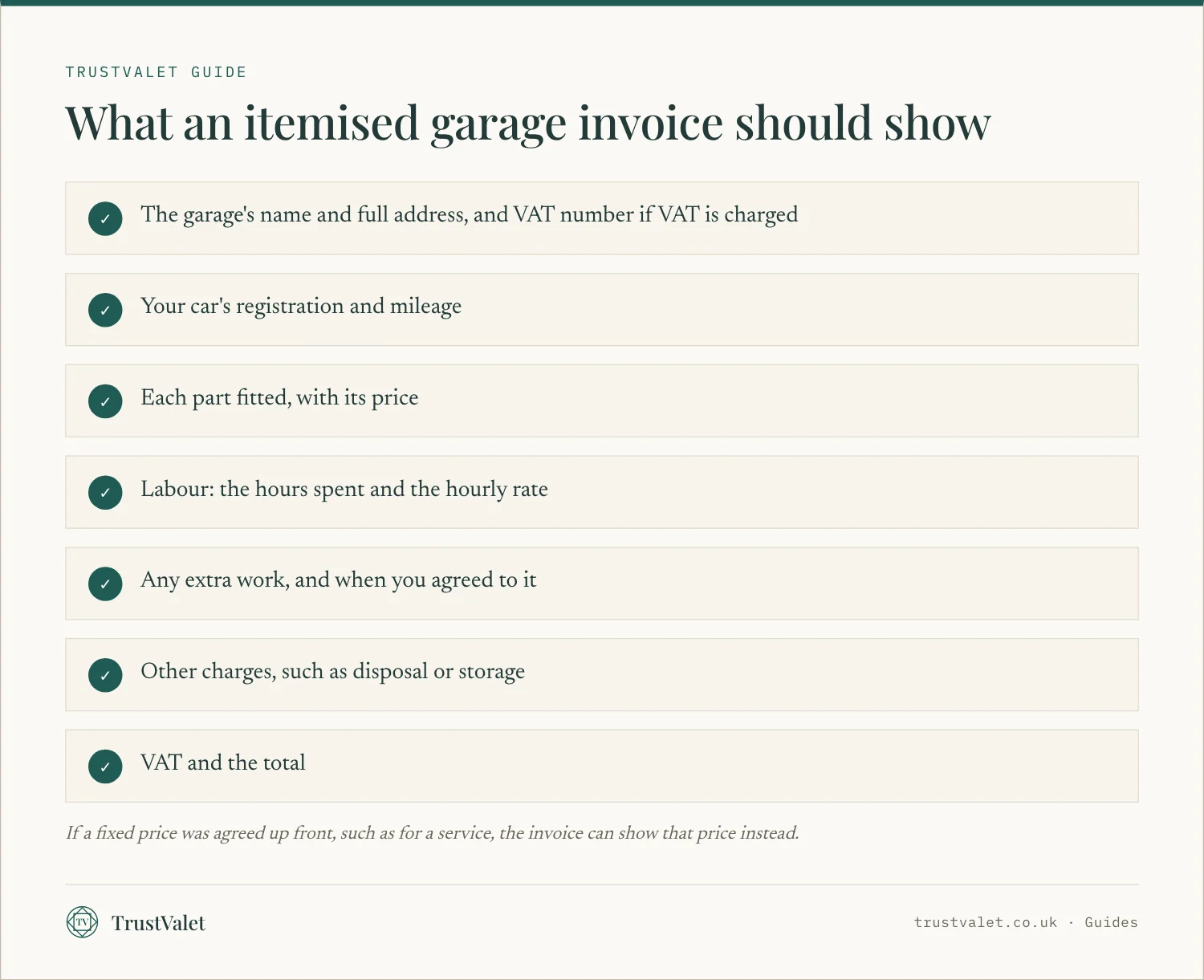
A single total on a scrap of paper tells you nothing about what was done. The Motor Ombudsman's code says that, unless a fixed price was agreed in advance, invoices should itemise the work, including the parts used, any extra work agreed, the labour rate and the number of hours. Even for a garage outside the code, an itemised invoice is the minimum you need to check a bill or make a complaint.
8. Pressure to decide now
"This price is only for today." "If you drive off now, I can't be responsible." A good mechanic explains the risk and lets you decide. Pressure selling is not only a warning sign: the Digital Markets, Competition and Consumers Act 2024 prohibits unfair commercial practices, including aggressive ones that use harassment, coercion or undue influence. Accredited garages also commit not to use high-pressure selling. If you feel rushed, take the car away if it is safe to drive, or ask for the diagnosis in writing and get a second opinion.
What to do if you think you have been overcharged
Act quickly and keep everything. The steps below work whether the problem is unauthorised work, a poor repair or a bill that is far above what you agreed.
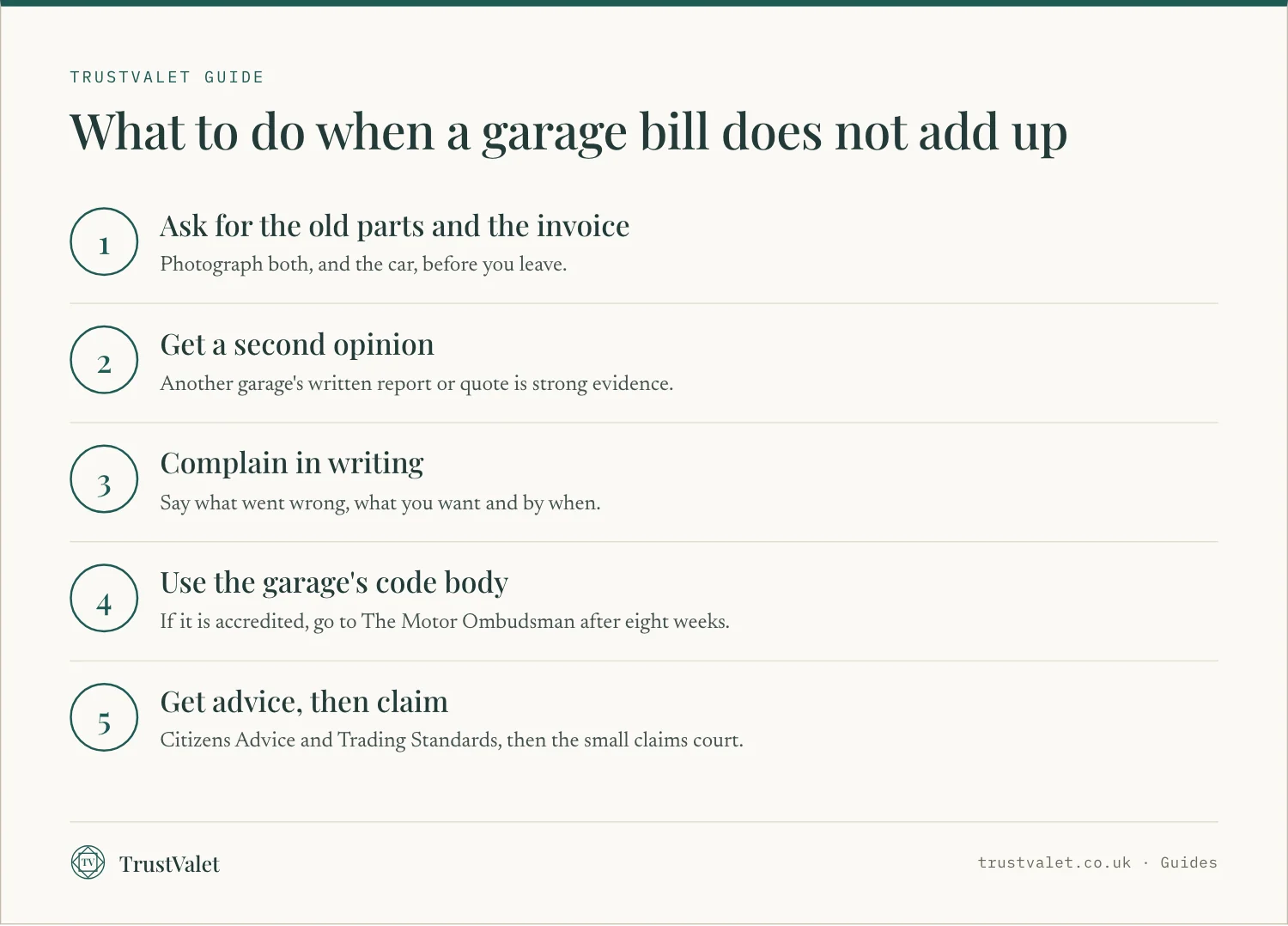
- Collect the evidence. Keep the job sheet, the invoice, any texts or emails, and the old parts. Photograph the car.
- Get a second opinion. Citizens Advice suggests asking another garage for a report, or for a written quote showing what the work should have cost. You and the original garage can also agree on an independent engineer's report and to accept its findings.
- Pay under protest if you need the car. A garage can keep your car while a bill is disputed, but it cannot sell it. If you need it back, pay and write "paying under protest" on the garage's copy of the job sheet and receipt, so it is clear you do not accept the charges.
- Complain in writing. Describe what went wrong, what you want (the work redone, a partial refund, the extra work removed from the bill) and a reasonable deadline. Under the Consumer Rights Act 2015, work not done with reasonable care and skill must be put right at the garage's cost, or the price reduced.
- Escalate. If the garage is accredited to The Motor Ombudsman and has not resolved the complaint after eight weeks, you can raise a dispute there. For MOT problems, contact DVSA. Otherwise, the Citizens Advice consumer helpline can advise you and pass the case to Trading Standards.
- Go to court as a last step. In England and Wales you can claim up to £10,000 through the county court small claims track, online or by post. Scotland and Northern Ireland have their own procedures.
Prevention is easier than a dispute
Most of these tactics fail against a driver who has a written quote, a named job with a limit, a request to see old parts, and a card receipt. Our ten questions to ask before hiring any tradesperson work for garages too, and how to check if a tradesperson is qualified covers the registers that sit behind the logos.
How TrustValet can help
TrustValet is a register built from public records, not a review site. For each company we show whether it is active, when it was incorporated, how many of its directors have verified their identity, who controls it and whether its filings are up to date, each with its source and the date we read it. A company can claim its page and add its website and phone number, and a company that chooses paid verification carries a dated certificate you can check.
We do not inspect repairs or judge prices, so this does not tell you whether a garage is honest. It does tell you who you are dealing with, which is what you need if you ever have to complain. Search the register, browse garages and mechanics, car parts suppliers or vehicle hire if your car is off the road, look in the automotive category, or find companies in Leeds, Glasgow and other towns. Read how we verify for the detail.
Questions
Do I have to pay for work a garage did without asking me?
Not if you asked for a specific job and the garage went beyond it. Citizens Advice says you can ask for the extra work to be undone, or pay only for what you agreed. If you told the garage to do whatever was needed, you pay for necessary work at a reasonable price.
Can I ask a garage for my old parts back?
You can ask, and it is best to ask when you book the car in. Garages accredited to The Motor Ombudsman commit to making replaced parts available for you to see until you collect the car, unless agreed otherwise.
Can I drive my car away after it fails its MOT?
Only if your current MOT is still valid and no dangerous problems were listed, and the car must still be roadworthy. Otherwise it needs repairing first. If you think the result is wrong, you can appeal to DVSA within 14 working days.
How do I complain about a garage?
Complain to the garage in writing first, with a deadline. If it is accredited to The Motor Ombudsman, you can raise a dispute there after eight weeks. Otherwise contact the Citizens Advice consumer helpline, which can refer the case to Trading Standards.
Can I take a garage to the small claims court?
Yes. In England and Wales you can claim up to £10,000 through the small claims track, online or by post. Keep the invoice, the job sheet, photos and any second opinion, as the court will want evidence.
Check the company first
Before you pay anyone, look the company up. Every page in the register shows what Companies House says, with the date we read it.
Ala Ciobanu · Ala Ciobanu edits the TrustValet guides. Every guide names its sources.
- Problem with a car repair (Citizens Advice)
- Service and Repair Code (The Motor Ombudsman)
- Make a complaint (The Motor Ombudsman)
- MOT test result (GOV.UK)
- MOT test result appeals and problems (GOV.UK)
- Consumer Rights Act 2015, services (legislation.gov.uk)
- Digital Markets, Competition and Consumers Act 2024, unfair commercial practices (legislation.gov.uk)
- Make a court claim for money (GOV.UK)