After any electrical work in your home, the electrician should give you a certificate showing the work meets BS 7671, the British Standard for electrical safety. For a new circuit, a new consumer unit or a rewire, that is an Electrical Installation Certificate (EIC). For smaller changes to an existing circuit, it is a Minor Electrical Installation Works Certificate. If the work is notifiable under Part P of the building regulations, you should also receive a Building Regulations Compliance Certificate within 30 days.
This guide covers England, with notes on Wales. For how electricians are registered, see how to check if a tradesperson is qualified. You can browse electricians in our register.
Three documents with similar names
Electrical paperwork is confusing because three documents sound alike. GOV.UK's guidance for landlords names all three: the Electrical Installation Certificate (EIC), the Minor Electrical Installation Works Certificate (MEIWC) and the Electrical Installation Condition Report (EICR).
- EIC. Issued when work is installed, for a new circuit, a new consumer unit or distribution board, or a rewire.
- MEIWC. Often called a Minor Works Certificate. Issued for an addition or alteration to an existing circuit.
- EICR. Not a certificate for new work. It is a report on the condition of an existing installation.
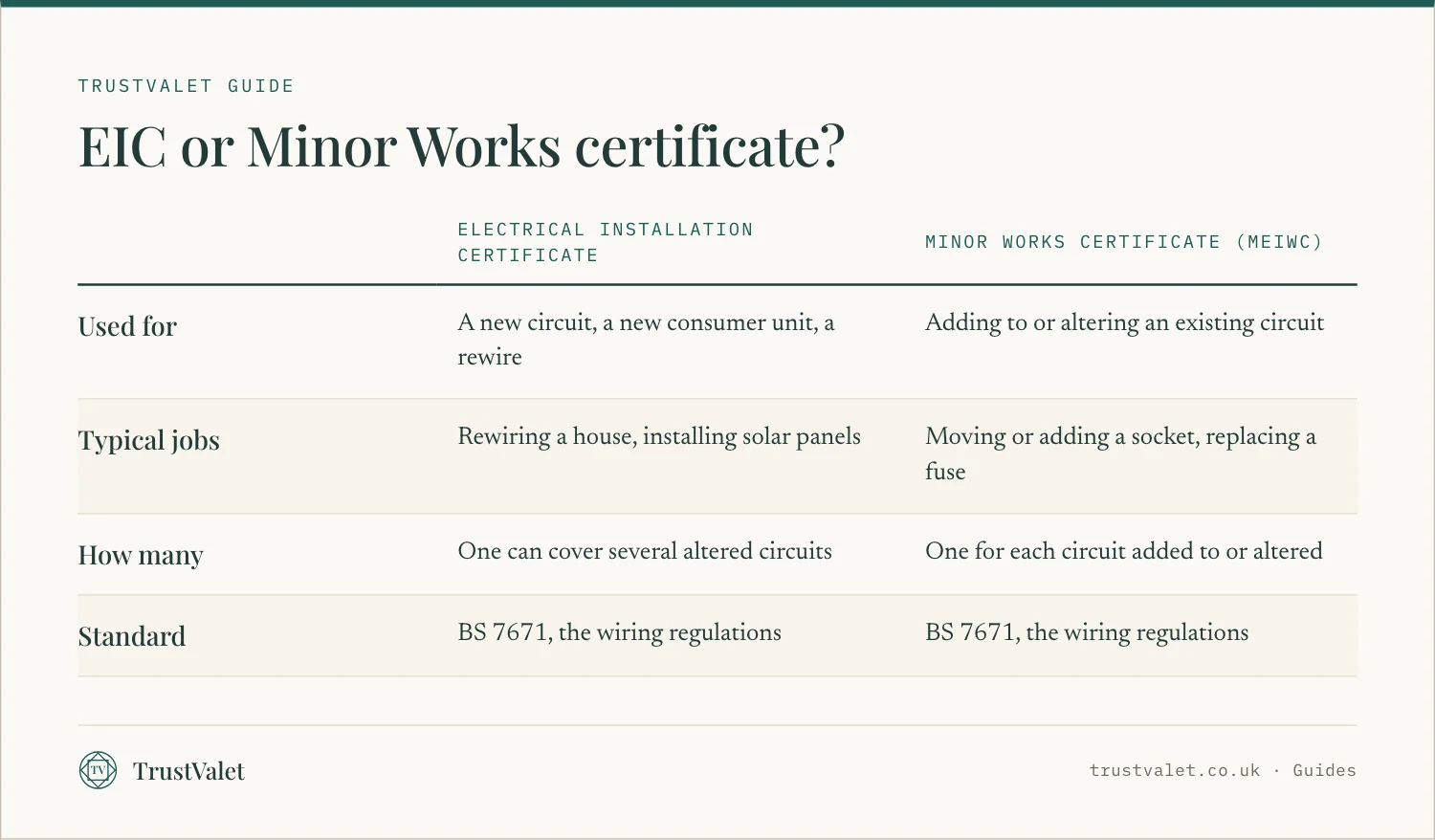
NICEIC, the trading name of Certsure, one of the scheme operators on GOV.UK's list, gives examples. You would expect a Minor Works certificate if a socket was moved or added, a light fitting repaired, or a circuit breaker replaced, and one for each circuit altered. You would expect an EIC for a rewire or a solar panel installation.
What an EICR is for
An EICR checks an installation that is already there. The electrical competent person register describes it as a report on whether the installation is in a satisfactory condition for continued service. Faults are coded C1 (danger present), C2 (potentially dangerous) or FI (further investigation needed), and any of these makes the report unsatisfactory. A C3 means improvement is recommended and does not make it unsatisfactory.
Owner-occupiers are not required by law to get an EICR. Landlords are, as explained below.
Part P: when work is notifiable in England
All electrical work in a home must meet Part P of the building regulations. Some of it must also be notified. In England, the electrical competent person register lists notifiable work as:
- installing one or more new circuits;
- replacing a consumer unit (fuse box);
- altering or adding to a circuit in a special location, such as the space around a bath or shower;
- a full or partial rewire, or a new installation.
Replacing a socket or light fitting like for like is not notifiable, but it must still be done safely and certified.
Wales is different
Wales has a longer list. It includes, for example, extending an existing circuit in a kitchen, and outdoor work such as a supply to a shed, garden lighting or an outdoor socket. If you are in Wales, ask your electrician or building control whether your job is notifiable.
The Building Regulations Compliance Certificate
Notifiable work can be signed off in two ways.
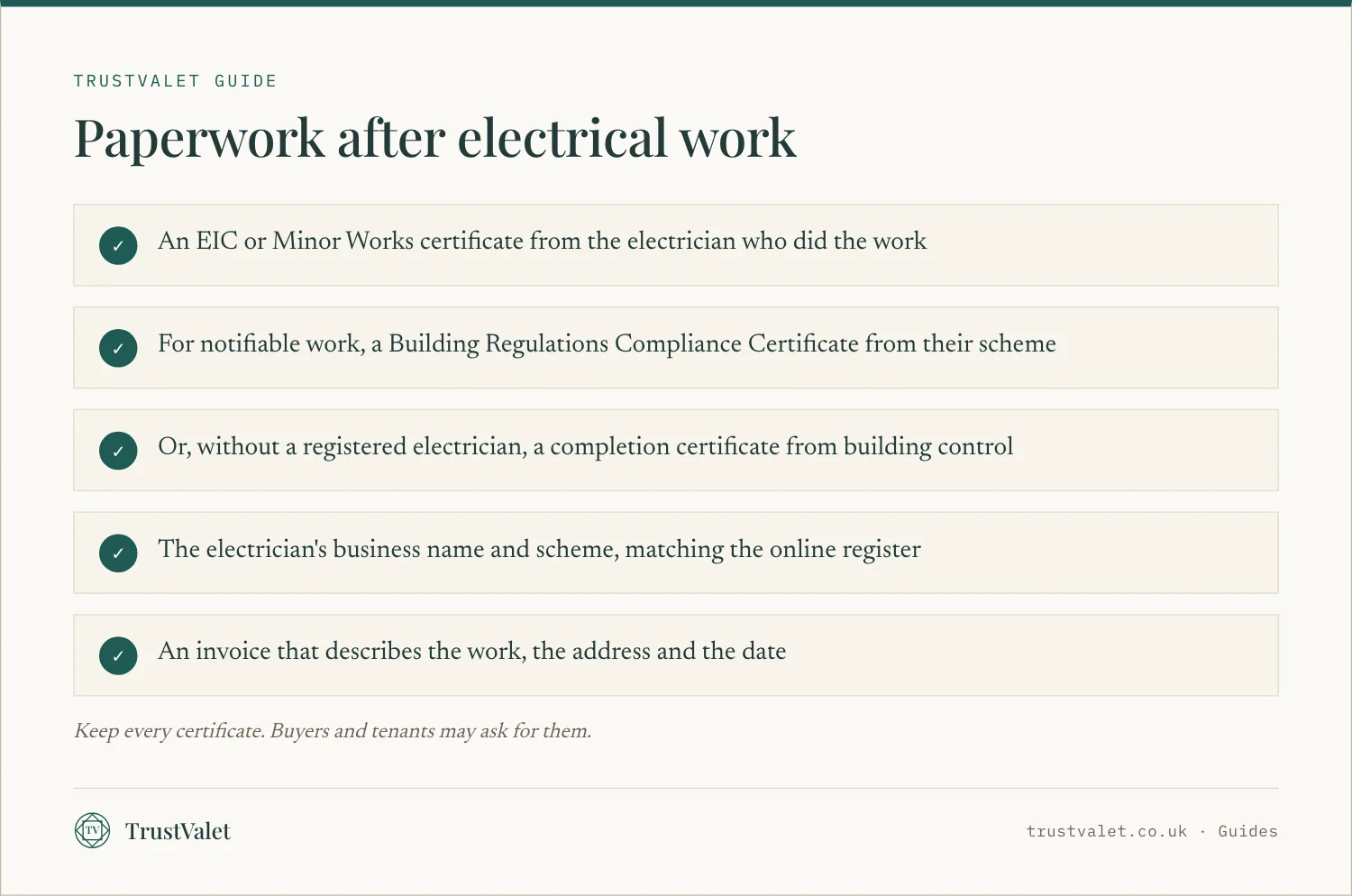
A registered electrician. An electrician registered with a competent person scheme can self-certify. Approved Document P says they should complete a BS 7671 certificate for every job and give it to the person who ordered the work. Then, within 30 days of completion, the installer or their scheme must give the occupier a Building Regulations Compliance Certificate and notify building control.
Building control. If the electrician is not registered, someone must tell building control before work starts. Building control inspects the work, or has it inspected, and issues a completion certificate if it complies. That route means a further fee, so agree in writing who applies and who pays.
GOV.UK says you may have to correct the work or pay a fine if building regulations are not followed. A council can also give retrospective approval, called a regularisation certificate, after work has been put right.
How to check a certificate and the electrician
The Electrical Competent Person register lists electricians registered with the government-approved scheme operators in England and Wales. You can search by postcode or by company name, and it separately lists inspectors registered for safety reports.

The certificate should come from the business that did the work. Approved Document P does describe one other route: an unregistered installer can appoint a registered third-party certifier before work begins, who then inspects and tests it. A certificate produced afterwards by someone who never saw the job is not that.
If you lose a Part P certificate, the scheme can usually help. NICEIC, for example, offers replacement copies for work its contractors notified, while the EIC itself has to come from the electrician.
Before the work starts
Most certificate problems can be headed off with a short written agreement. Before you say yes, ask the electrician:
- which certificate you will get, an EIC or a Minor Works certificate;
- whether the job is notifiable, and which scheme will issue the compliance certificate;
- when the certificates will be handed over, ideally before the final payment.
The electrical competent person register also suggests agreeing the timetable and payment terms in writing, avoiding cash, and asking for a receipt. If something goes wrong and you cannot settle it with the electrician, contact the scheme operator they are registered with. If they are not registered with any scheme, the register points you to Citizens Advice.
Landlords: the 5-year rule in England
The Electrical Safety Standards in the Private Rented Sector (England) Regulations 2020 require landlords to have the electrical installation inspected and tested by a qualified person at intervals of no more than 5 years, or sooner if the last report says so. Under GOV.UK's guidance, the landlord must:
- get a report, usually an EICR, with a date for the next inspection;
- give existing tenants a copy within 28 days of the inspection;
- give new tenants a copy before they move in;
- give the council a copy within 7 days of a written request;
- have any remedial or further investigative work done within 28 days, or sooner if the report says so.
If a home is newly built or completely rewired, GOV.UK says the EIC can be given to tenants instead, and no further check is needed for 5 years after it was issued. The rules were extended to social landlords from 1 November 2025.
In Wales, the electrical competent person register says the Renting Homes (Fitness for Human Habitation) (Wales) Regulations 2022 also require an inspection at least every 5 years. Browse landlords and letting agents or property management companies.
What to keep for selling the house
NICEIC says you may be asked for your EIC, Minor Works certificates and Building Regulations Compliance Certificates when selling or letting. GOV.UK notes that a registered installer's compliance certificate shows up in solicitors' searches.
Keep them together with the invoices, and keep any boiler installation certificates in the same folder. If you are selling, your estate agent will pass them to the buyer's side.
Red flags
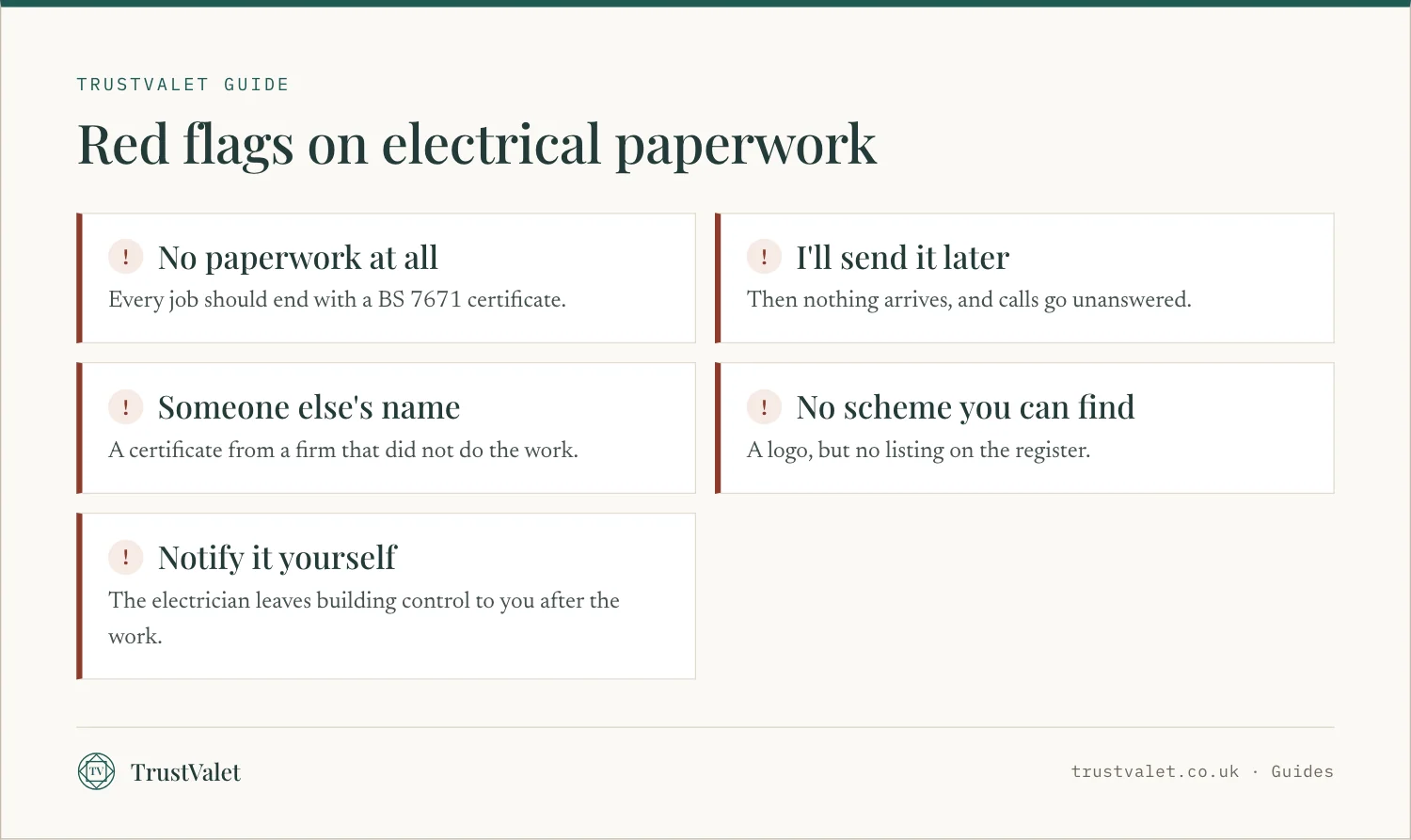
"I'll send it later" is the most common. A registered electrician fills in the BS 7671 certificate as part of the job, so ask for it before you make the final payment. If they cannot say which scheme will issue the compliance certificate, treat it as a warning. Our guide to red flags of a bad contractor covers the wider signs.
For solar panels and heat pumps, the electrical connection is notifiable too; see MCS certified installers and energy companies.
How TrustValet can help
TrustValet does not check electrical scheme membership, insurance or the quality of anyone's work. Use the electrical competent person register for that.
What we show is the company behind the quote. TrustValet is a register built from public records. A company page shows what Companies House holds: its status, incorporation date, filing deadlines and whether any are overdue, how many directors have verified their identity, who controls it, any charges and its filing history, each with its source and the date we read it. See how to check if a UK company is legit.
A company can also choose to be verified: a person runs 14 checks against public registers and issues a dated certificate. Search the register of companies, browse trades, look by city, for example London or Leeds, or read how we verify.
Questions
What is an Electrical Installation Certificate?
An EIC confirms that new electrical work, such as a new circuit, a new consumer unit or a rewire, has been designed, inspected and tested to BS 7671. The electrician who did the work should give it to you.
What is the difference between an EIC and an EICR?
An EIC is issued for new installation work. An EICR is a report on the condition of an existing installation, coded C1, C2, C3 or FI. Landlords in England need an EICR at least every 5 years.
Do I get an EIC for changing a socket?
Usually not. Adding to or altering an existing circuit, such as moving a socket, is normally certified with a Minor Electrical Installation Works Certificate, one for each circuit altered.
How long does a Part P certificate take?
For notifiable work by a registered electrician, Approved Document P says the installer or their scheme must give you the Building Regulations Compliance Certificate within 30 days of the work being completed.
How often do landlords need an EICR in England?
At intervals of no more than 5 years, or sooner if the last report says so. Existing tenants get a copy within 28 days of the inspection, and new tenants before they move in.
Check the company first
Before you pay anyone, look the company up. Every page in the register shows what Companies House says, with the date we read it.
Ala Ciobanu · Ala Ciobanu edits the TrustValet guides. Every guide names its sources.
- Electrical safety: Approved Document P (GOV.UK)
- Building regulations approval (GOV.UK)
- Electrical safety standards in the private and social rented sectors: guidance (GOV.UK)
- Electrical Safety Standards in the Private Rented Sector (England) Regulations 2020, regulation 3 (legislation.gov.uk)
- Building Regulations explained (Electrical Competent Person)
- Landlords (Electrical Competent Person)
- Householders and landlords help hub (NICEIC)
- Competent person schemes: current schemes (GOV.UK)