Solar panels are an expensive purchase that should last for decades, and they are easy to sell badly: the salesperson controls the performance estimate, the price and the paperwork, and problems may not show up for months. MCS certification is one of the most useful checks you can make on a solar installer, but it is often misunderstood. This guide explains what it is, what it gets you, and what else a rooftop solar job involves.
The short answer
No law says a solar installer must be MCS certified. In practice, you will almost always want one who is, for two reasons:
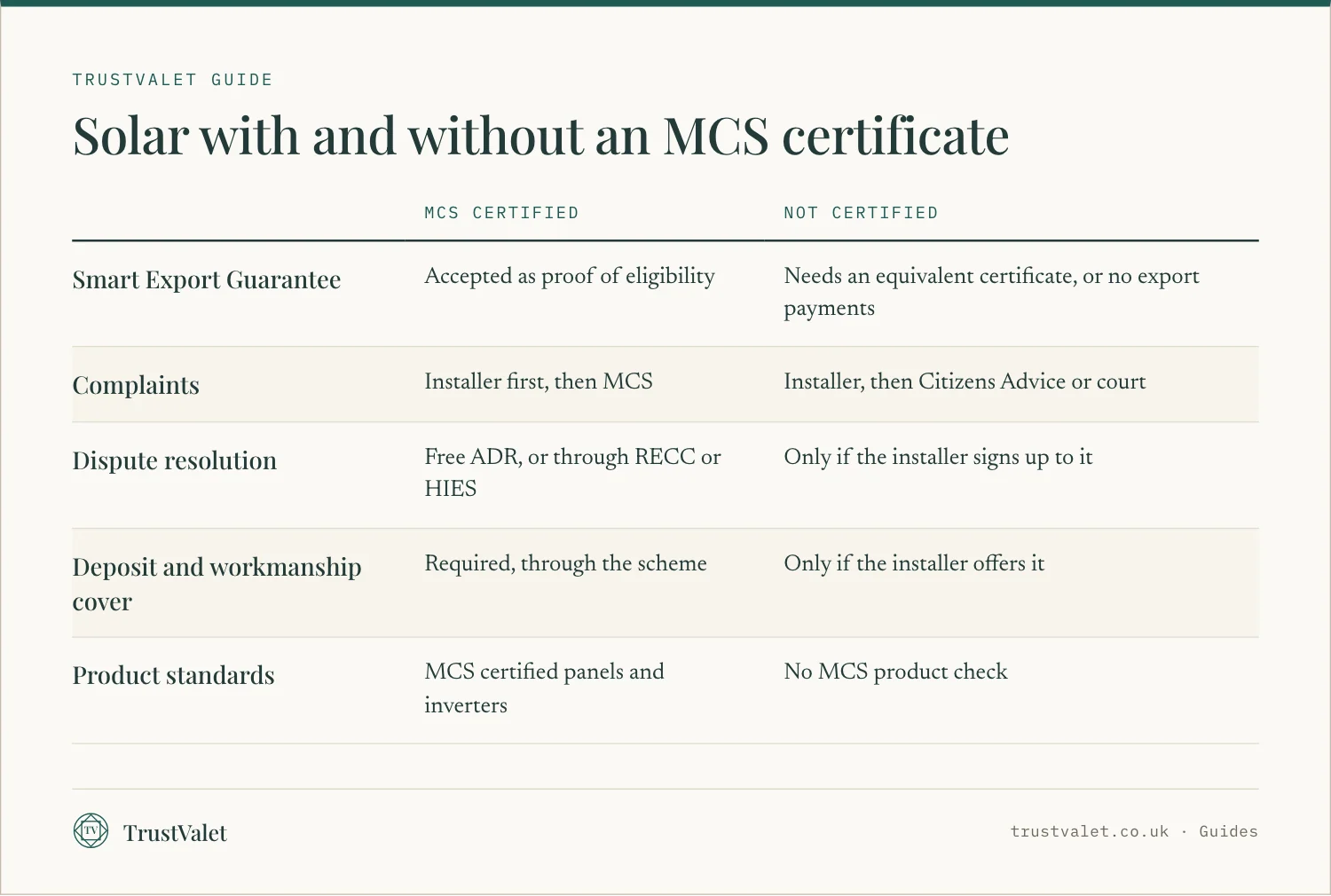
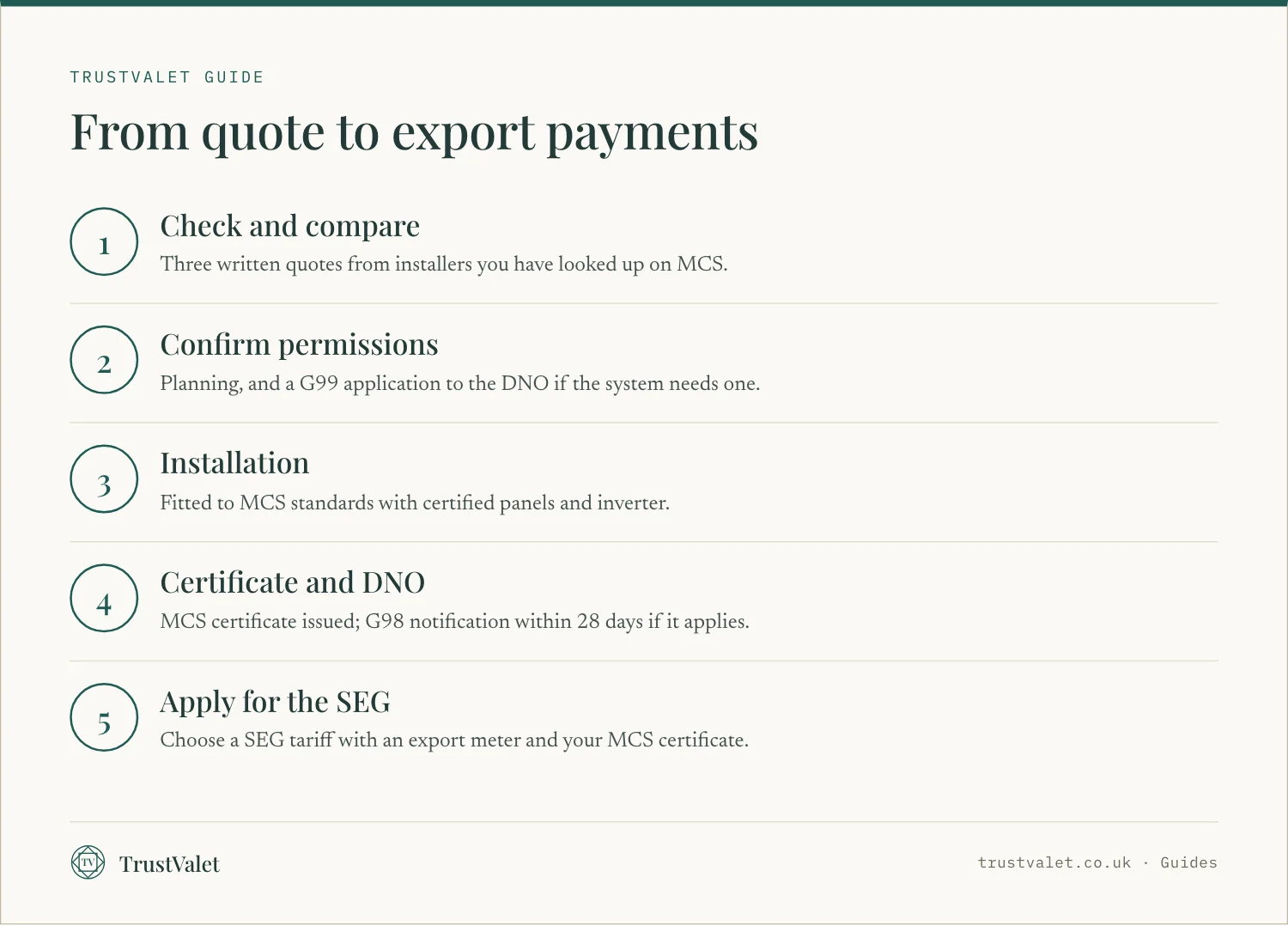
- Export payments. To be paid for electricity you send to the grid under the Smart Export Guarantee, a system of up to 50kW must show that the installation and installer are suitably certified. An MCS certificate is the proof Ofgem names for this.
- Protection. MCS certified installers must meet consumer protection requirements, protect your deposit and give you workmanship cover, and if things go wrong there is a complaints route that does not end at the installer's door.
What MCS certification is
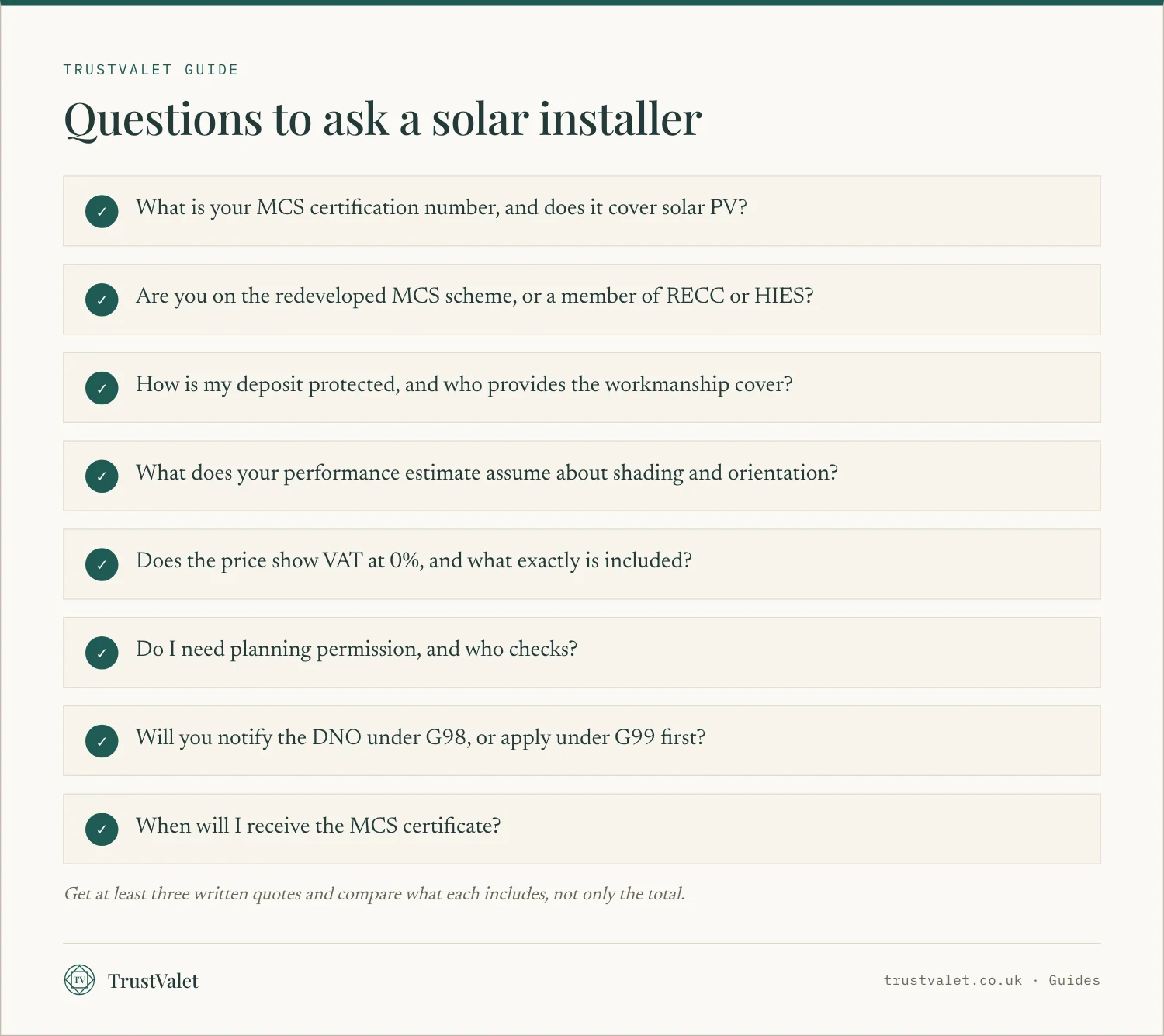
MCS (the Microgeneration Certification Scheme) describes itself as the UK's quality mark for small-scale renewable energy systems such as solar PV, heat pumps and battery storage. It sets standards for products, which must be tested for performance and quality, and for installers, who must design and install systems to the MCS Installation Standards using MCS certified products. When a certified installer finishes a job, the installation is registered and you receive an MCS certificate for it.
MCS certifies businesses for specific technologies. An installer certified for heat pumps is not automatically certified for solar PV, so check that the certificate covers the work you are buying.
Why it matters for the Smart Export Guarantee
The Smart Export Guarantee (SEG) has run since 1 January 2020 and is administered by Ofgem. Electricity suppliers with at least 150,000 domestic customers must offer an export tariff, and smaller suppliers can choose to. Each supplier sets its own rate and terms, but the rate must always be above zero, and you do not have to take your export tariff from the company that supplies your electricity.
Ofgem's guidance for generators says that to be eligible, a solar PV installation of up to 50kW must show that the installation and installer are suitably certified, have an export meter, and have an export MPAN. It names an MCS certificate as one way to show this, and accepts equivalent certification to EN ISO/IEC 17065:2012 for installers outside MCS. The SEG covers installations in Great Britain.
If an installer tells you certification "does not matter", ask them which equivalent scheme they hold and get it in writing. Without either, you may be left with panels that save you money on your own use but earn nothing for what you export.
Consumer protection: the scheme is changing
MCS is part way through moving its installers to a redeveloped scheme, with a transition that runs until 31 March 2027. What protects you depends on which scheme your installer is on, so ask.
Under the original scheme, MCS installers must belong to a consumer code approved by the Chartered Trading Standards Institute: the Renewable Energy Consumer Code (RECC) or HIES. RECC requires its members to insure deposits, any further advance payments and the workmanship warranties they issue, so you are protected if the installer stops trading. The code body also offers dispute resolution.
Under the redeveloped scheme, consumer code membership is no longer mandatory, because MCS takes on that role itself. Installers must give you the MCS Customer Commitment at first contact, MCS handles complaints directly once you have raised them with the installer, and free alternative dispute resolution is available, with decisions binding on the installer. Every installer must also buy an MCS approved financial protection product on your behalf, covering remediation for at least six years from installation, including if the installer goes out of business, with the claim excess capped at £250.
Either way, ask for the name of the deposit and workmanship protection provider before you pay anything, and keep the policy documents.
How to check an installer
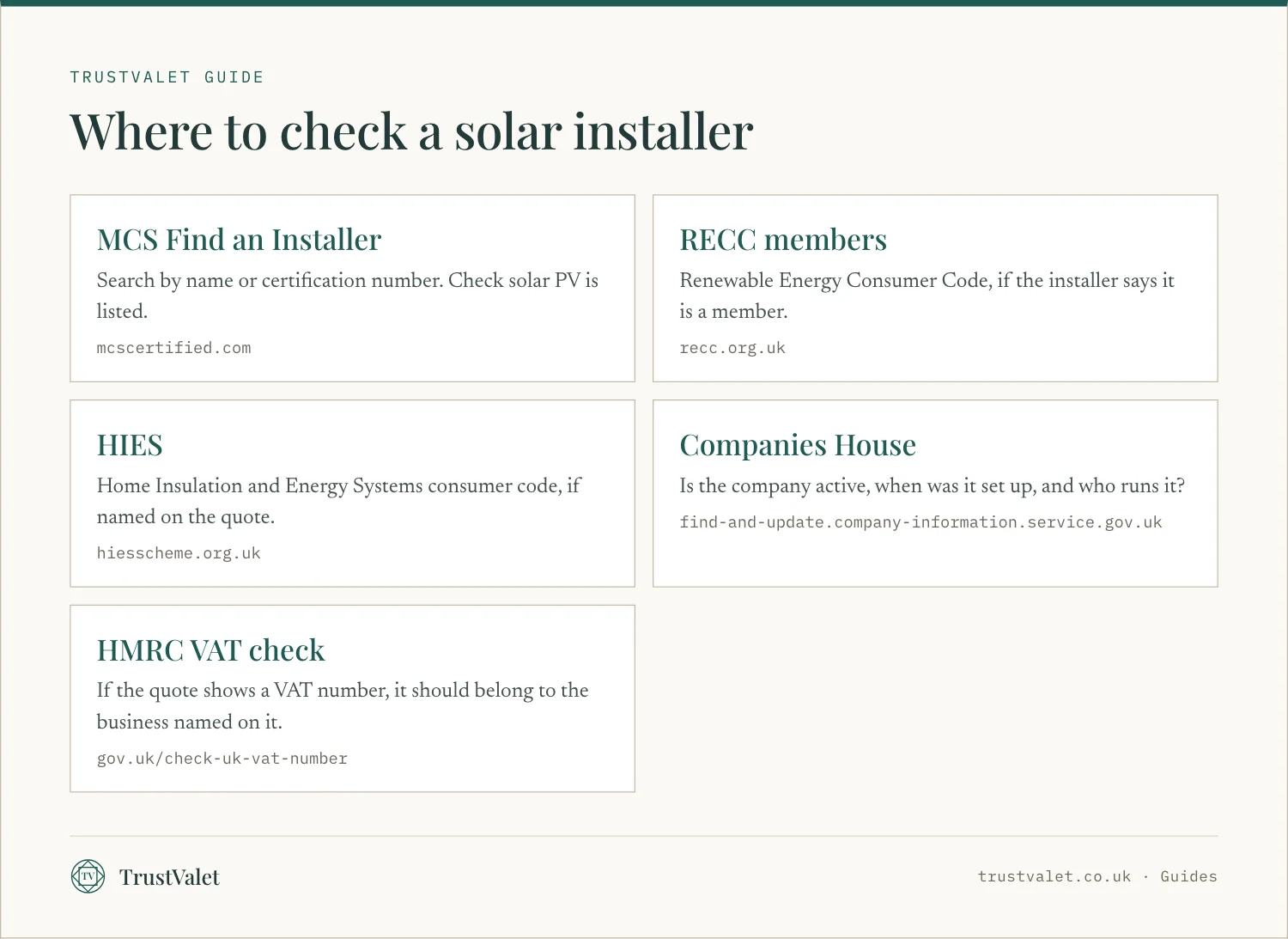
Start with MCS Find an Installer, which lets you search by business name or certification number. Check that the name matches the one on your quote exactly and that solar PV is among the technologies listed. If the installer says it belongs to RECC or HIES, check the code's own member list too.
Then look at the business itself. A limited company that was incorporated recently, is overdue with its accounts, or trades under a different name from the one on the MCS register deserves a question. You can look up any company in our register and see what Companies House holds, with the date we read it. Our guide on how to check if a tradesperson is qualified covers the wider set of registers for trades.
Be wary of anyone who contacts you claiming to be from MCS. MCS has warned about texts and calls, using its name, that tell solar owners their warranty has expired and try to sell a replacement. Its only website is mcscertified.com.
VAT: 0% until March 2027
HMRC's VAT Notice 708/6 sets out a temporary zero rate of VAT for installing energy-saving materials, including solar panels, in residential accommodation. In Great Britain the zero rate has applied since 1 April 2022, and in Northern Ireland since 1 May 2023. It runs to 31 March 2027, after which these installations revert to the reduced rate of 5%. Since 1 February 2024, batteries retrofitted to an existing solar system are also covered.
The relief applies to the installation, supplied and fitted by the installer, not to panels you buy on their own. Check that your quote shows VAT at 0%, and ask the installer to explain any line charged at a different rate.
Planning permission
In England, most rooftop solar panels on a house are permitted development under Part 14 of the General Permitted Development Order, so no planning application is needed, provided the limits are met. On a pitched roof, the panels must not protrude more than 0.2 metres beyond the roof slope or sit higher than the highest part of the roof, excluding any chimney. The permitted development rights do not apply to a listed building, and in a conservation area panels cannot go on a wall or roof enclosure that fronts a highway. Flats and flat roofs have their own limits.
Wales, Scotland and Northern Ireland have their own planning rules. Wherever you live, check with your local planning authority before work starts; the Planning Portal is a good starting point in England. Connecting the system also involves electrical work that must meet the building regulations, so ask the installer how it will be certified, and if you are unsure about the roof itself, ask whether it has been checked to carry the load.
Telling the network operator: G98 and G99
Every solar PV system connected to the grid must be reported to the local distribution network operator (DNO). MCS's guidance sets out the two routes. Under Engineering Recommendation G98, for systems up to 16 amps per phase, the installer notifies the DNO within 28 days of commissioning. Under G99, for anything larger, including many systems with battery storage, permission to connect must be granted before installation. Your installer should handle this and give you a copy.
Contracts signed at home
Many solar systems are sold on a home visit. For a contract made in your home, the Consumer Contracts Regulations 2013 usually give you 14 days to cancel, and the installer must give you written cancellation information. If you ask for work to start within those 14 days, you may have to pay for what has been done. Our ten questions to ask before hiring any tradesperson and our guide to avoiding cowboy builders cover the warning signs that apply to any sales visit.
How TrustValet can help
TrustValet is a register built from public records. For each company we show whether it is active, when it was incorporated, how many of its directors have verified their identity, who controls it and whether its filings are up to date, each fact with its source and the date we read it. A company can claim its page and add its website and phone number, and verified companies carry a dated certificate you can check. Featured placements are labelled as advertising.
We do not check MCS status or inspect installations, so always use the MCS register as well. Browse energy companies, including energy companies in London, electricians and roofing contractors, explore the energy and environment category, or look up companies in Bristol and other towns. Read how we verify for the detail.
Questions
Is it illegal to install solar panels without MCS certification?
No. MCS is not a legal requirement. But to receive Smart Export Guarantee payments for a system up to 50kW you must show suitable certification, usually an MCS certificate, and most consumer protections come through the scheme.
Can I get paid for exported electricity without an MCS certificate?
Only with an equivalent certificate. Ofgem accepts installations and installers certified to EN ISO/IEC 17065:2012 as an alternative, but you should ask your chosen SEG supplier what it will accept before you buy.
Do I pay VAT on solar panels?
Not on a residential installation supplied and fitted by an installer before 1 April 2027. HMRC applies a temporary zero rate until 31 March 2027, after which the rate reverts to 5%. Panels bought on their own do not qualify.
Do I need planning permission for solar panels?
In England, most rooftop panels on a house are permitted development, if they do not protrude more than 0.2 metres from the roof slope or rise above the highest part of the roof. Listed buildings and some conservation area sites need permission. Check with your council.
What happens if my solar installer goes out of business?
That is what deposit and workmanship protection is for. RECC members must insure deposits and warranties, and under the redeveloped MCS scheme installers buy a protection product for you with at least six years of cover. Keep the policy details.
Check the company first
Before you pay anyone, look the company up. Every page in the register shows what Companies House says, with the date we read it.
Ala Ciobanu · Ala Ciobanu edits the TrustValet guides. Every guide names its sources.
- Smart Export Guarantee: generators (Ofgem)
- Smart Export Guarantee: guidance for generators (Ofgem)
- Find an MCS certified installer (MCS)
- The redeveloped installer scheme (MCS)
- Deposit and workmanship warranty protection (RECC)
- VAT on energy-saving materials and heating equipment, Notice 708/6 (GOV.UK)
- General Permitted Development Order 2015, Schedule 2 Part 14 (legislation.gov.uk)
- Notifying DNOs of small-scale renewable installations (MCS)