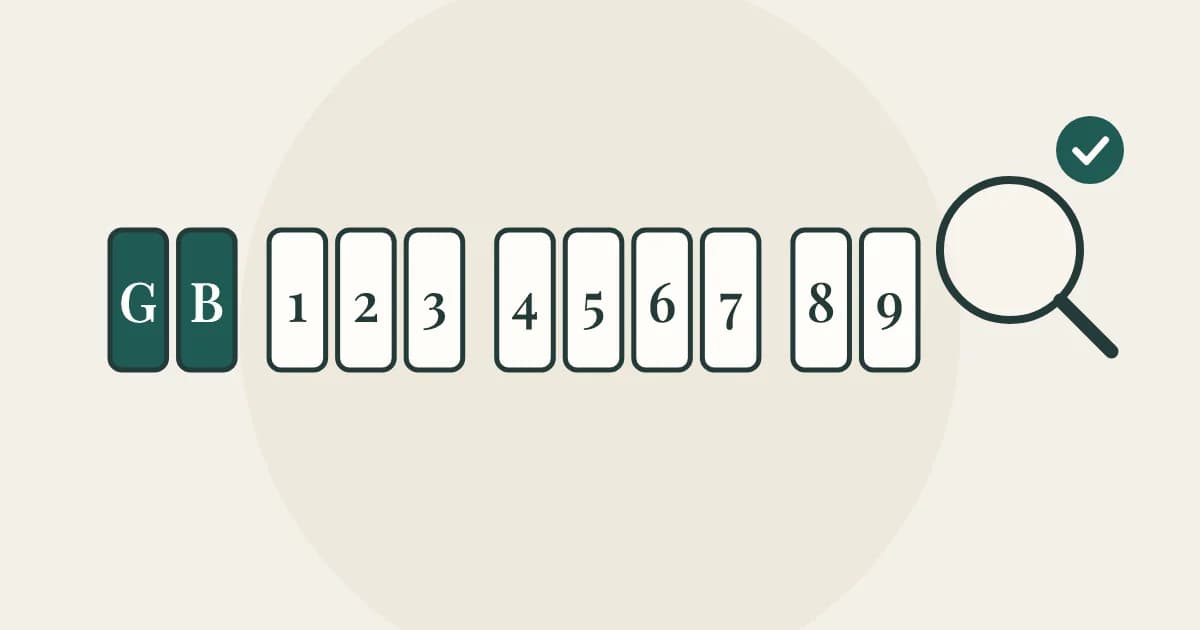
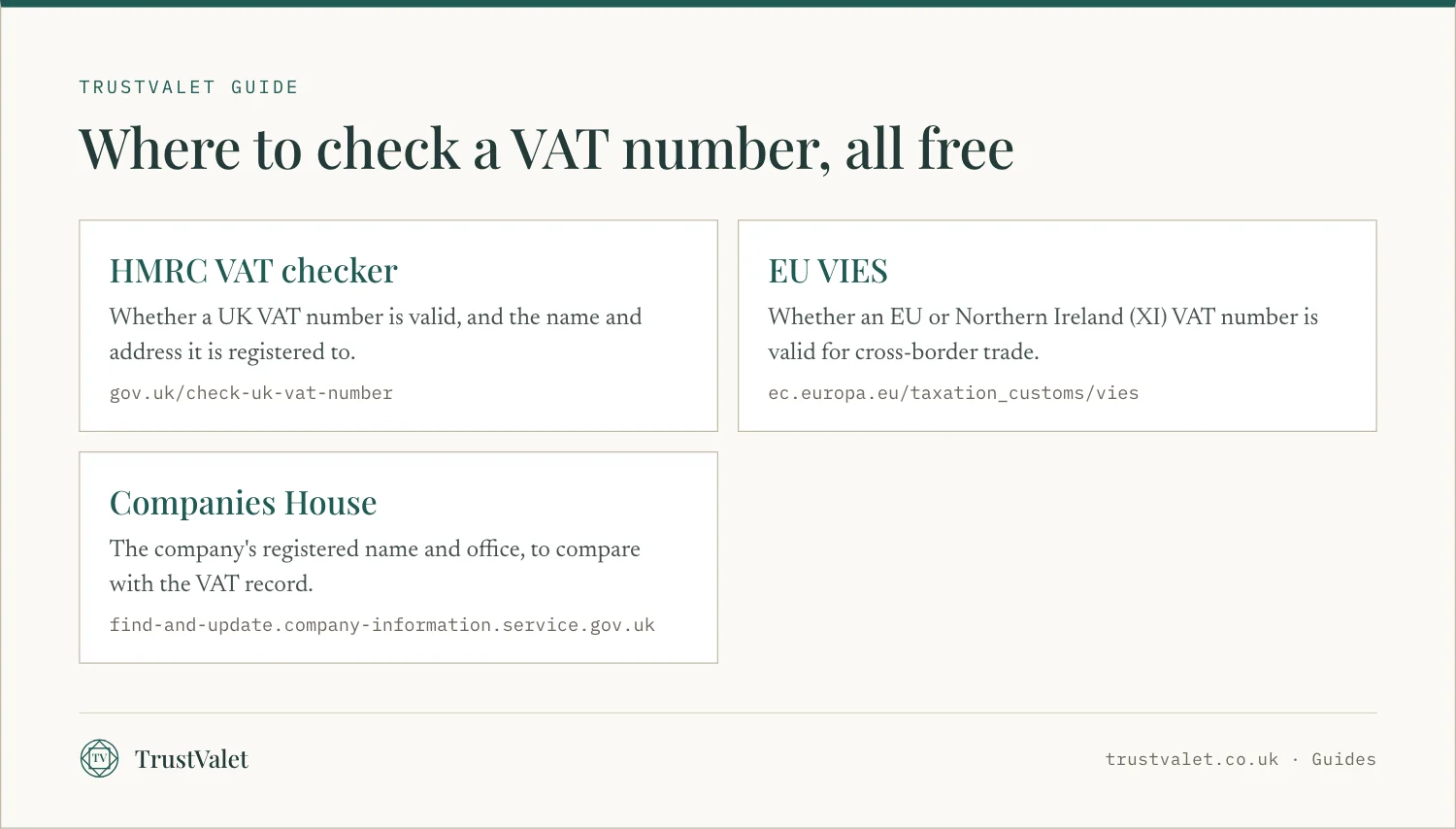
To check a VAT number in the UK, use HMRC's free Check a UK VAT number service on GOV.UK. Enter the nine digits, with or without GB in front, and it tells you whether the number is valid and the name and address of the business it belongs to. You cannot search by company name, so ask the business for its number, which should be on its invoices. For EU numbers and Northern Ireland numbers starting XI, use the EU's VIES checker instead.
This guide covers the format of a UK VAT number, what each checker can and cannot tell you, what a VAT invoice must show, and the signs that a number is fake. It is one of the checks in our wider guide on how to check if a UK company is legit.
What a UK VAT number looks like
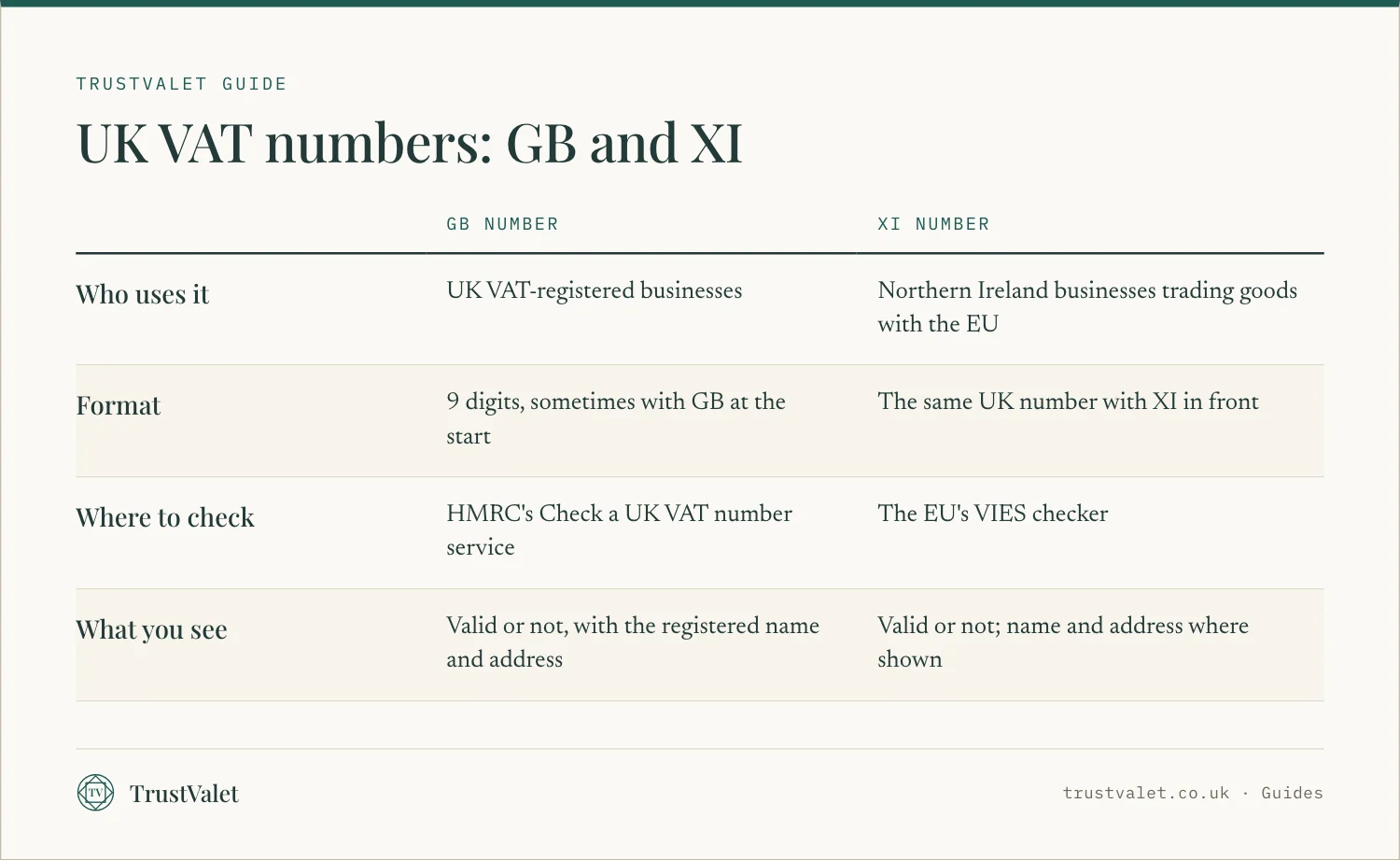
HMRC describes a UK VAT number as nine numbers, sometimes with "GB" at the start. For example, 123456789 or GB123456789. The business will find it on its VAT registration certificate.
Some Northern Ireland businesses use a different prefix. A business trading goods between Northern Ireland and the EU puts "XI" in front of its UK VAT registration number. The digits stay the same.
A few longer or shorter forms exist. The EU's VIES guidance lists, for XI numbers, a 12-digit form for branch traders and short forms starting GD for government departments and HA for health authorities. You will rarely see these on a trader's invoice.
How to use HMRC's free checker
The service is on GOV.UK under "Check a UK VAT number". It confirms two things:
- whether the UK VAT registration number is valid
- the name and address of the business the number is registered to
You need the number before you start. HMRC says plainly that you cannot use the service to find out whether a business is registered for VAT by searching its name. That answers a common question: there is no free official way to look up a VAT number by company name. Ask the business, or look on its invoices, receipts or website.
If you run a VAT-registered business yourself, you can also ask the service for proof of when you checked. You will need your own VAT number to get a reference.
Once you have a name and address back, compare them with what you were given. For a limited company, also look it up on Companies House or in our register, and check who owns it.
EU numbers and Northern Ireland: VIES
For VAT numbers from EU countries, and for Northern Ireland XI numbers, use VIES, the European Commission's VAT information exchange system. HMRC's own guidance points businesses there to verify customers' EU VAT numbers.
VIES tells you whether a number is valid. Whether it shows a name and address depends on the country: some allow it, some do not. Like HMRC's service, VIES cannot find a number from a name and address. The Commission says the number should be supplied to you directly by your customer or supplier.
One quirk: in some countries, such as Spain and Italy, businesses must register their number for EU use. If they have not, VIES shows it as invalid even though it exists at home.
What must appear on a VAT invoice
Only a business registered for VAT can charge VAT. HMRC's guidance is direct: you must register for VAT to start charging it, and every invoice must include your VAT number and show the VAT separately.
HMRC's VAT guide, Notice 700, lists what a full VAT invoice must show. A trading name is allowed, but the name and address under which the business is registered for VAT must appear somewhere on the document.
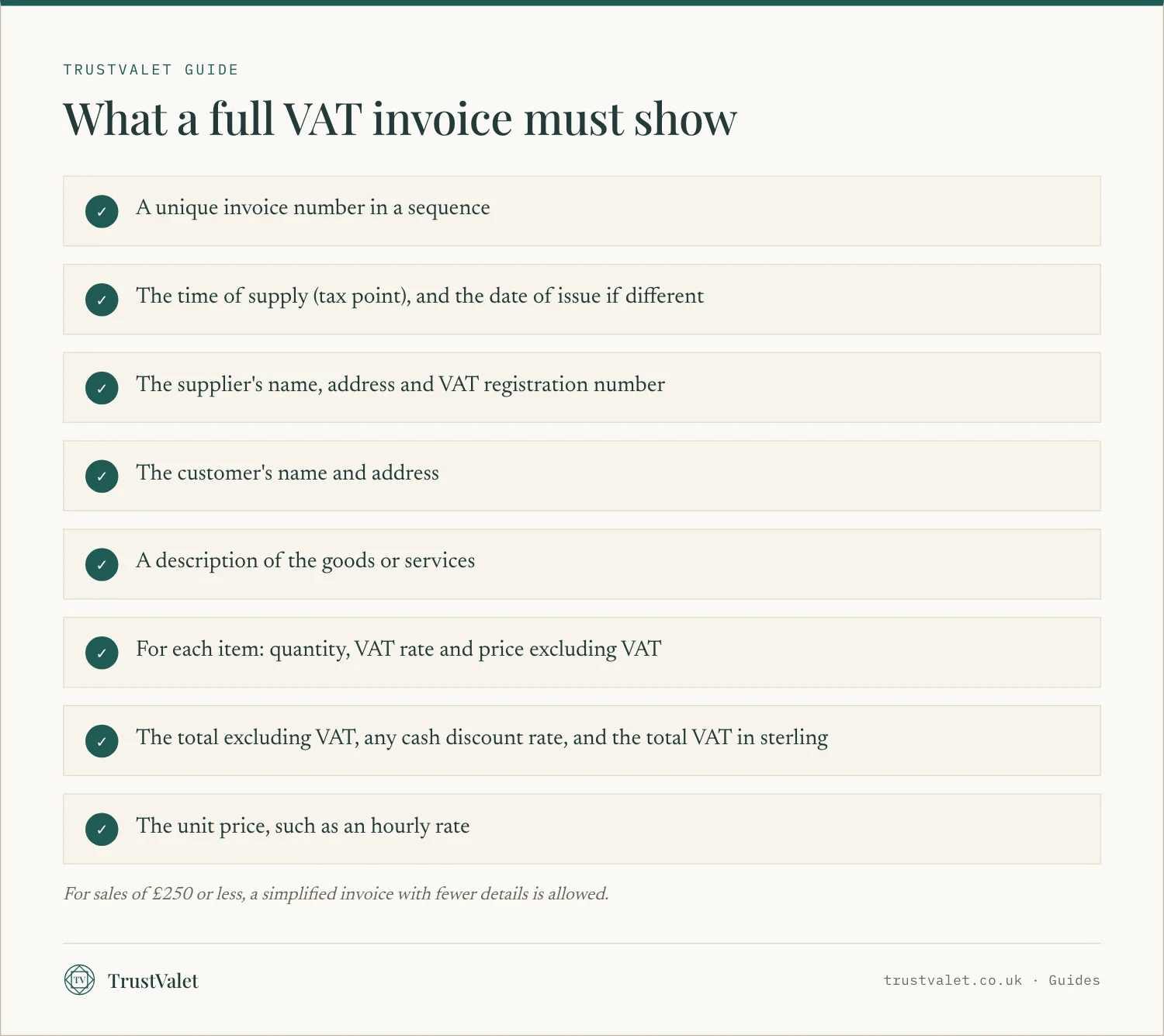
For a sale of £250 or less, and if the customer agrees, a business can issue a simplified invoice. It still needs the supplier's name, address and VAT number, the time of supply, a description, and the total including VAT with the VAT rate.
If you are a VAT-registered business buying from a shop, you can ask for a VAT invoice. HMRC says a retailer should give one when asked, and may face a penalty for refusing a taxable person.
Check the rate as well as the number
A valid number does not mean the VAT on the bill is right. There are three rates. Most goods and services are charged at the standard rate of 20%.
Some things carry the reduced rate of 5%, for example domestic fuel or power, and mobility aids installed in the home of someone over 60. Others are zero-rated, such as books and newspapers, and children's clothes and shoes. A zero-rated item still goes through the VAT system, but at 0%.
If an invoice charges 20% on something you expected to be taxed at a lower rate, ask the business which rate it used and why. GOV.UK publishes a list of reduced and zero-rated goods and services you can check against. An honest business will explain, and correct the invoice if it got it wrong.
Signs of a fake or misused VAT number
Most VAT numbers you meet are genuine. The ones worth worrying about usually fail in one of a few simple ways.
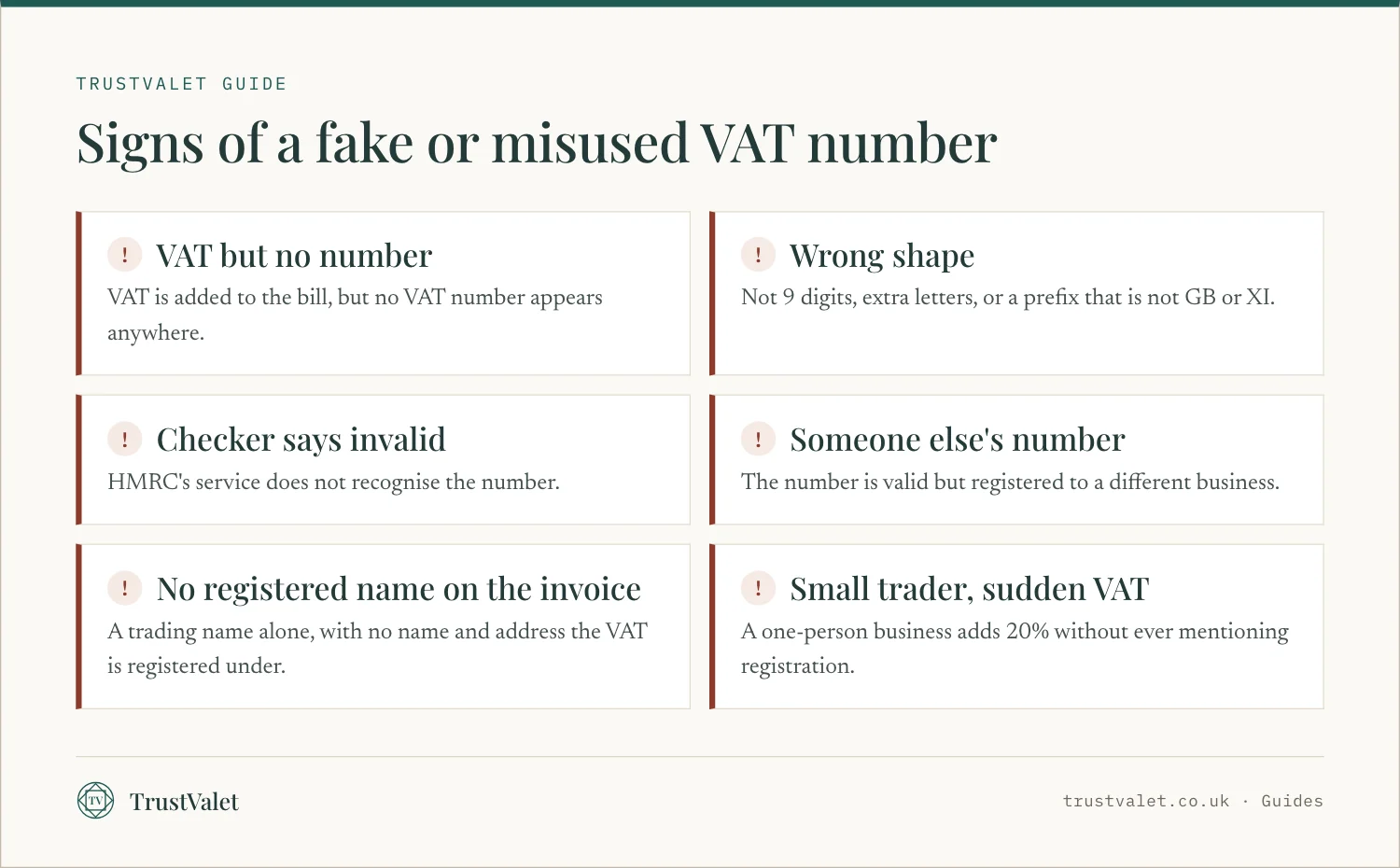
VAT with no number. If a bill adds VAT, the business must show its VAT number. No number is the clearest warning of all.
A number that fails. Type it into HMRC's checker yourself. If it is not recognised, ask why before you pay.
A number that belongs to someone else. This is the one people miss. A valid number is not enough: the name and address it returns should match the business you are paying. A number copied from another firm will pass the validity test and fail the name test.
A new business. One honest exception exists. A business that has just registered may still be waiting to be told its number. HMRC allows it to issue the VAT invoice within 30 days of being told. Ask for the invoice to follow, and check the number when it arrives.
This matters most for builders and other trades, where a quote can jump by a fifth once VAT is added. Our guide to avoiding cowboy builders covers the other warning signs.
When a business has to register
A business must register for VAT when its VAT taxable turnover goes over £90,000, or is expected to. It can also choose to register below that. So a small trader who is not registered is not doing anything wrong, as long as they do not charge VAT.
Our guide to first-year limited company deadlines explains when a new company needs to think about registration.
If a trader charged VAT without being registered
HMRC is clear that only a VAT-registered person can issue a VAT invoice, and that there are financial penalties for issuing one without authority. The law also lets HMRC recover any amount shown as VAT on an invoice from the person who issued it, whether or not they are registered.
If you are a business, do not reclaim that VAT. HMRC says that knowingly using an invoice from an unregistered person to reclaim VAT is an offence.
Then report it. HMRC's route is its online form for reporting tax fraud or evasion, on GOV.UK under "Report tax fraud or avoidance to HMRC". You do not have to give your own details, and HMRC asks you not to investigate further or tell anyone you are reporting. If you cannot use the form, call the HMRC fraud hotline on 0800 788 887.
Separately, ask the trader in writing to correct the invoice. Keep copies of the quote, the invoice and the checker result. If the listing on TrustValet shows something wrong, you can also report it.
How TrustValet can help
TrustValet is a register built from public records. Each company page shows what Companies House holds, such as its status, filing deadlines and who controls it, with the source and the date we read each fact. Our sources page lists them.
Some companies choose to be verified: 14 checks against public registers, one of which checks the company's VAT number with HMRC or VIES. A person decides each check, and the result is a dated certificate anyone can check. How we verify explains every check. It does not vet workmanship, reviews or ratings. For what a badge can and cannot prove, read what verified really means.
Questions
How do I check a UK VAT number?
Use HMRC's free Check a UK VAT number service on GOV.UK. Enter the nine digits, with or without GB. It tells you whether the number is valid and the name and address of the business it is registered to.
Can I check a VAT number by company name?
No. HMRC's service needs the number and cannot search by business name, and the EU's VIES works the same way. Ask the business for its VAT number, which should appear on its invoices, receipts or website.
What does an XI VAT number mean?
It is a UK VAT number with XI in front, used by Northern Ireland businesses trading goods with the EU. Check XI numbers on the EU's VIES service.
Can a business charge VAT if it is not VAT registered?
No. You must be registered for VAT to charge it, and only a VAT-registered person can issue a VAT invoice. There are financial penalties for issuing one without authority, and HMRC can recover the VAT shown.
How do I report a business charging VAT without a VAT number?
Use HMRC's online form to report tax fraud or avoidance on GOV.UK, or call the HMRC fraud hotline on 0800 788 887 if you cannot use the form. You do not have to give your own details.
Check the company first
Before you pay anyone, look the company up. Every page in the register shows what Companies House says, with the date we read it.
Ala Ciobanu · Ala Ciobanu edits the TrustValet guides. Every guide names its sources.
- Check a UK VAT number (GOV.UK)
- VAT guide, VAT Notice 700 (GOV.UK)
- VAT on movements of goods between Northern Ireland and the EU, VAT Notice 725 (GOV.UK)
- Charge, reclaim and record VAT (GOV.UK)
- VAT thresholds (GOV.UK)
- Report tax fraud or avoidance to HMRC (GOV.UK)
- VIES VAT number validation (European Commission)
- Value Added Tax Act 1994, Schedule 11, paragraph 5 (legislation.gov.uk)