"Verified" is one of the most reassuring words a directory can put next to a business, and one of the least precise. On one site it means someone looked at a passport. On another it means a company number was typed in and found. On a third it means reviews were checked, and on a fourth it means the business paid a fee. None of these is wrong in itself. The problem comes when you read the badge as a promise it was never meant to make.
This guide sets out the different things directories call verified, what each one proves and what it does not, the questions to ask about any badge, and exactly what TrustValet's own verification checks.
The five things "verified" usually means
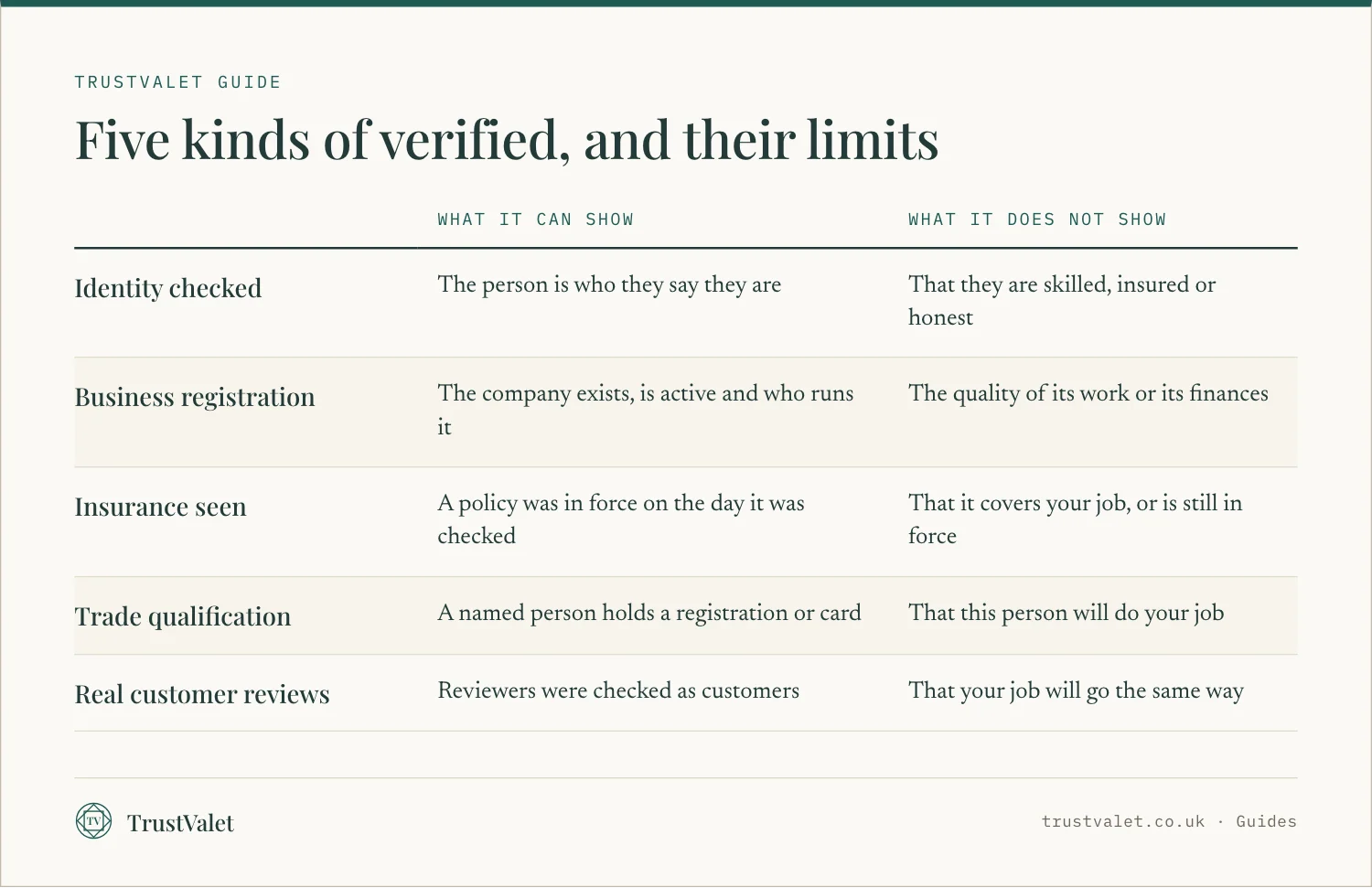
1. Identity checked
The directory confirmed that a person is who they say they are, usually by checking photo identification, sometimes with a selfie or a third-party identity service. This stops someone creating a profile under a false name. It says nothing about whether that person is skilled, insured or trading honestly.
2. Business registration checked
The directory confirmed that a company exists on the public register, is active, and perhaps who its directors are. This is useful, especially when a quote names a limited company. But registration is easy: a company can be incorporated in a day, and an active status says nothing about the quality of its work or the health of its finances.
3. Insurance seen
The directory saw an insurance certificate, usually public liability cover. That tells you a policy existed on the day it was checked. It does not tell you the policy covers the kind of work you need, the value of your job, or that it has not lapsed since. Ask the business for its current certificate and check the name, the dates and the type of cover.
4. Trade qualification or registration checked
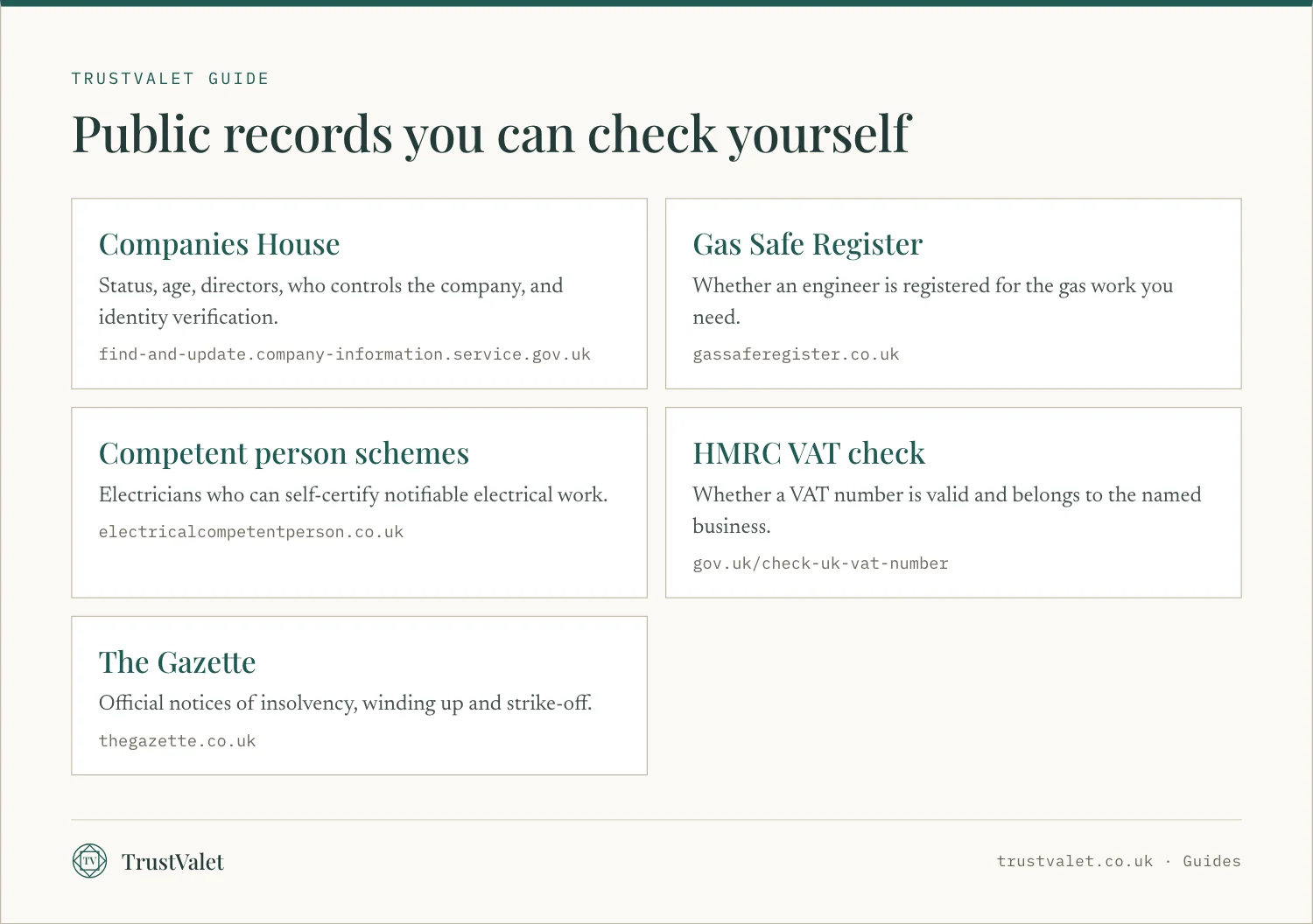
The directory confirmed that a person holds a qualification or is on a trade register. Some registrations are required by law: anyone working on gas appliances must be on the Gas Safe Register. Others, such as membership of a competent person scheme for electrical work, allow a business to self-certify certain work under the building regulations. A registration belongs to a named person or business, so check that the person who will do your job is the one who holds it.
5. Reviews from real customers
The directory took steps to confirm that reviewers were genuine customers, for example by checking contact details or asking for proof of the job. Since April 2025, businesses that publish consumer reviews have had a legal duty to take reasonable and proportionate steps to prevent and remove fake reviews, and the Competition and Markets Authority has published guidance on what that means. Genuine reviews tell you how past jobs went. They are not a forecast for yours.
A new public check: director identity verification
One check that used to be missing from the public record is now there. Under the Economic Crime and Corporate Transparency Act 2023, identity verification for company directors and people with significant control became a legal requirement at Companies House from 18 November 2025.
From that date, new directors must verify their identity to incorporate a company or be appointed to one. Existing directors verify as part of their company's next confirmation statement, during a 12-month transition period. People with significant control must also provide a verified identity within the period Companies House sets for them. Verification is done through GOV.UK One Login or through an Authorised Corporate Service Provider, and each verified person receives a Companies House personal code.
This matters because, before the change, anyone could be named as a director without proving who they were. It does not tell you whether a director is competent or whether the company is well run. It tells you that the people on the register are real, identified individuals. While the transition runs, a director who has not yet verified is not necessarily doing anything wrong: their company's filing date may simply not have arrived.
Questions to ask any directory about its badge
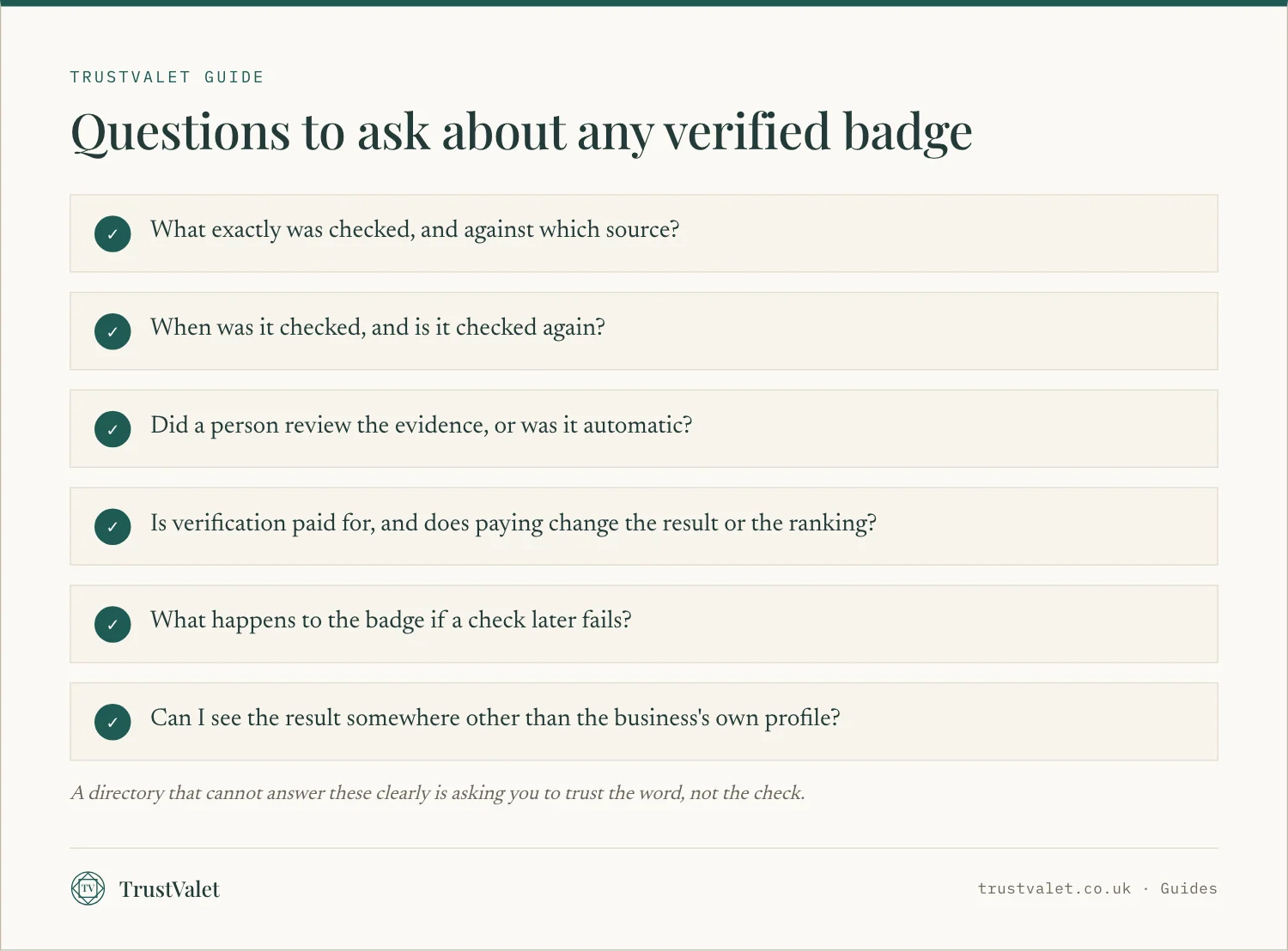
A badge is only as useful as the check behind it. Before you rely on one, look for clear answers to these questions, usually on the directory's own "how we check" page:
- What was checked, and against what? A public register, a document the business uploaded, or the business's own word?
- When? A check made three years ago describes that day, not today.
- Is it repeated? Insurance lapses and companies fall behind with filings. Look for a date or an expiry.
- Did a person decide? Automated checks are fast, but a person can spot a mismatch that software misses.
- Does money change anything? Many directories charge for verification or for placement. That is fine if the result and the ranking do not depend on payment, and if paid placement is clearly labelled.
- What happens when a check fails later? A badge should change or disappear, not stay in place.
What TrustValet's verification checks
TrustValet is a register built from public records. It does not vet, rate or recommend businesses, and it does not check workmanship. For every company in our register, we show what Companies House holds: status, incorporation date, how many directors have verified their identity, who controls the company by kind of control, filing deadlines and charges, each with its source and the date we read it. Our sources page lists where each kind of fact comes from.
A company can claim its page and add its website and phone number. It can also choose to be verified. Verification is optional. It is free while the company shows our badge on its own website, or £19 a year (£49 once for five years) without it, as set out on our pricing page. It consists of 14 checks against public registers and the company's own website:
- Companies House: the company is registered and active, and its directors are on record.
- VAT: the VAT number is checked with HMRC or the EU VIES service.
- Website identity: the name on the website matches the company, and the website publishes the company number, contact details and terms.
- Domain and website: the domain's age from the registry, a valid TLS certificate, the domain receiving email, the website resolving, and proof that the company controls its domain.
- Public notices and filings: no insolvency notices in The Gazette, and no overdue filings or strike-off action.
A person decides every verification. A passed verification produces a dated certificate with its own code, and a live badge that shows the certificate's current status, so a badge on a company's website cannot keep claiming a verification that has expired or been withdrawn.
What it does not check
TrustValet verification does not inspect any work, and it does not guarantee prices, timelines or workmanship. Its 14 checks do not include insurance cover or trade qualifications. A verification describes the day it was made. Featured placement on TrustValet is labelled as advertising and changes nothing else: it does not affect verification, the facts on a company's page or its certificate.
How to check a TrustValet certificate
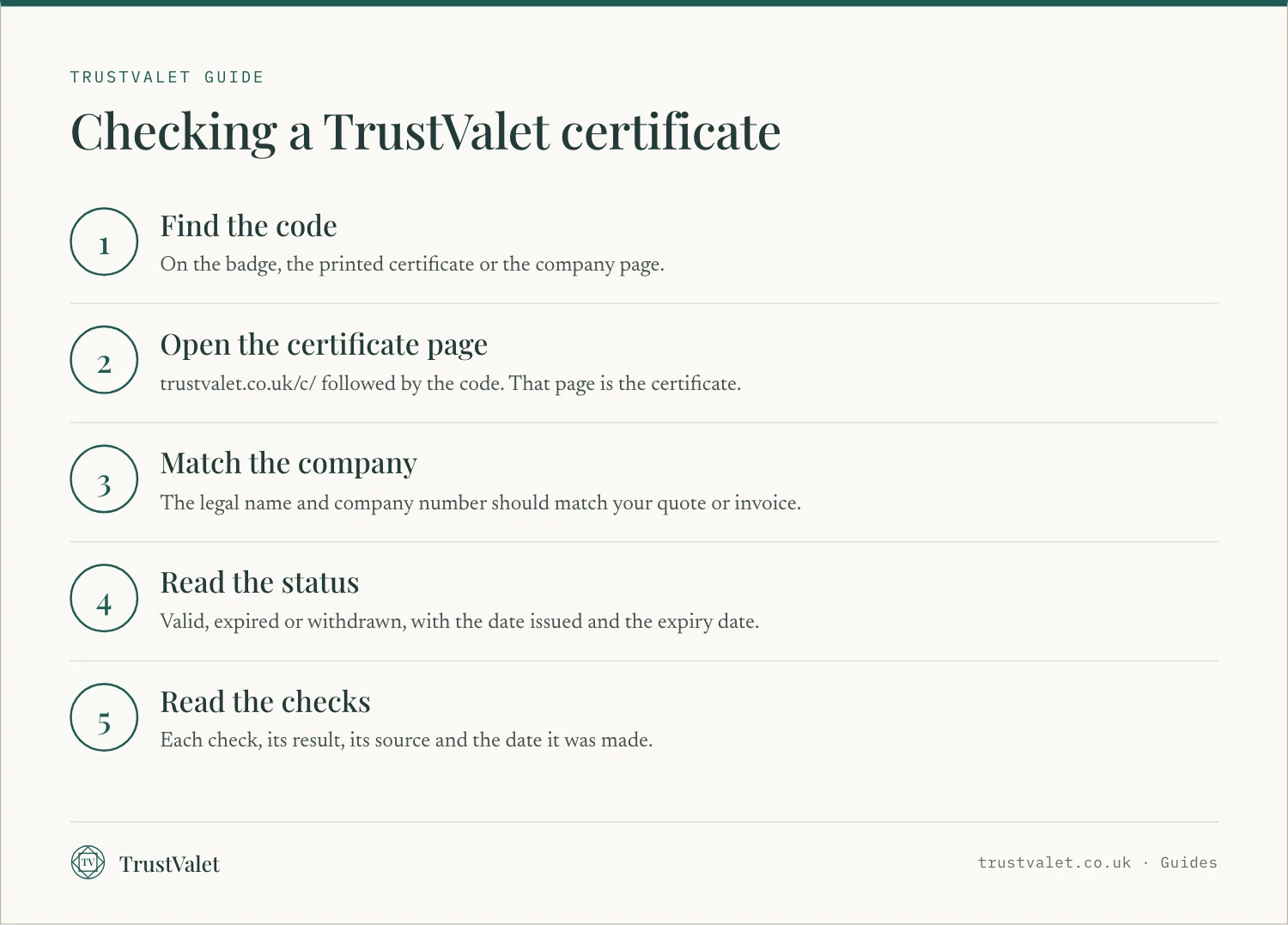
Every certificate lives at its own address: trustvalet.co.uk/c/ followed by the certificate's code. The page is the certificate. A badge, a PDF or a printed copy all point back to it, and the page is what counts.
On it you will see the company's legal name and number, whether the certificate is valid, expired or withdrawn, the date it was issued and when it expires, and each check with its result, its source and the date it was made. It also states what the certificate does not certify. Match the company number to the one on your quote or invoice, and if the details differ, ask why. How we verify explains each check in more detail.
How TrustValet can help
A verified badge, ours included, is one piece of evidence. It is not a substitute for your own checks. For trades, our guide to checking whether a tradesperson is qualified covers the registers each trade needs, and Checkatrade vs hiring direct explains how platforms describe their own checks. For professional firms, see how to vet a marketing agency.
You can browse electricians, accountants, solicitors or companies in London and Leeds, and look up any company's public record in our register. If you run a company and want to be verified, see get verified.
Questions
Does a verified badge mean a business does good work?
No. Verification checks facts about a business, such as its identity, registration, insurance or reviews, at a point in time. It does not inspect or guarantee the quality of any particular job.
Do company directors have to verify their identity?
Yes. Under the Economic Crime and Corporate Transparency Act 2023, identity verification for directors and people with significant control became a legal requirement at Companies House from 18 November 2025, with a 12-month transition for existing directors.
What does TrustValet verification check?
Fourteen checks against public registers and the company's own website, including Companies House status, directors, VAT number, website identity, domain ownership, Gazette insolvency notices and overdue filings. A person decides each verification.
Does TrustValet check insurance or workmanship?
No. TrustValet does not inspect work or guarantee prices, timelines or workmanship, and its checks do not cover insurance or trade qualifications. The certificate page states what it does not certify.
How do I check a TrustValet certificate is genuine?
Open trustvalet.co.uk/c/ followed by the certificate code. The page shows whether it is valid, expired or withdrawn, the dates, and each check with its source. Match the company number to your quote.
Check the company first
Before you pay anyone, look the company up. Every page in the register shows what Companies House says, with the date we read it.
Ala Ciobanu · Ala Ciobanu edits the TrustValet guides. Every guide names its sources.
- Verifying your identity for Companies House (GOV.UK)
- Companies House confirms identity verification rollout from 18 November 2025 (GOV.UK)
- People with significant control (GOV.UK)
- Fake reviews guidance, CMA208 (GOV.UK)
- Check a UK VAT number (GOV.UK)
- The Gazette, official public record
- Find a competent person (Electrical Competent Person)