
Marketing is an unregulated trade in the UK. There is no licence to hold, no exam to pass and no register an agency has to join before it can take your money. That is not a reason to distrust every agency, but it does mean the checks fall to you. The good news is that most of them are free, public and quick.
This guide covers what to check about the company, how to test its claims, how to keep ownership of your accounts and content, which contract terms matter, and the data protection and advertising rules that apply once an agency starts working for you. It applies whether you are hiring a marketing agency for search and paid ads, a design agency for a rebrand, or a web and data specialist to rebuild your site.
Start with the company, not the pitch
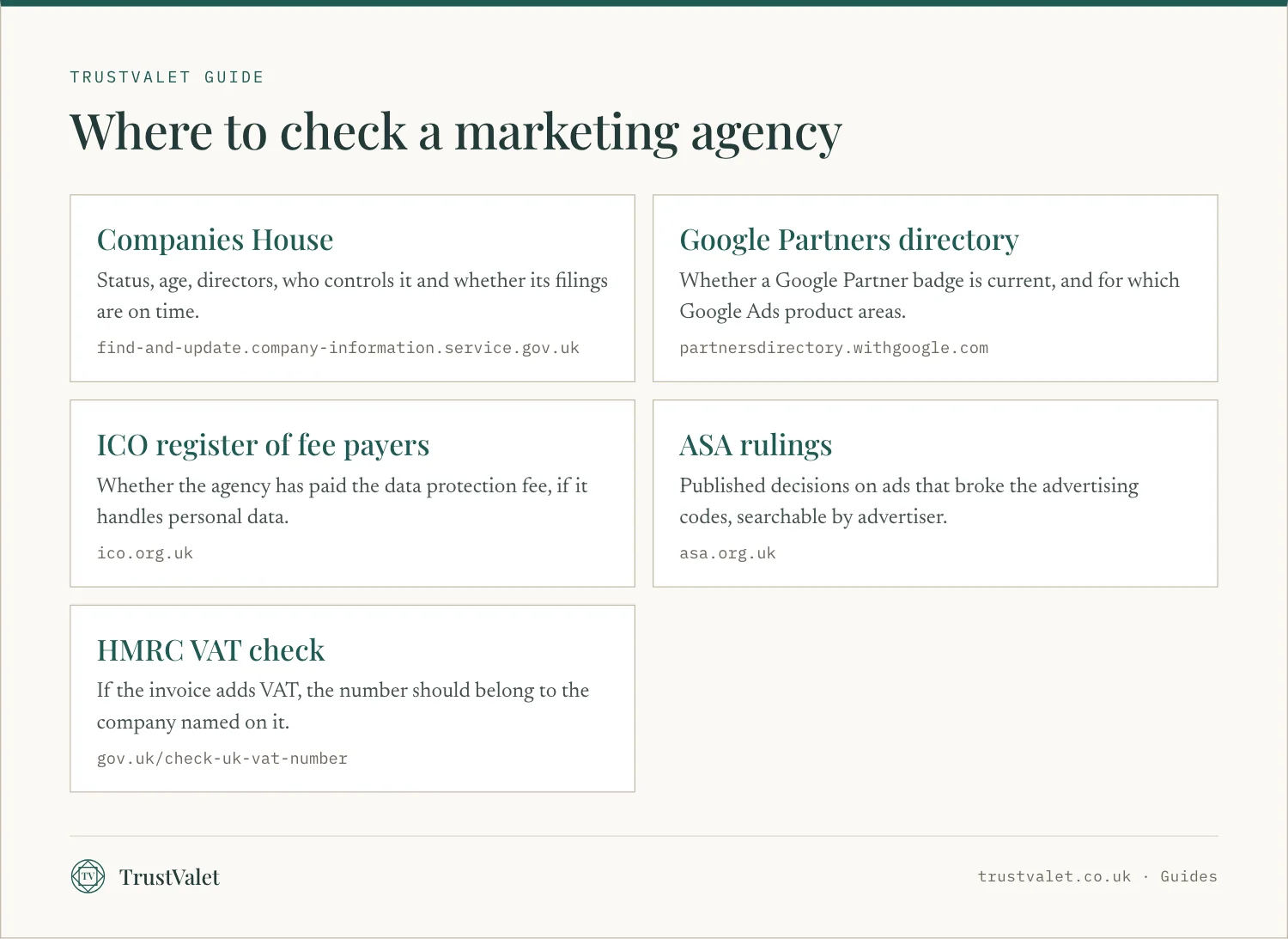
A pitch deck shows you what an agency wants you to see. The public record shows you what it is. Before a second meeting, look the company up on Companies House. It takes a few minutes and answers four questions.
Is it the company you think it is?
Many agencies trade under a brand name that differs from the registered one. The contract and invoices should name the legal entity, with its company number. Check that the number on the proposal matches the company you found, and that the registered name is the one that will sign.
How old is it, and is it active?
An active status and a few years of history do not prove quality, but a company incorporated last month, or one marked as in liquidation or proposed for strike-off, deserves a direct question. A new company can be a senior team that has just set up on its own. It can also be the same people under a new name after the last company closed. Ask.
Who runs it and who controls it?
The officers list shows the directors and when they were appointed. The people with significant control register shows who owns or controls the company, and how. If the person pitching to you is not on either list, find out what their role is. You can also click through a director's name to see other companies they have run, including any that were dissolved.
Are its filings up to date?
Overdue accounts or a late confirmation statement is a small sign of how a business runs its own affairs. It is worth knowing before you hand it your budget.
Test the case studies
Case studies are marketing. Treat them as claims to check rather than evidence.
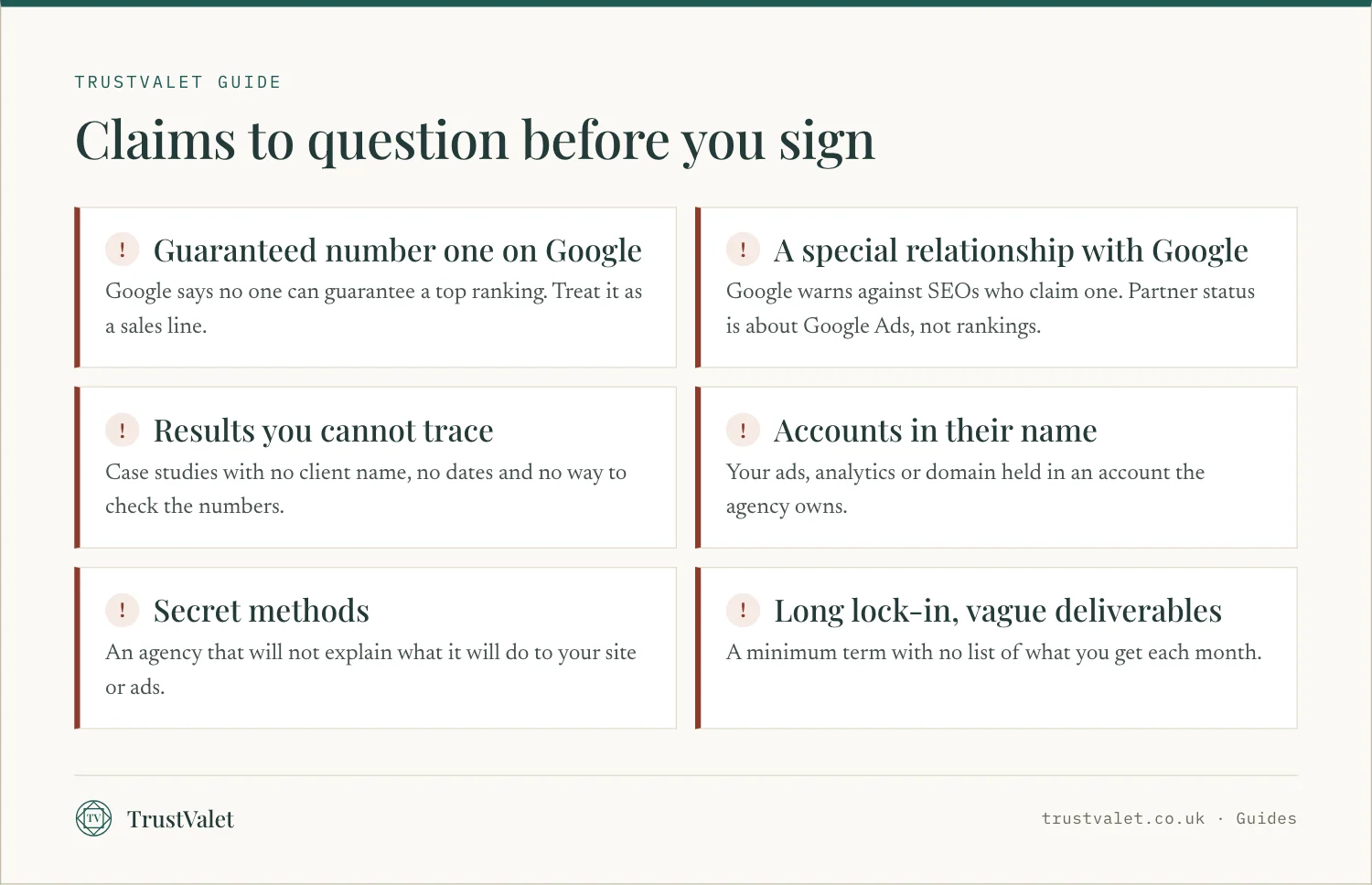
Ask for two or three clients you can speak to, ideally in a sector like yours, and ask them what the agency did, what changed, and how the relationship ended if it has. Check that the websites and campaigns in the portfolio are live and look like the screenshots. A result such as "traffic up 300%" means little without a start point, a time period and a source. Ask which tool the figure came from and whether you could see the report.
Be wary of anonymous case studies. There are good reasons to keep a client confidential, but an agency with no named clients at all should be able to explain why.
Claims to be wary of
Some promises are common enough in marketing sales that search engines and regulators have addressed them directly.
Google's own guidance on hiring an SEO is plain: no one can guarantee a number one ranking on Google. It also warns against anyone who claims a special relationship with Google or offers priority submission, and against companies that are secretive about what they intend to do. The same page suggests that, at the audit stage, you grant read access to Search Console only, not write access.
A Google Partner badge is a different thing. It is awarded through the Google Partners programme to companies that manage Google Ads, and Google sets requirements on performance, spend and certifications, which it checks daily. It says nothing about organic search rankings, social media or design. If an agency shows the badge, search for it in the Google Partners directory, where listed Partners have a page naming their website and the product areas in which they hold Google Ads certifications. A badge you cannot find there is a question to ask.
Keep ownership of your accounts, data and content
The most expensive problem with a marketing agency is often not poor results. It is finding, when you leave, that your ad account, analytics history or website sits in an account the agency owns.
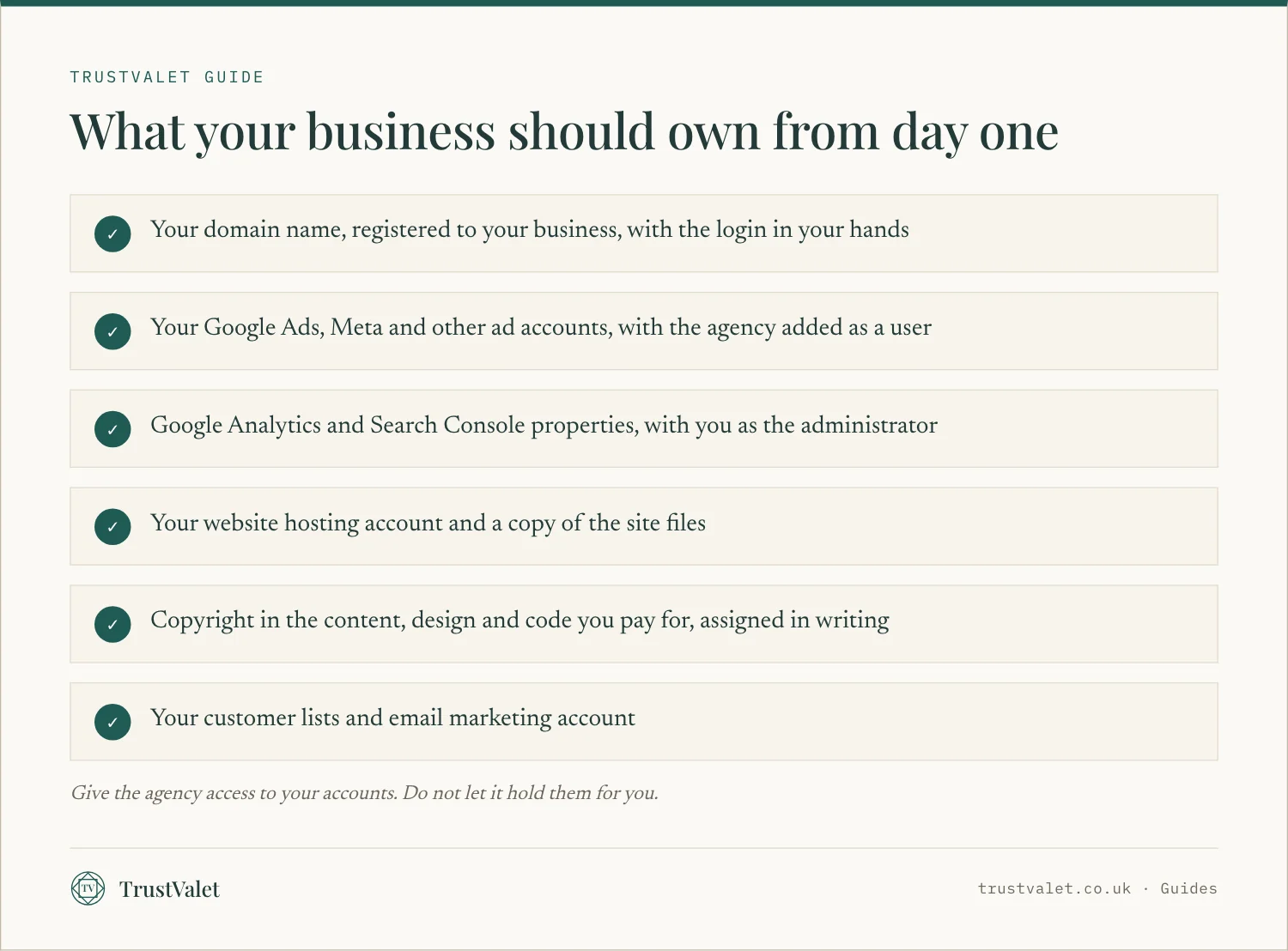
Set things up the other way round from the start:
- Create your ad accounts, analytics and Search Console properties in your own business name, and add the agency as a user.
- Keep the domain name registered to your business, with the registrar login in your hands.
- Make sure you, not the agency, are the administrator on every account that holds your data.
- Keep a copy of your website files and any content produced for you.
Copyright needs its own attention. Under the Copyright, Designs and Patents Act 1988, the author of a work is its first owner, and work made by employees in the course of their job belongs to their employer. For work an agency produces for you, that usually means the agency owns the copyright unless the contract says otherwise. If you want to own the logo, copy, photographs or code you pay for, the contract should assign copyright to you, and an assignment must be in writing and signed by the agency. A licence to use the work is not the same as owning it.
Read the contract before the first invoice
Business-to-business contracts carry fewer statutory protections than consumer contracts, so the terms you sign matter more. Read these closely:
- Minimum term and notice period. How long are you committed for, and how much notice do you have to give? Check whether the contract renews automatically.
- Deliverables. What exactly does the monthly fee buy? A list of tasks, hours or outputs is easier to hold an agency to than "ongoing optimisation".
- Reporting. What you receive, how often, and from which tools. You should be able to check the figures in your own accounts.
- Ad spend and fees. Whether your ad budget is paid directly by you to the platform or passes through the agency, and how the agency's fee is calculated.
- Ownership and exit. Copyright, account access and a handover of files and logins when the contract ends.
- Subcontracting. Whether the work may be passed to another company or freelancers, and who is responsible for it.
If a contract is long, or the spend is large, have a solicitor read it. Our list of solicitors is a place to start.
Data protection: the ICO fee and a processing agreement
If an agency will handle personal data for you, such as your customer list, website form submissions or email subscribers, data protection law applies to how it does so.
Under the Data Protection (Charges and Information) Regulations 2018, organisations that process personal information must pay a data protection fee to the Information Commissioner's Office unless they are exempt. The ICO publishes a searchable register of fee payers, so you can check the agency's entry by name.
Where the agency processes personal data on your behalf, you are usually the controller and the agency the processor. UK GDPR requires a written contract between the two, often called a data processing agreement, covering matters such as acting only on your instructions, confidentiality, security, the use of sub-processors and what happens to the data at the end. The ICO's guidance on controller and processor contracts sets out what to include.
Advertising rules still apply to you
If the agency writes ads, social posts or marketing emails for you, those communications are covered by the UK Code of Non-broadcast Advertising and Direct and Promotional Marketing, known as the CAP Code. The Code must be followed by advertisers, agencies and media, and it is enforced by the Advertising Standards Authority. Your business remains the advertiser, so a misleading claim in an ad an agency wrote is still your problem. Agree who checks claims before publication, and keep evidence for anything you state as fact, such as prices, savings or results. The ASA publishes its rulings, and it is worth searching them for the agency's past clients as well as your own sector.
Before you sign
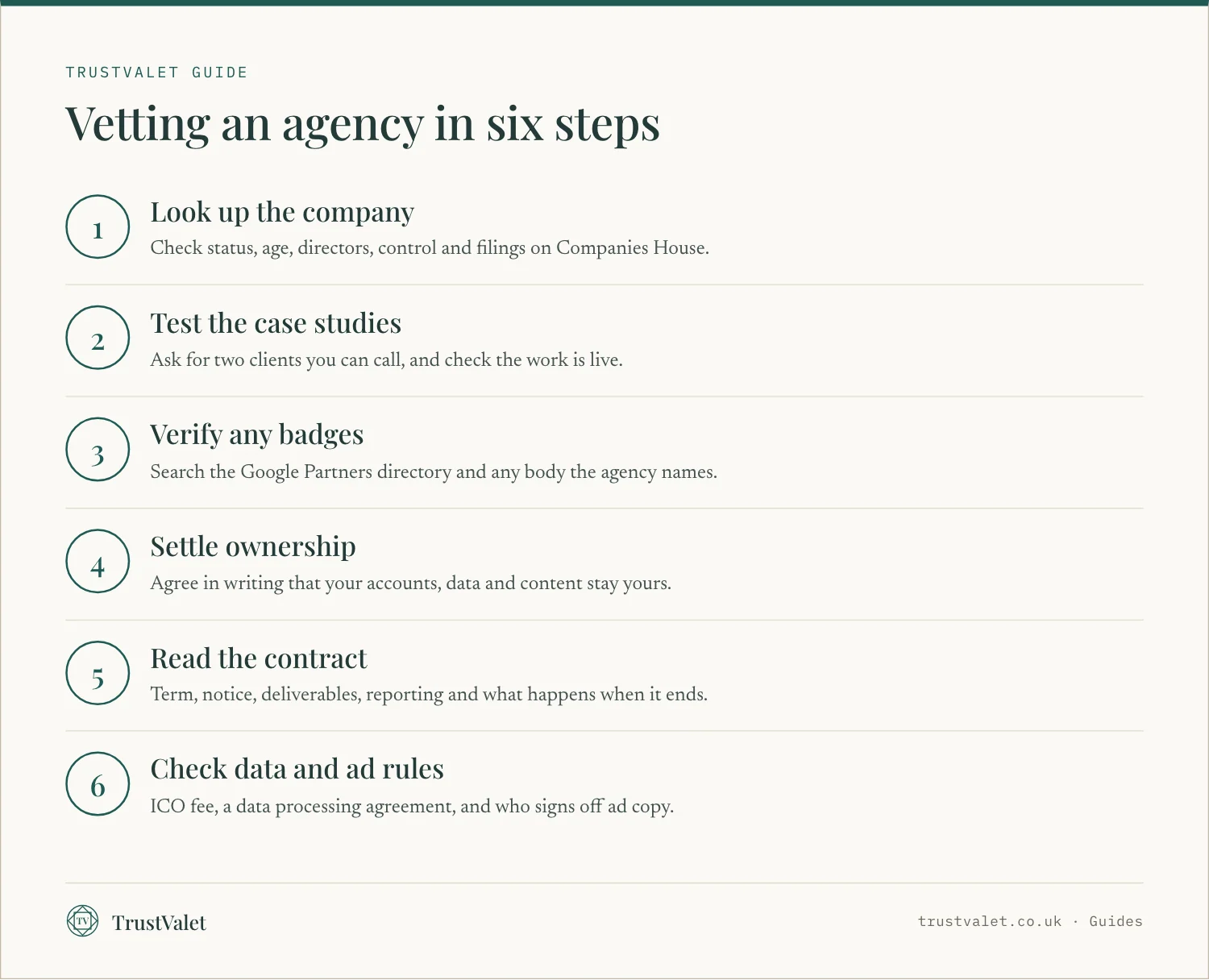
Put the answers side by side. A trustworthy agency will be easy to find on the public record, happy to name clients you can call, clear about what it will do, comfortable with you owning your accounts and content, and willing to put all of that in the contract. For more on spotting trouble early, read our guide to red flags of a bad contractor. The same instincts apply to agencies as to builders.
How TrustValet can help
TrustValet is a register built from public records, not a review site. For every company in our register, we show what Companies House holds: status, incorporation date, how many directors have verified their identity, who controls the company and by what kind of control, filing deadlines and charges, each with its source and the date we read it. We do not rate or recommend agencies, and we do not check the quality of their work.
Some agencies choose to be verified. That means 14 checks against public registers and the agency's own website, including its VAT number, whether its website names the company and publishes its terms, and whether it controls its domain, all decided by a person and recorded on a dated certificate. Our guide to what "verified" really means explains what those checks prove and what they do not, and how we verify lists them in full.
Browse marketing agencies in Manchester, marketing agencies in London or all digital services. If you run an agency yourself, see how to get verified.
Questions
Do marketing agencies need a licence in the UK?
No. Anyone can set up and trade as a marketing agency. Agencies must still follow general law, including data protection law and, for the ads they create, the CAP Code enforced by the Advertising Standards Authority.
Can an SEO agency guarantee a number one ranking on Google?
No. Google's own guidance says no one can guarantee a number one ranking on Google, and advises caution with anyone who claims a special relationship with Google.
How do I check a Google Partner badge is real?
Search for the agency in the Google Partners directory. Listed Partners have a page showing their website and the Google Ads product areas in which they hold certifications. The badge relates to Google Ads, not organic search.
Who owns the content an agency creates for me?
Under the Copyright, Designs and Patents Act 1988 the author is the first owner, so an agency usually owns what its staff create unless the contract assigns copyright to you. An assignment must be in writing and signed by the agency.
Do I need a data processing agreement with my agency?
If the agency processes personal data on your behalf, such as customer lists or form submissions, UK GDPR requires a written contract between you as controller and the agency as processor. The ICO's guidance lists what it must cover.
Check the company first
Before you pay anyone, look the company up. Every page in the register shows what Companies House says, with the date we read it.
Ala Ciobanu · Ala Ciobanu edits the TrustValet guides. Every guide names its sources.
- Do you need an SEO? (Google Search Central)
- How to become a Google Partner or Premier Partner (Google Ads Help)
- Google Partners directory (Google Ads Help)
- Data protection fee (ICO)
- Contracts and liabilities between controllers and processors (ICO)
- The CAP Code, non-broadcast (ASA and CAP)
- Copyright, Designs and Patents Act 1988, section 11 (legislation.gov.uk)
- Copyright, Designs and Patents Act 1988, section 90 (legislation.gov.uk)