
In short: a confirmation statement is the yearly check that the information Companies House holds about your company is right. Every company must file one at least once every 12 months, including dormant and non-trading companies, even if nothing has changed. You have 14 days after the end of each review period to file. It costs £50 online or £110 by post, and Companies House will not accept it until every director has verified their identity.
This guide explains what the statement confirms, how the dates work, how to file, and what happens if you are late. It also shows how anyone can check whether a company's statement is overdue, which is a useful signal when you look a business up.
What the confirmation statement is
The confirmation statement replaced the old annual return (form AR01). It does not report your finances. Your accounts do that, on their own deadline. The statement is about who and what the company is.
When you file, you confirm that the public record is up to date. If something is wrong, you correct it, either before you file or in the statement itself, depending on what it is.
What it confirms
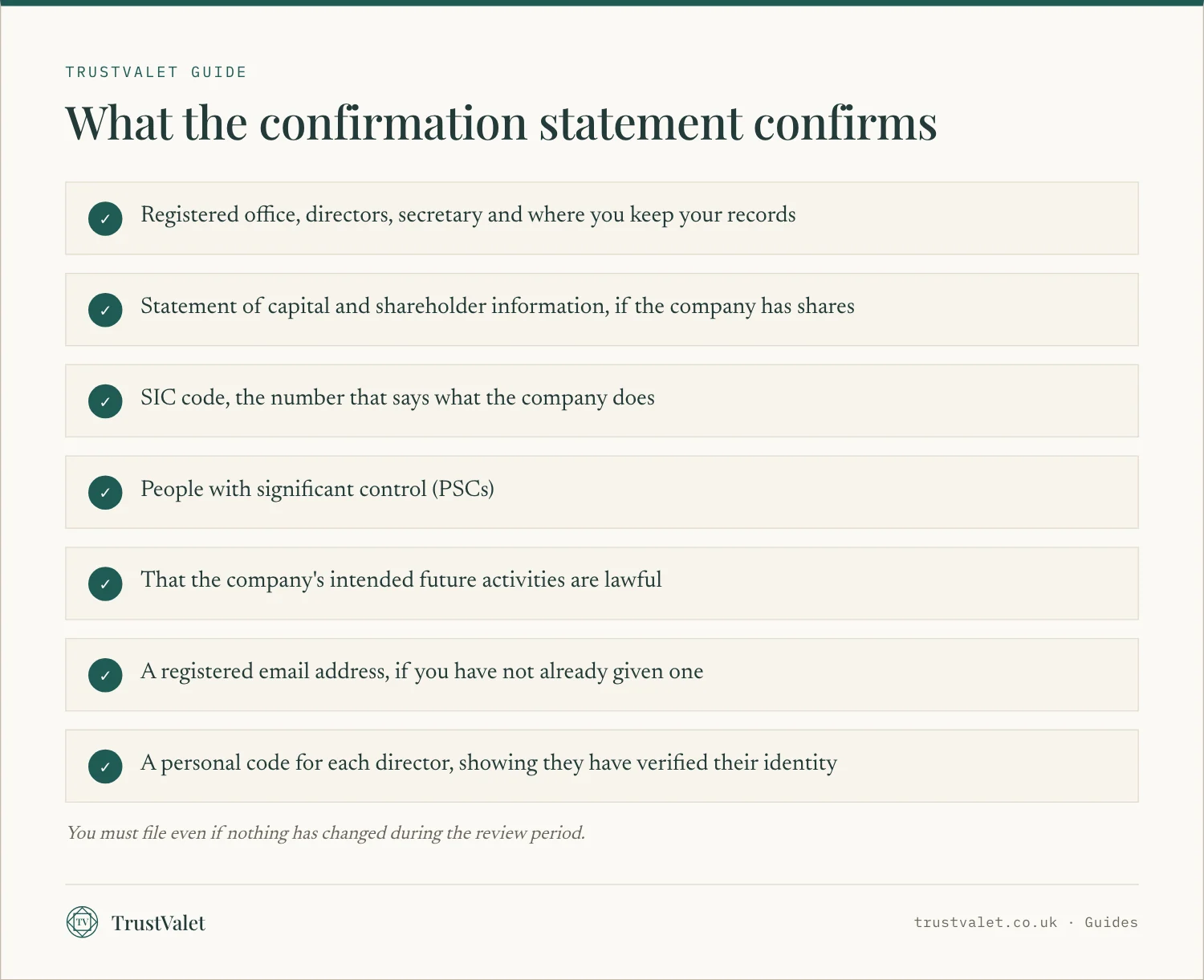
GOV.UK lists what you need to check each year:
- the registered office, directors, secretary and the address where you keep your records
- the statement of capital and shareholder information, if your company has shares
- your SIC code, the number that identifies what your company does
- your people with significant control (PSCs)
Recent reforms added more. You must state that the company's intended future activities are lawful. You must also give a registered email address if you have not already provided one. Companies House uses it to contact you, and it is not published on the public register.
When it is due
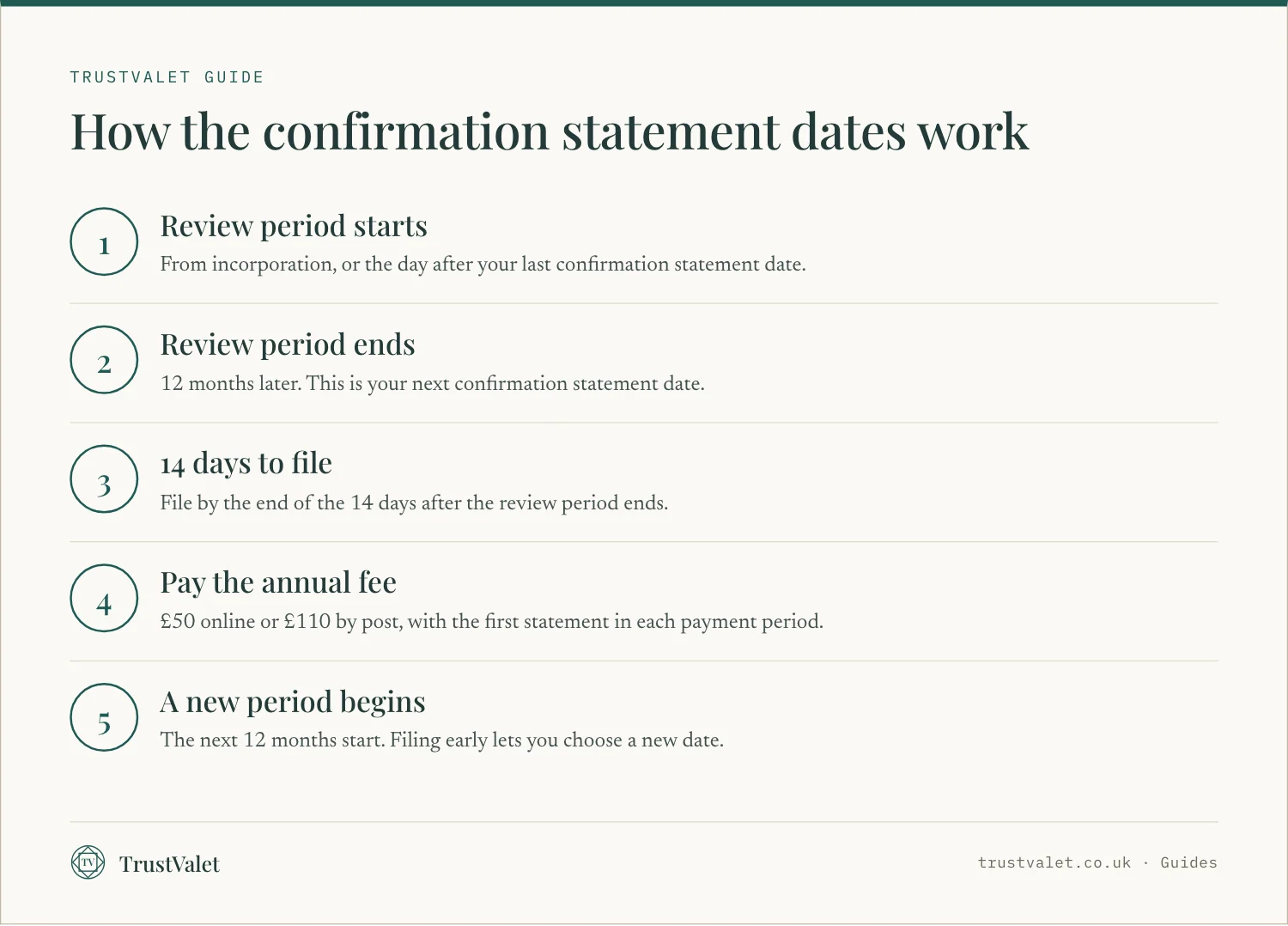
Your deadline runs from a review period. The first one ends 12 months after the date your company was incorporated. After that, each review period ends 12 months after the confirmation statement date on your last statement.
You can file up to 14 days after the review period ends. So the date shown on the register as the confirmation statement date is not the deadline: the deadline is 14 days later.
Our first-year deadlines guide works through an example. A company incorporated on 10 March 2026 has a confirmation statement date of 9 March 2027, and must file by 23 March 2027.
Filing early
You do not have to wait for the review period to end. If you file early, you choose a new confirmation statement date, and your next review period starts the day after it. Filing early is a simple way to stop the deadline creeping up on you.
Getting a reminder
You can check your confirmation date and filing deadline on the Companies House register at any time. Companies House also offers email reminders when it is time to file.
The fee
It costs £50 to file your confirmation statement online and £110 to file a paper form CS01 by post. The Companies House fees page lists the same £50 for filing through software.
The fee is tied to a payment period, which is separate from your review period. A payment period covers 12 months, starting with the date of incorporation, and you cannot change it. You pay with your first statement in each payment period. Any further statements in the same period are free.
How to file
There are three ways to file:
- Online, with the Companies House service. You need the company's password and authentication code. If you do not have them, you can register for online filing, and the code is posted to your registered office.
- Through filing software. Many accountants file this way for their clients.
- By post, on paper form CS01. This costs more and takes longer to process.
Directors must verify first
Since identity verification became compulsory, the confirmation statement is where existing directors prove it. On your next statement you give a Companies House personal code for each director and tick a statement confirming each has verified.
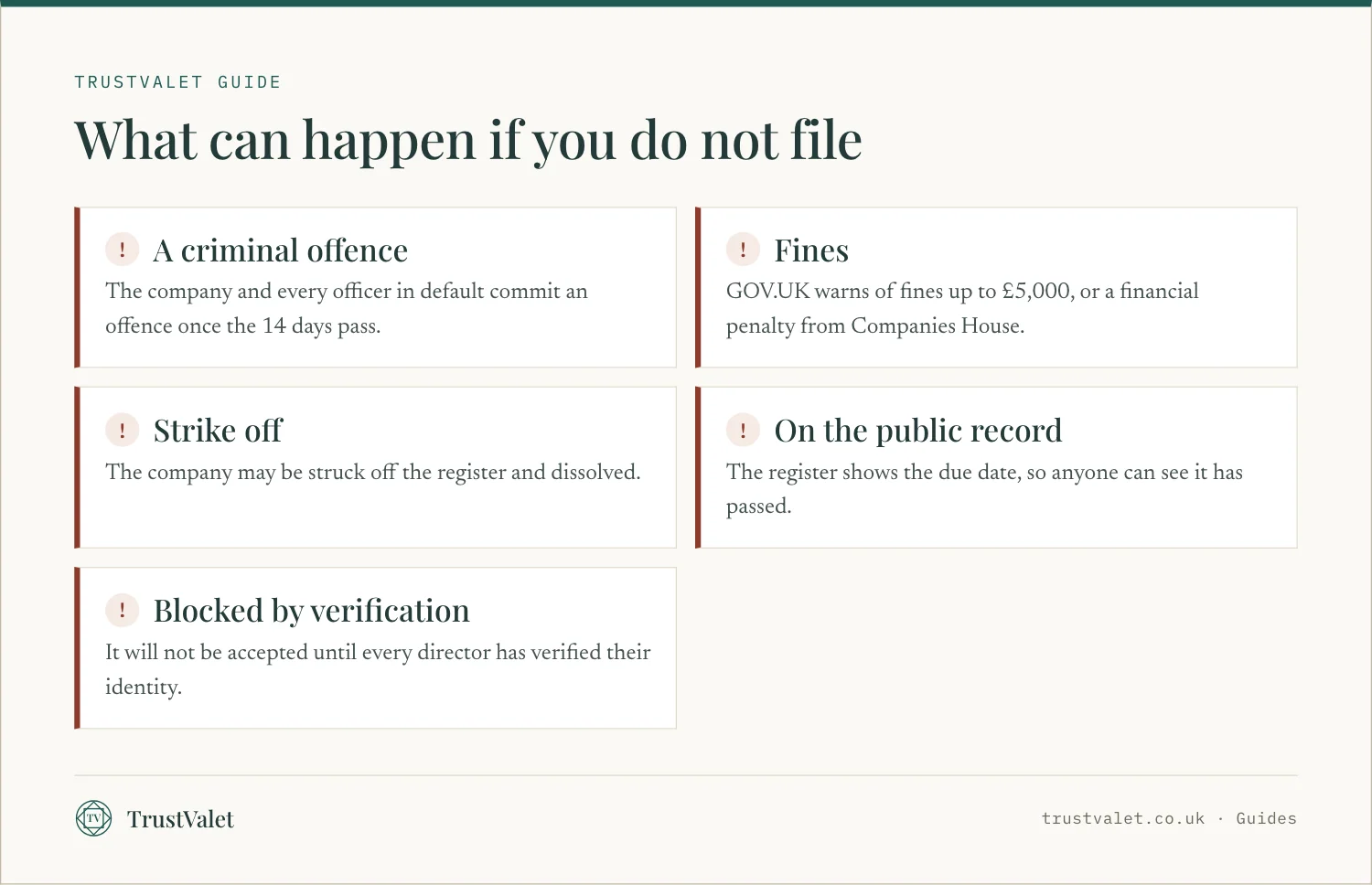
Companies House says it will not accept the confirmation statement until all directors have verified their identity. So if one director has not done it, the whole filing is stuck, and the deadline keeps running. Our guide to identity verification for directors explains how to verify for free and how the personal code works.
PSCs verify too, but they give their code through a separate PSC service, in their own 14 day window. They do not hold up the statement.
Changes: in the statement or separately
Not every change can go in the confirmation statement. Some must be reported to Companies House first, on their own form or online.
Changes you can make in the statement
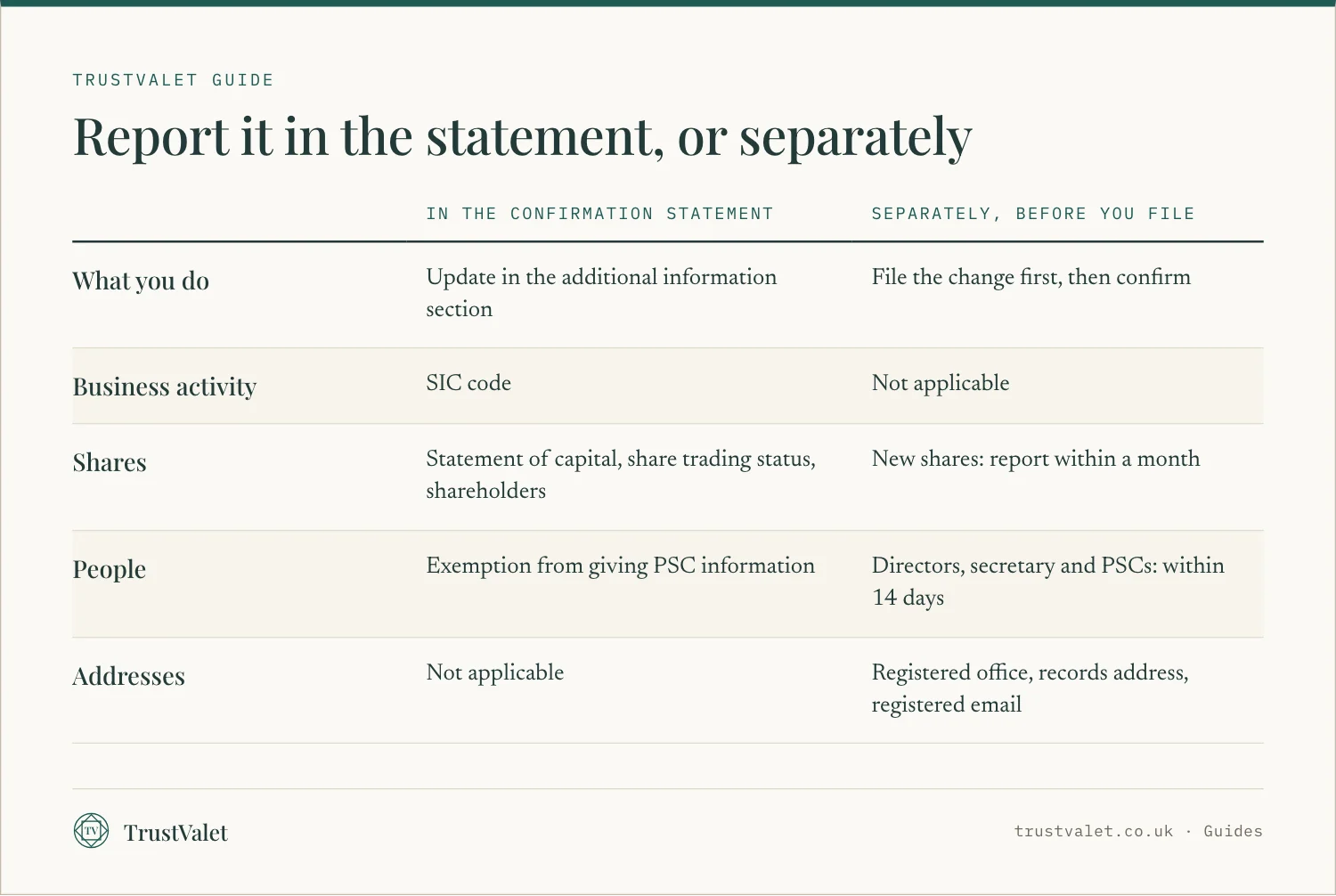
The statement has an additional information section. You can use it if there have been changes to your:
- SIC code
- statement of capital
- trading status of shares
- exemption from providing PSC information
- shareholder information
Changes you must report before you file
Before you confirm, you must tell Companies House about changes to your directors and secretary, your PSCs, your registered office address and your registered email address.
Most of these have their own deadline, whatever your confirmation date:
- Directors and secretaries: within 14 days of a change, including a director's personal details such as an address
- PSCs: within 14 days of a change
- The address where you keep your records: within 14 days
- New shares: within a month of issuing them
In other words, the confirmation statement is a yearly safety net, not a way to catch up on changes you should already have reported.
What happens if you are late
Missing the deadline is more serious than a late fee. Under section 853L of the Companies Act 2006, if a company does not deliver its statement within 14 days after the end of a review period, an offence is committed by the company and by every officer in default. The offence continues until the statement is filed.
GOV.UK warns that you can be fined up to £5,000 and your company may be struck off if you do not file. Companies House guidance also says it may issue a financial penalty.
A company that is struck off is dissolved, and it stops existing as a legal person. Our guide to what "dissolved" means explains what that does to its bank account, its contracts and anyone still trading under its name.
If you have missed it
File as soon as you can. If a director has not verified, that comes first, because the statement will not be accepted without every director's code. If you are unsure what you need to fix, an accountant or a business support adviser can help, and a solicitor can advise if strike off has already started. You can browse all of them in our professional services category.
How anyone can check a company's statement
Confirmation statement dates are public. On the Companies House register, a company's page shows its next statement date, the date it is due by and the date of its last statement. If the due date has passed, anyone can see it.
That makes it a useful check before you hire or pay a business. One overdue statement can be an honest slip. A history of late filings, or a statement overdue alongside overdue accounts, is worth asking about. Our guide on how to check if a UK company is legit shows where this fits among the other checks.
The same facts appear on TrustValet. Each company page in our register shows the confirmation statement deadline and whether it is overdue, next to the accounts deadline, with the source and the date we read it.
How TrustValet can help
TrustValet is a register built from public records. A company page shows what Companies House holds: status, incorporation date, accounts and confirmation statement deadlines and whether either is overdue, how many active directors have verified their identity, who controls the company, charges and filing history. We re-read published companies about monthly, so once you file, the overdue flag clears after our next read.
If you run a company, search for it and claim the page for free. You can add your website, phone number, description and logo.
If you want to show more, you can apply to get verified. A person checks your company against 14 public registers and your website, and you get a dated certificate and a live badge, free while you show that badge on your website, or £19 a year (£49 once for five years) without it (see pricing). How we verify lists every check. We never vet workmanship, collect reviews or rate companies.
Questions
What is a confirmation statement?
It is a yearly filing that confirms the information Companies House holds about your company is correct, including its registered office, officers, shareholders, SIC code and PSCs. Every company must file one at least once every 12 months, even if nothing has changed.
When is my confirmation statement due?
Your review period ends 12 months after incorporation, or after the confirmation statement date on your last statement. You then have 14 days to file. The register shows both dates for every company.
How much is the confirmation statement fee?
£50 to file online or through software, and £110 to file paper form CS01 by post. You pay once in each 12 month payment period, with the first statement you file in it.
What happens if my confirmation statement is overdue?
The company and every officer in default commit an offence. GOV.UK warns of fines up to £5,000, and the company may be struck off the register. File as soon as you can.
Why can I not file my confirmation statement?
Often because a director has not verified their identity. Companies House will not accept the statement until every director has verified and their personal code is included.
Check the company first
Before you pay anyone, look the company up. Every page in the register shows what Companies House says, with the date we read it.
Ala Ciobanu · Ala Ciobanu edits the TrustValet guides. Every guide names its sources.
- Filing your company's confirmation statement (Companies House)
- Running a limited company: confirmation statement (GOV.UK)
- Running a limited company: company information you must report (GOV.UK)
- File your confirmation statement with Companies House (GOV.UK)
- Companies House fees (GOV.UK)
- When you need to verify your identity for Companies House (GOV.UK)
- Companies Act 2006, section 853L (legislation.gov.uk)