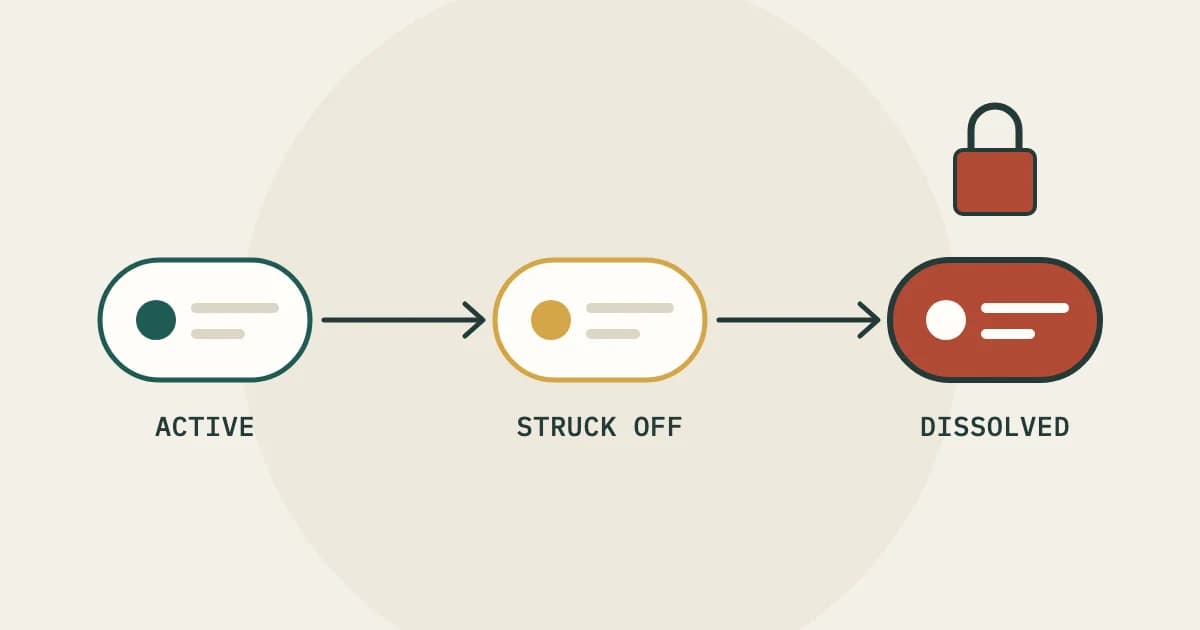
A dissolved company is one that has been struck off the Companies House register and no longer exists as a legal entity. It cannot trade, sign contracts, hold a bank account or own property. Whatever it still owned passes to the Crown. Anyone trading under a dissolved company's name is not that company. A dissolved company can sometimes be restored to the register, usually within six years.
This guide explains how a company ends up dissolved, what happens to its assets, whether it can come back, and what to do if it owes you money. For a wider set of checks before you pay any business, see how to check if a UK company is legit.
Active, dissolved and the statuses in between
Every company on the register has a status. The one you want to see before you do business is Active, which means the company exists and is on the register.
Dissolved means the company has been removed and has ended. Between the two, you may see statuses such as Liquidation, where the company is being wound up, or In Administration. A company can also show as Active with a proposal to strike off, which means the process of removing it has started.
A company in liquidation still exists. It becomes dissolved only when the process ends. You can check any company's current status in our register, or browse the A to Z of companies.
How a company becomes dissolved
There are three common routes.
Voluntary strike-off
The directors can close a company by asking Companies House to strike it off. This is also known as dissolving the company. GOV.UK says a company can only be struck off this way if, among other conditions, it has not traded or sold off any stock in the last three months and is not threatened with liquidation.
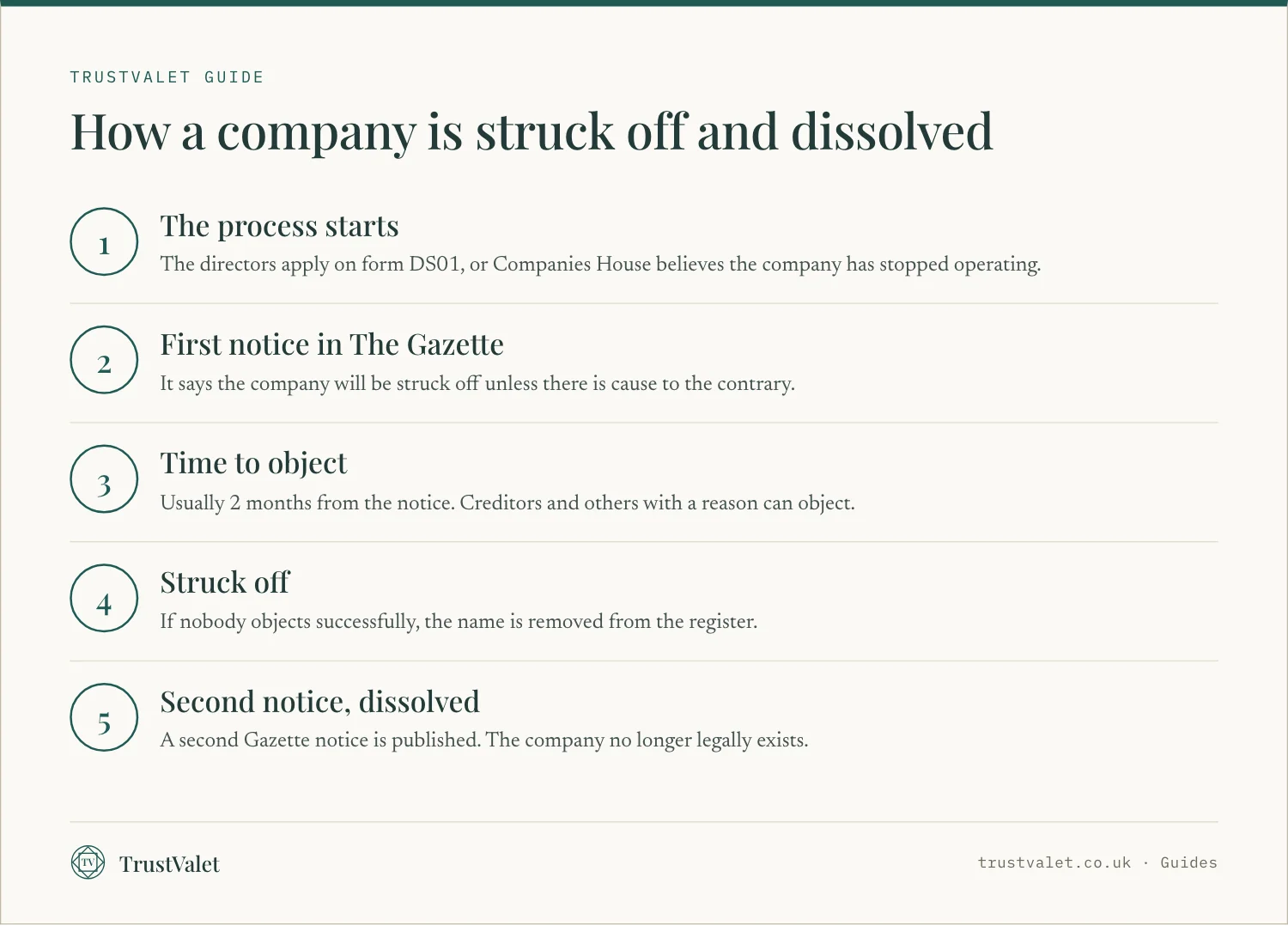
The directors send form DS01, signed by a majority of them. Companies House publishes a notice in The Gazette. If nobody objects, the company is struck off once the two months in the notice have passed. A second notice then appears in The Gazette, and the company no longer legally exists.
Compulsory strike-off by Companies House
Companies House can also start the process itself. Under the Companies Act 2006, if the registrar has reasonable cause to believe a company is not carrying on business or in operation, it writes to the company to ask. If there is no answer, or the answer is that the company has stopped, the registrar can publish a notice in The Gazette. That notice says the company will be struck off and dissolved at the end of two months unless cause is shown to the contrary.
At the end of that period the registrar can strike the company off and publish a second notice. The company is dissolved when that notice is published.
After liquidation
A company that is wound up is dissolved at the end of the liquidation. In a voluntary winding up, the liquidator sends a final account to Companies House. Under the Insolvency Act 1986, the company is deemed dissolved three months after that account is registered, unless a court defers the date.
The notices in The Gazette
The Gazette is the official public record, and strike-off notices are published there. The first notice is your warning: the company is on its way off the register. The second confirms that it has gone.
The Gazette also publishes insolvency notices, such as winding-up petitions and the appointment of liquidators. If you are owed money, searching it by company name and number is one of the most useful things you can do.
What happens to the company's assets
When a company is dissolved, its property and rights become bona vacantia, which means ownerless goods. Under the Companies Act 2006 they belong to the Crown, or to the Duchy of Lancaster or the Duke of Cornwall, depending on where the company was based.
GOV.UK spells out what this means in practice. The company loses access to its bank accounts, and any balance, together with payments it receives later, such as refunds from HMRC, passes to the Crown. That is why directors are told to deal with the assets before they apply to strike off.
Can a dissolved company still trade?
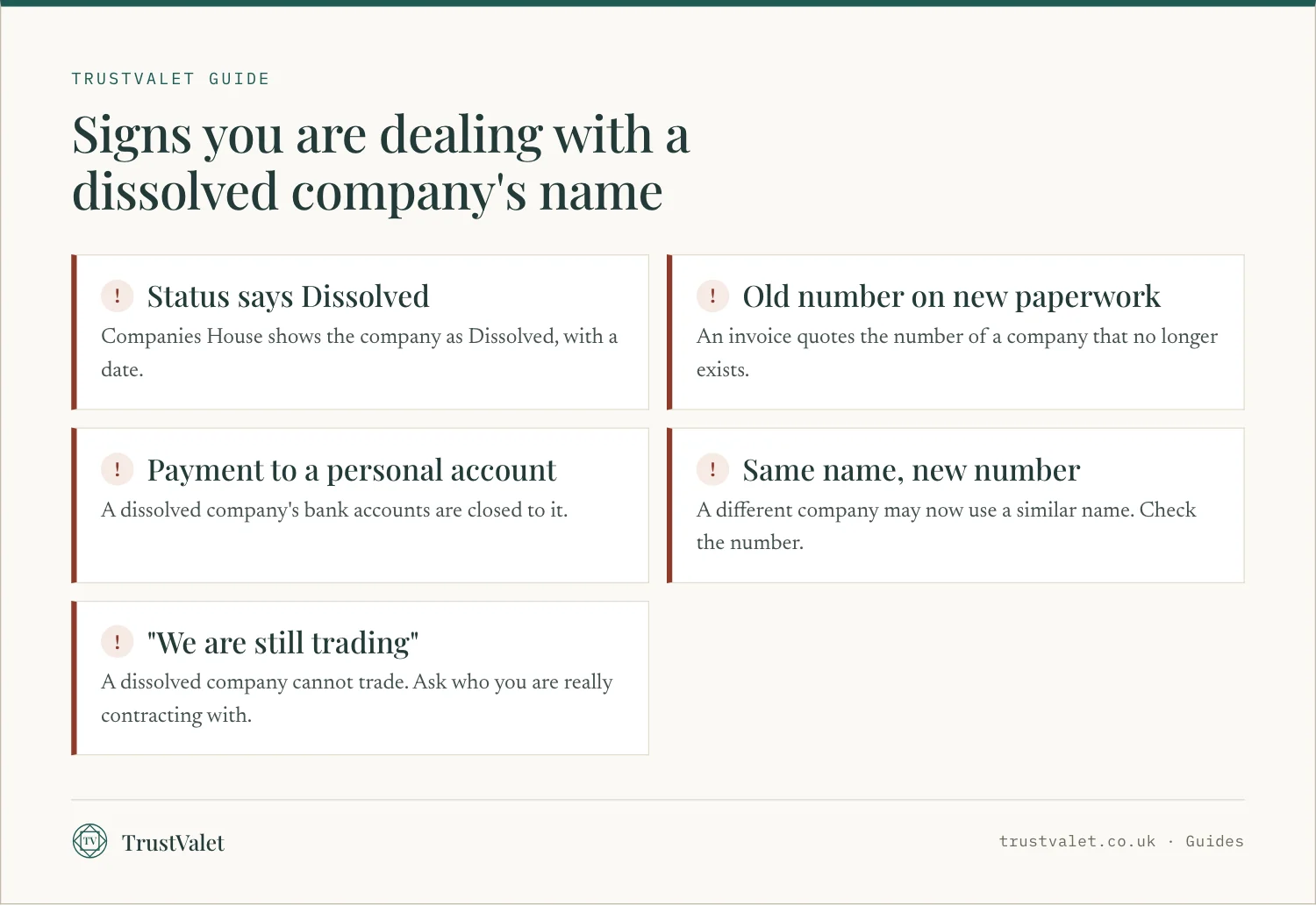
No. A dissolved company does not legally exist, so it cannot trade, make contracts, send invoices or take payments. The voluntary strike-off rules even require directors to withdraw their application if the company is trading.
So if someone is still using a dissolved company's name, the company is not the one doing business with you. You are dealing with a person, or with some other business, and you need to know which. Check the company number on any quote or invoice, not only the name. A new company may have been set up under a similar name, with a different number.
A dissolved status is also a common warning sign for trades. Our guide on how to avoid cowboy builders covers the others.
Can a dissolved company be restored?
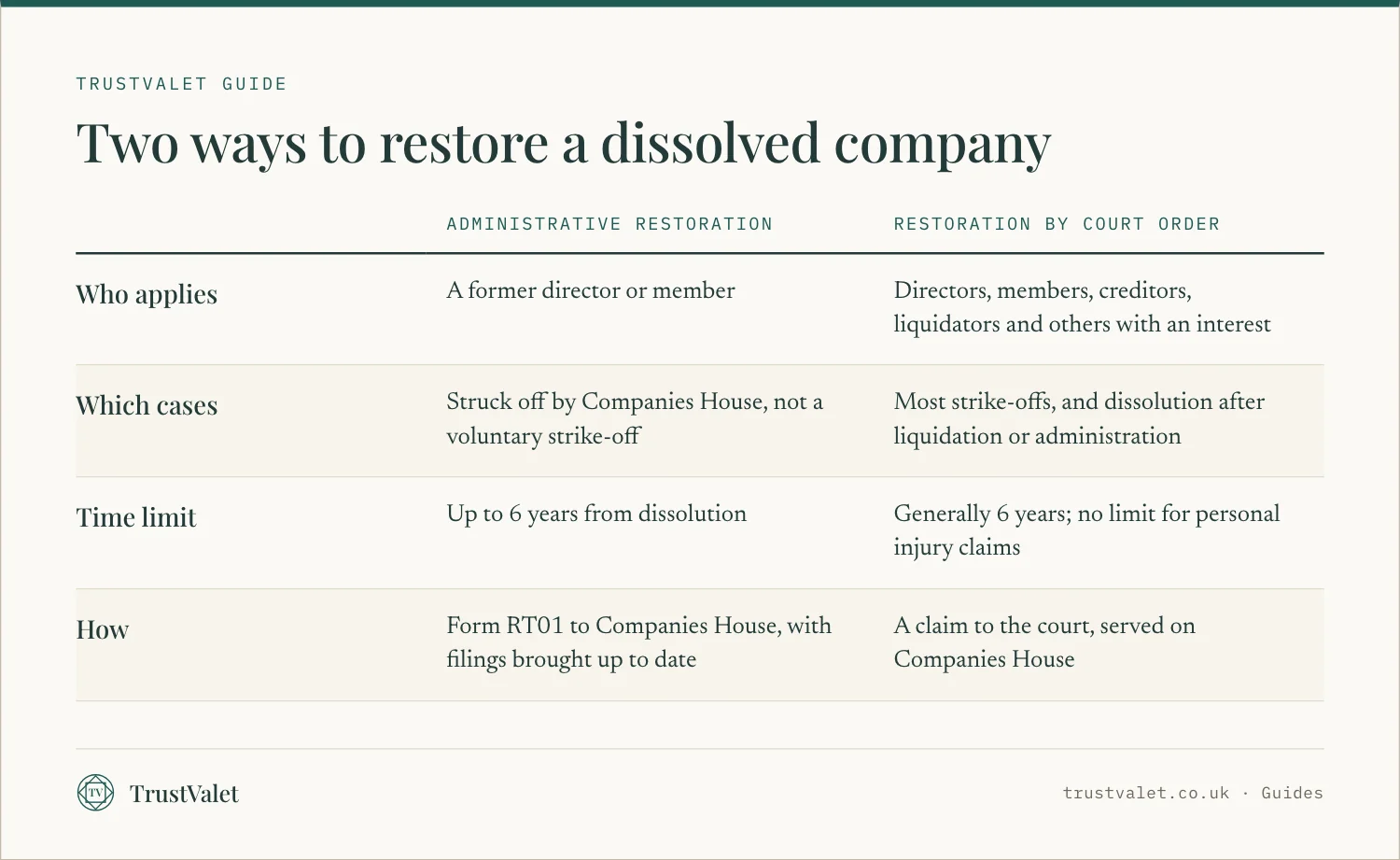
Yes, in some cases. Once restored, the company is treated as if it had continued in existence and had never been struck off. There are two routes.
Administrative restoration
A former director or member can apply to Companies House on form RT01. This route is only open if Companies House struck the company off, for example as a defunct company that was in fact still carrying on business. It is not available if the directors applied to strike it off voluntarily.
The application must be made within six years of dissolution. Before applying, the company's filings must be brought up to date, outstanding penalties paid and, if needed, a bona vacantia waiver obtained.
Restoration by court order
A wider group can apply to the court, including former directors, members, creditors and liquidators, anyone who had a contract with the company and anyone with a potential legal claim against it. This route also covers voluntary strike-offs and companies dissolved after liquidation or administration.
You can generally apply within six years of dissolution. If the application relates to a personal injury claim, there is no time limit. Court restoration involves legal steps and costs, so many people take advice from a solicitor first.
If a dissolved company owes you money or has a contract with you
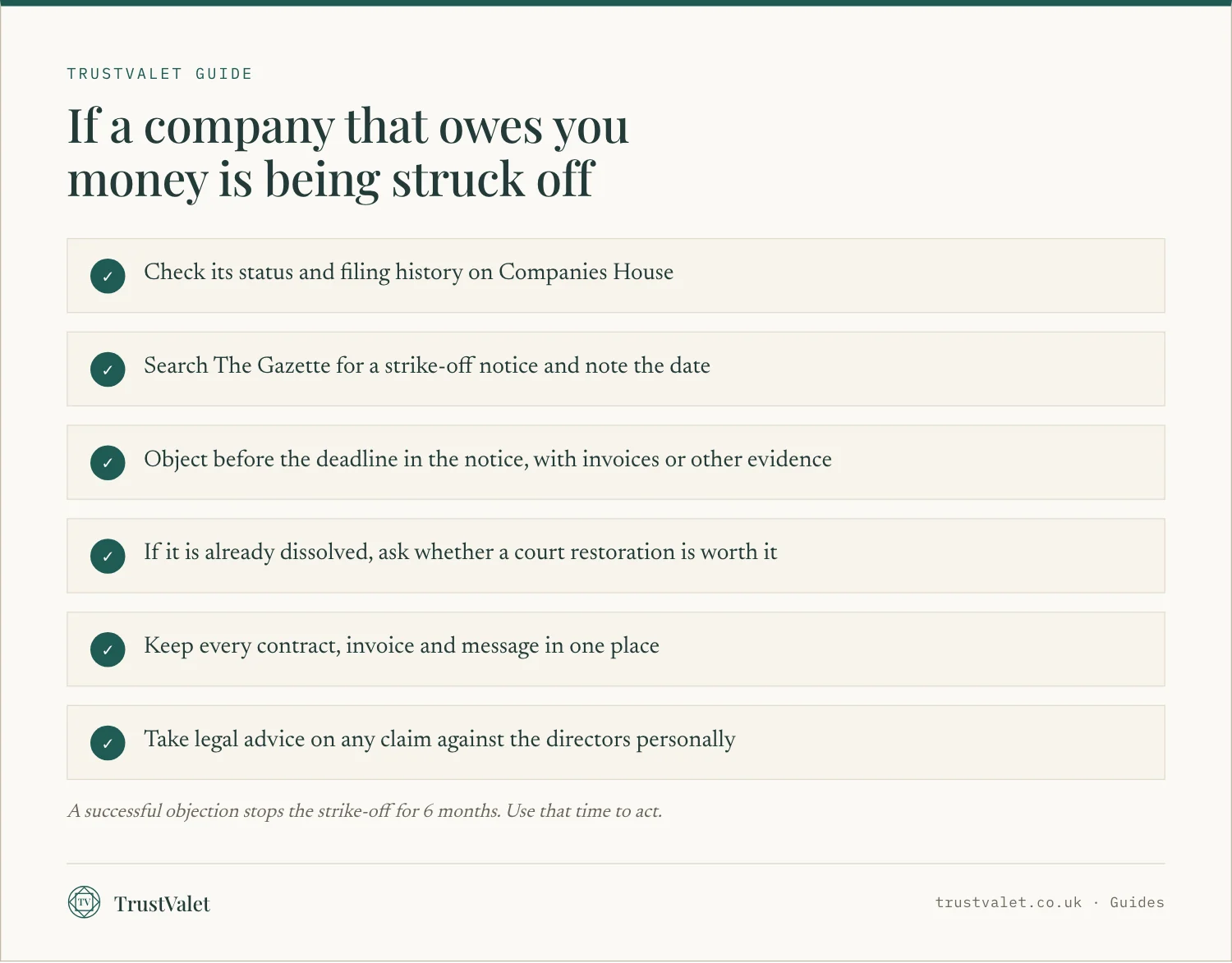
If the company has not been struck off yet, act quickly. GOV.UK says a creditor can object after the strike-off notice appears in The Gazette, with evidence such as invoices. The notice gives the deadline, which is either two months or 28 days from its date. If the objection succeeds, the company will not be struck off for another six months. From 1 December 2026, Companies House will accept objections only through its online service.
If the company has already been dissolved, a creditor can apply to the court to restore it within the time limit, and then pursue the claim against the restored company. Whether that is worth the cost depends on the amount and on what the company holds.
When Companies House strikes a company off, the law says any existing liability of its directors, managing officers and members continues as if the company had not been dissolved. Whether anyone is personally liable to you depends on the facts, so take legal advice before you spend money on a claim.
A contract with a dissolved company cannot be performed by it. If you are paying for work under such a contract, stop and find out who is actually doing the work and who you would claim against.
How to check a company's status
Search the company on Companies House and read the status at the top of its page, with the date of incorporation and, if dissolved, the date it ended. Then look at the filing history for recent strike-off activity, and search The Gazette by name and number.
Newly formed companies deserve a look too: you can browse new companies on TrustValet. The director identity rules are covered in our guide to Companies House identity verification.
How TrustValet can help
TrustValet is a register built from public records. Each company page shows its Companies House status, incorporation date, accounts and confirmation statement deadlines and whether they are overdue, who controls it and its filing history. Every fact carries its source and the date we read it, and published companies are re-read about monthly, so a change to Dissolved shows up there too. Our sources page explains where each fact comes from.
Companies can also choose to be verified: 14 checks against public registers, including Companies House status, overdue filings and strike-off action, and The Gazette insolvency notices, all decided by a person. How we verify describes each check, and anyone can check a certificate. Verification does not vet workmanship, reviews or ratings, and a listed company is not an endorsed company. If a page looks wrong, please report it.
Questions
What does dissolved mean for a UK company?
It means the company has been struck off the Companies House register and no longer exists as a legal entity. It cannot trade, and its remaining property and rights pass to the Crown as bona vacantia.
Can a dissolved company still trade?
No. A dissolved company does not legally exist, so it cannot trade, make contracts or take payments. Anyone trading under its name is a person or another business, not the dissolved company.
Can a dissolved company be restored?
Yes, in some cases. A former director or member can apply to Companies House for administrative restoration within 6 years if Companies House struck it off. Others, including creditors, can apply to the court, generally within 6 years.
What happens to a dissolved company's money?
Its property and rights become bona vacantia and pass to the Crown, or to the Duchy of Lancaster or Duke of Cornwall. That includes bank balances and payments received later, such as HMRC refunds.
A company that owes me money is being struck off. What can I do?
Object to Companies House after the strike-off notice appears in The Gazette and before its deadline, with evidence such as invoices. A successful objection delays the strike-off for 6 months. If it is already dissolved, you may be able to apply to the court to restore it.
Check the company first
Before you pay anyone, look the company up. Every page in the register shows what Companies House says, with the date we read it.
Ala Ciobanu · Ala Ciobanu edits the TrustValet guides. Every guide names its sources.
- Strike off your limited company from the Companies Register (GOV.UK)
- Object to a limited company being struck off (GOV.UK)
- Restoring a company to the Companies House register (GOV.UK)
- Company Restoration Guide, Government Legal Department (GOV.UK)
- Companies Act 2006, section 1000 (legislation.gov.uk)
- Companies Act 2006, section 1012 (legislation.gov.uk)
- Insolvency Act 1986, section 201 (legislation.gov.uk)
- Objections to company strike off to be submitted online only from 1 December 2026 (GOV.UK)