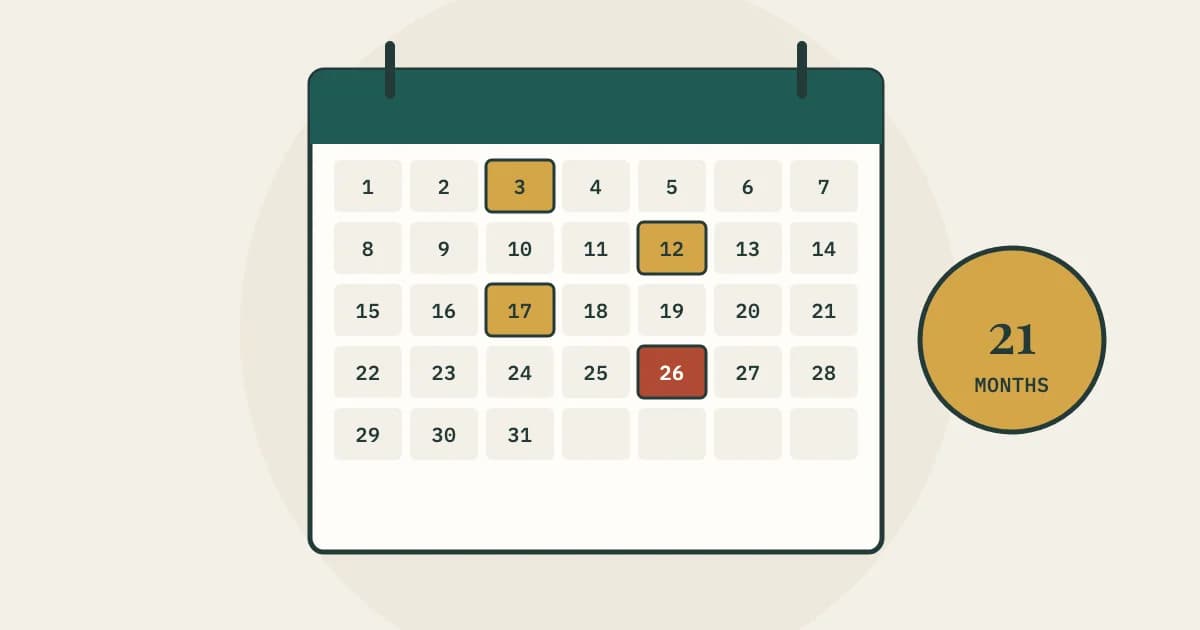
In short: a new private limited company files its first confirmation statement within 14 days after the first anniversary of incorporation, and its first accounts within 21 months of incorporation. It must tell HMRC within 3 months of starting to do business, pay Corporation Tax 9 months and 1 day after each accounting period ends, and file each Company Tax Return within 12 months. VAT and PAYE registration depend on your turnover and on whether you pay anyone.
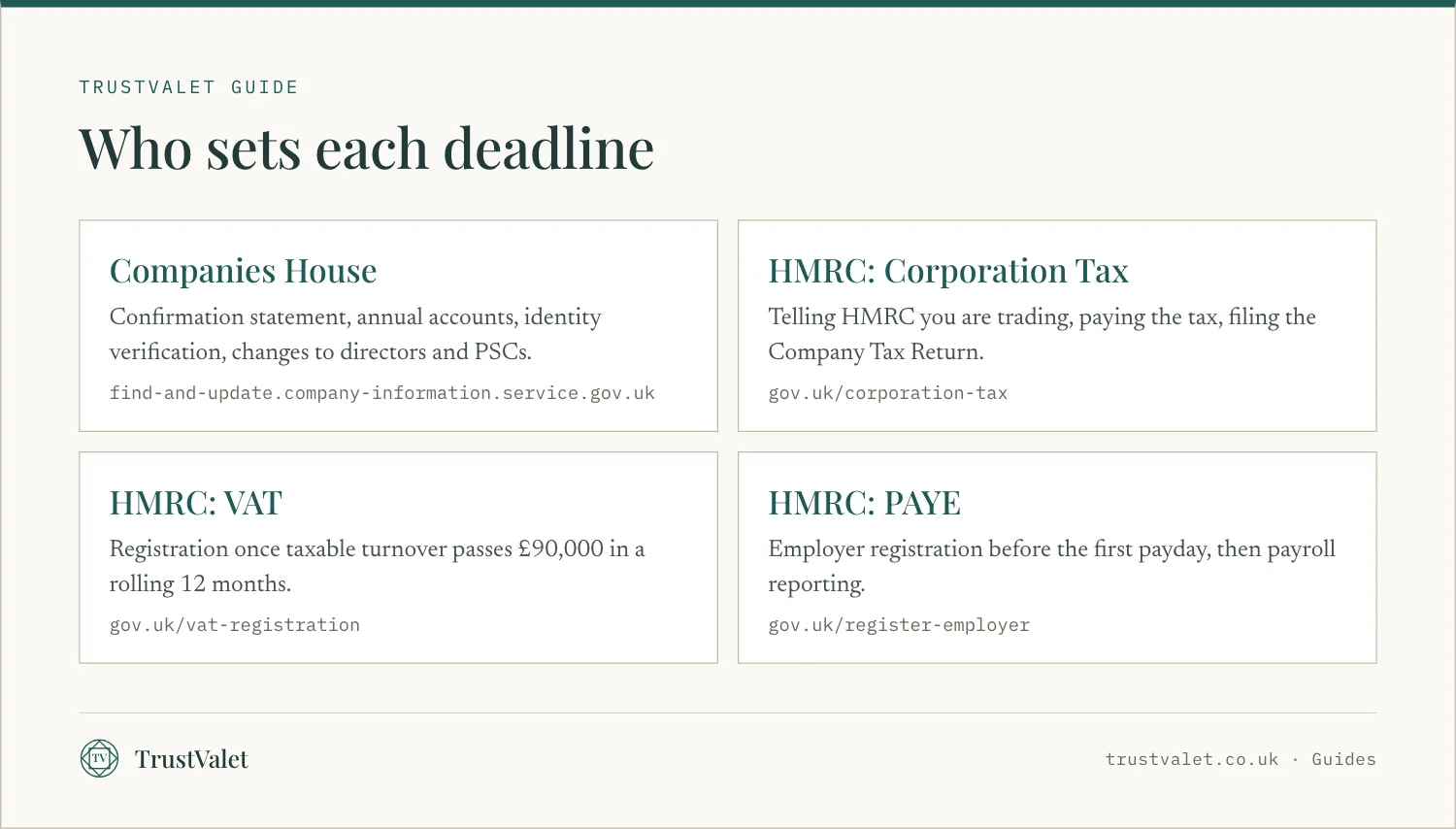
The deadlines come from two bodies, Companies House and HMRC, and each keeps its own clock. This guide takes them one at a time, then puts them in a single worked calendar for a company incorporated on 10 March 2026.
Companies House deadlines
Companies House holds the public record of your company. Its deadlines are shown on your company's page on the register, so you can always check them there.
Directors' identity verification
Since 18 November 2025, every director of a new company must verify their identity before the company is registered. Each director's personal code goes into the registration filing. People with significant control (PSCs) verify too, and give their code when they are added to the register or within 14 days.
Our guide to Companies House identity verification for directors explains how to verify for free and what the personal code is for.
Your first confirmation statement
The confirmation statement confirms that the information Companies House holds about your company is correct. That covers the registered office, directors, shareholders, SIC code and PSCs.
Your first review period ends 12 months after incorporation. You then have 14 days to file. On the register, a company incorporated on 10 March 2026 shows a confirmation statement date of 9 March 2027, due by 23 March 2027.
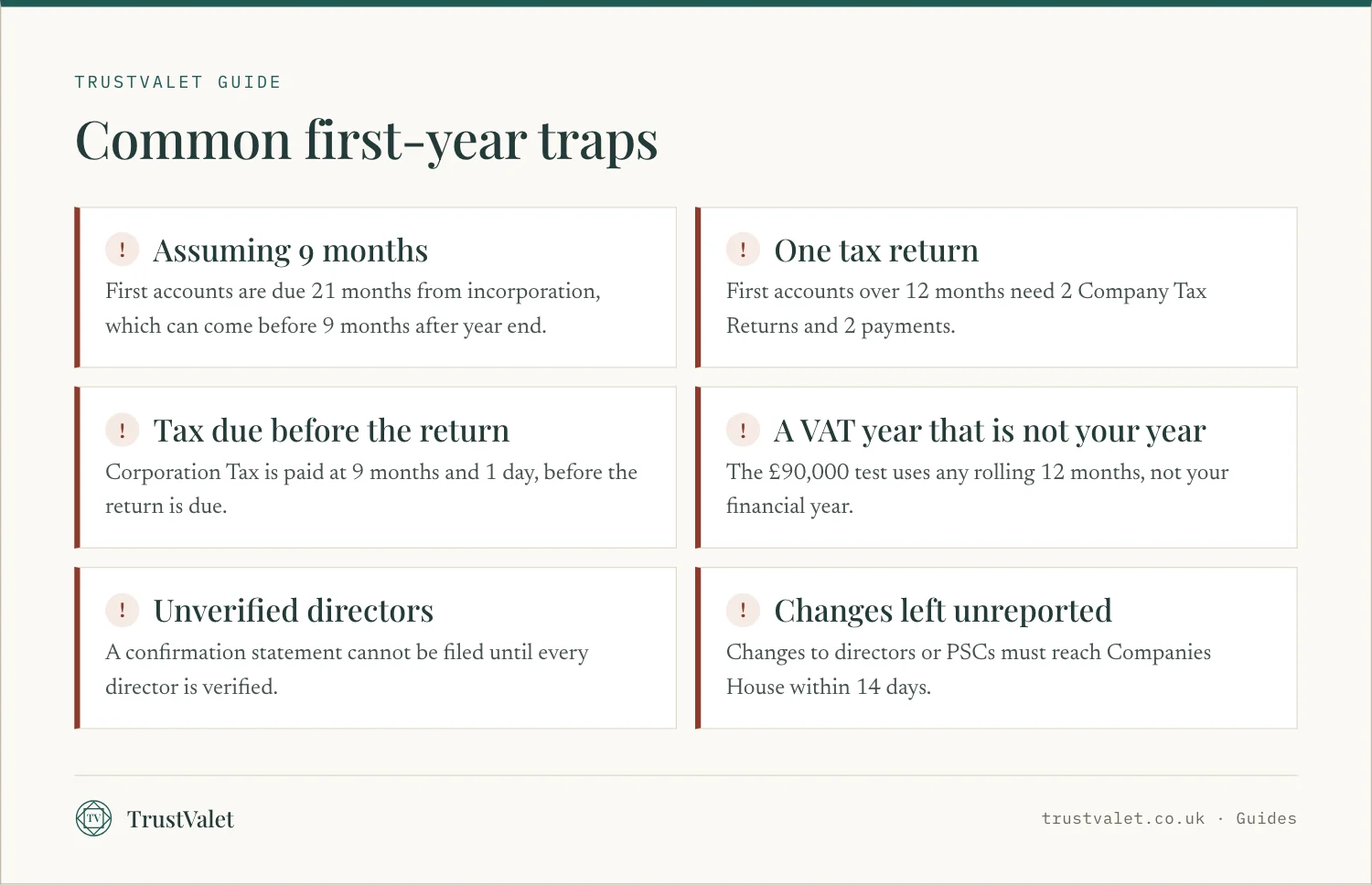
It costs £50 to file online and £110 by post. The company cannot file it unless all its directors have verified their identity. Not filing can lead to a fine of up to £5,000 and the company being struck off.
Your accounting reference date
Companies House sets your company's year end automatically. Your first accounting reference date is the last day of the month in which the first anniversary of incorporation falls. Every later year ends on the same date.
That means your first accounts usually cover more than 12 months. A company incorporated on 10 March 2026 has an accounting reference date of 31 March, so its first accounts run from 10 March 2026 to 31 March 2027.
You can change the date by shortening or extending the period, within limits. Talk to your accountant before you do, because it moves every deadline that follows.
Your first accounts
A private company must file its first accounts within 21 months of incorporation. After that, accounts are due 9 months after each financial year ends.
The first deadline is easy to misjudge. For our example company, 21 months from 10 March 2026 is 10 December 2027, three weeks earlier than 9 months after its year end. Your directors must approve the accounts before they are filed.
HMRC deadlines
HMRC deals with the tax side. Its dates run from your accounting period for Corporation Tax, which is not always the same as your financial year.
Telling HMRC you have started
Your company must tell HMRC when it comes within the charge to Corporation Tax, no later than 3 months after its first accounting period begins. That period starts on the day the company starts to do business, which includes buying, selling, advertising, renting a property or employing someone.
You do this by adding Corporation Tax services to your business tax account, if you did not set it up when you registered the company. You will need the company number, the date you started to do business and the company's 10-digit Unique Taxpayer Reference.
Two tax periods in year one
An accounting period for Corporation Tax cannot be longer than 12 months. If your first accounts cover more than 12 months, you file 2 Company Tax Returns: one for the first 12 months and one for the rest. Each has its own payment date.
Paying Corporation Tax
Corporation Tax is due 9 months and 1 day after the end of each accounting period. You do not get a bill. If the company owes nothing, you still need to tell HMRC.
The Company Tax Return
The Company Tax Return, form CT600, is due 12 months after the end of the accounting period it covers. When the first accounts run for more than 12 months, the law also allows 12 months from the end of the accounts period, whichever is later. You must file a return even if the company made a loss.
VAT: once turnover passes £90,000
VAT registration is not tied to a date. It depends on your taxable turnover. You must register if:
- your taxable turnover for the last 12 months goes over £90,000, or
- you expect it to go over £90,000 in the next 30 days
The 12 months are rolling, so check the total at the end of every month. If you pass the threshold, you must register within 30 days of the end of that month.
You can register voluntarily below the threshold, for example to reclaim VAT on business costs. An accountant can tell you whether that makes sense for you.
PAYE: before anyone is paid
If your company will pay anyone a salary, it must register as an employer with HMRC before the first payday. GOV.UK says this applies even if the only employee is you, as the sole director. You cannot register more than 2 months before you start paying people.
Keeping records and your PSC details up to date
Deadlines are only half the job. A company also has to keep records and report changes as they happen.
PSC and director details
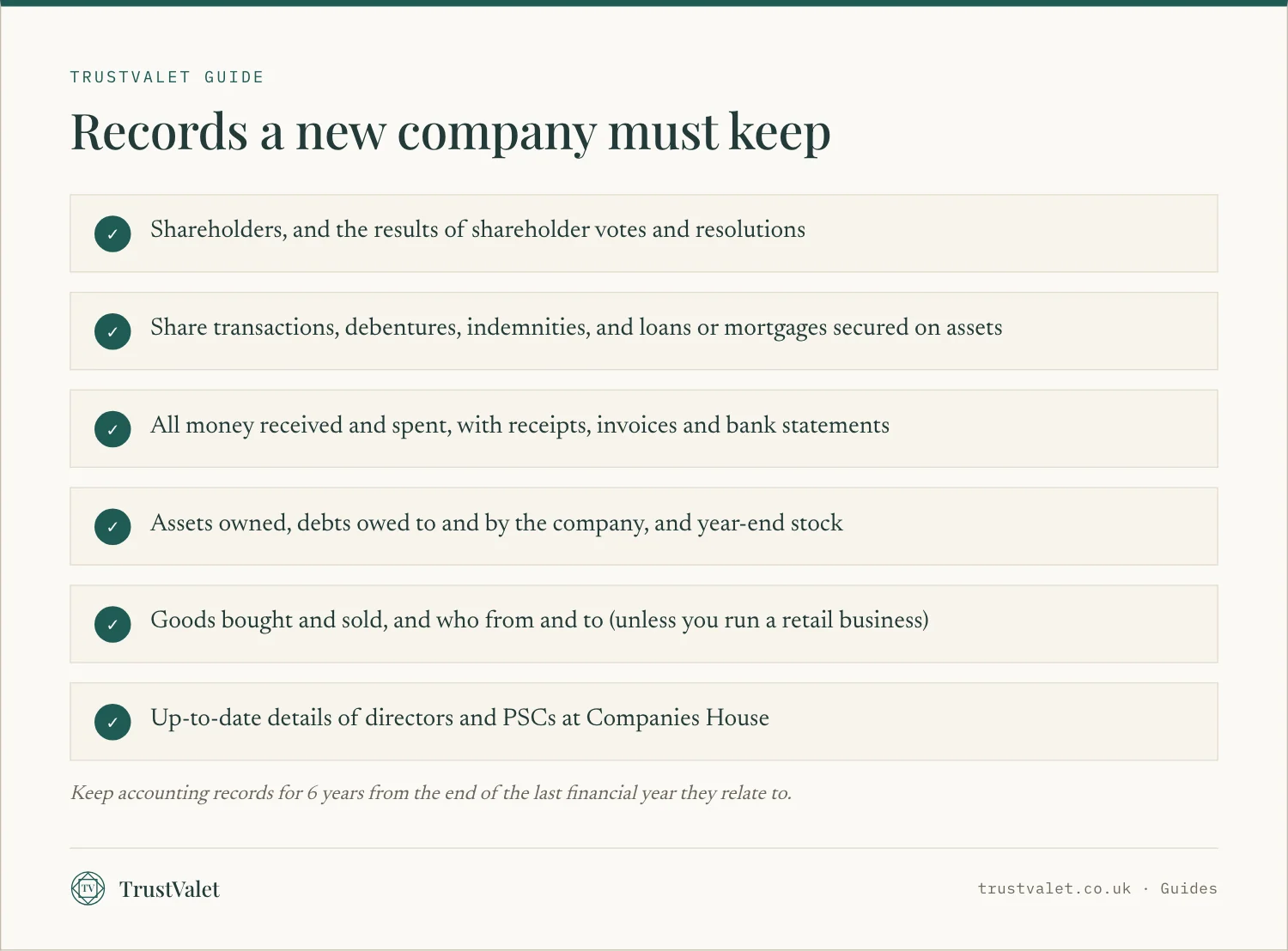
Your PSC details go to Companies House when the company is set up. After that, you must tell Companies House within 14 days of any change to your PSCs, such as a new shareholder with more than 25%, or a change of address. The same 14 days apply to changes to directors.
Company and accounting records
You must keep records about the company itself, such as shareholders and resolutions, and full accounting records. If you keep them anywhere other than the registered office, you must tell Companies House.
Accounting records must be kept for 6 years from the end of the last financial year they relate to. HMRC can fine a company £3,000, or a director can be disqualified, for not keeping them.
A worked calendar
Here is how the dates fall for a company incorporated on 10 March 2026 that starts trading the same day, with no change to its year end. The dates for the confirmation statement and first accounts match what the Companies House register shows for companies incorporated that day.
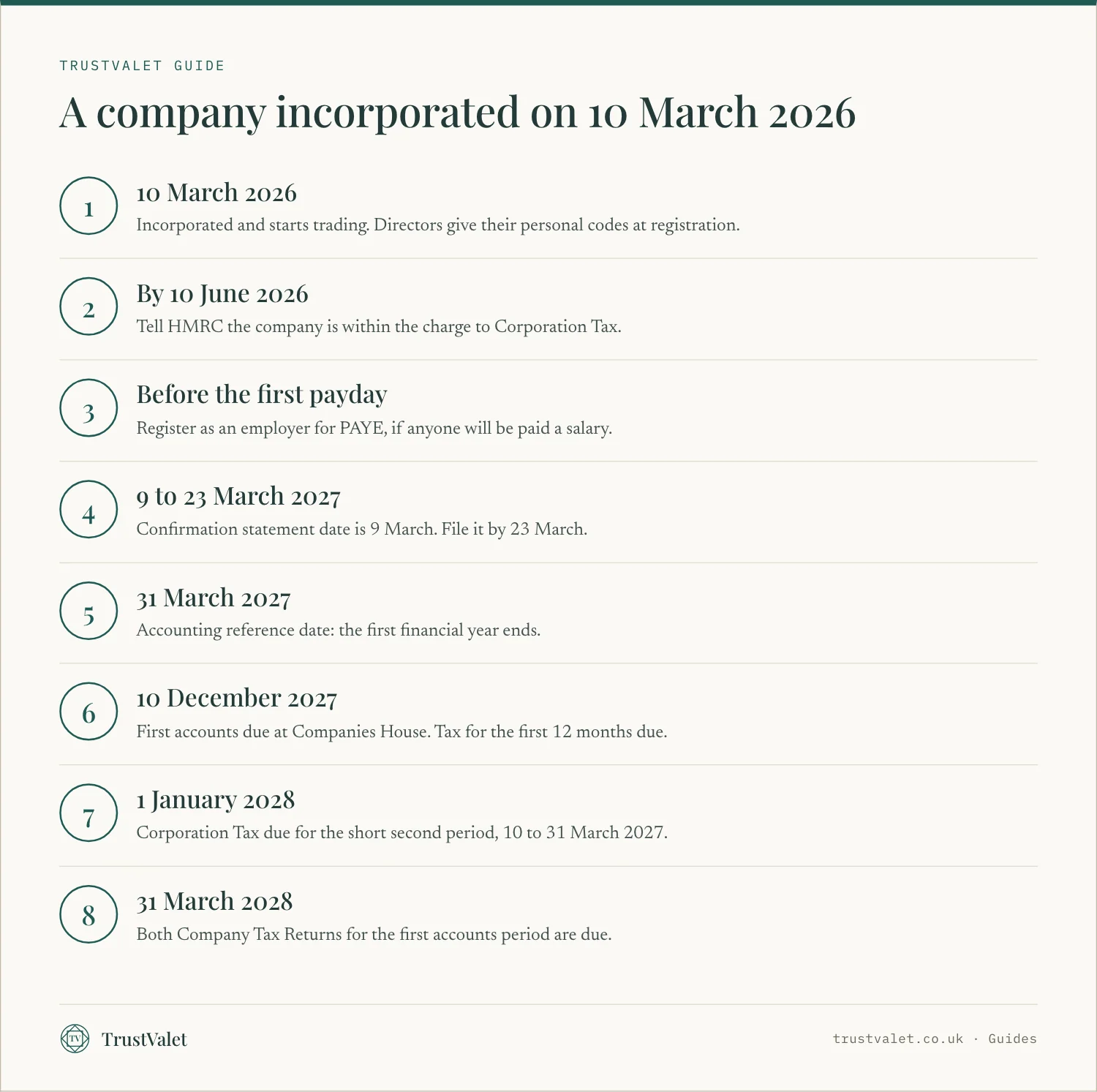
Two dates land on 10 December 2027: the first accounts, and Corporation Tax for the first 12 months (10 March 2026 to 9 March 2027). The short second period, 10 to 31 March 2027, has its tax due on 1 January 2028. Both Company Tax Returns are due by 31 March 2028.
In year two, things get simpler. The confirmation statement comes round each March, the accounts are due by 31 December, and there is usually one tax return a year.
Getting help
You stay legally responsible for your company's filings, even if someone else does them. Many new companies hand the accounts and tax return to an accountant, and use a solicitor or business support adviser for questions about shares and control. You can browse them in our professional services category, or by city, for example accountants in London.
How TrustValet can help
TrustValet is a register built from public records. Your company may already have a page in our register. Each page shows what Companies House holds: status, incorporation date, your accounts and confirmation statement deadlines and whether either is overdue, how many active directors have verified their identity, and who controls the company. Each fact shows its source and the date we read it, and we re-read published companies about monthly, so a late filing shows up and so does the fix.
Search for your company and claim the page for free. You can add your website, phone number, description and logo, so customers who check you find a real business behind the number.
When you are ready, you can apply to get verified. A person checks your company against 14 public registers and your website, and you get a dated certificate and a live badge, free while you show that badge on your website, or £19 a year (£49 once for five years) without it (see pricing). How we verify lists every check. We never vet workmanship, collect reviews or rate companies.
Questions
When are a new limited company's first accounts due?
A private limited company must file its first accounts with Companies House within 21 months of the date it was incorporated. After that, accounts are due 9 months after the end of each financial year.
When is the first confirmation statement due?
The first review period ends 12 months after incorporation, and you have 14 days after that to file. It costs £50 online or £110 by post, and every director must have verified their identity first.
Do I need to file two Company Tax Returns in my first year?
Often, yes. A Corporation Tax accounting period cannot be longer than 12 months, so if your first accounts cover more than 12 months you file two returns, each with its own payment date.
When must a new company register for VAT?
When taxable turnover for the last 12 months goes over £90,000, or you expect it to go over £90,000 in the next 30 days. You must register within 30 days of the end of the month you went over.
When do I have to tell HMRC about Corporation Tax?
No later than 3 months after the company's first accounting period begins, which is when it starts to do business. You do this by adding Corporation Tax services to your business tax account.
Check the company first
Before you pay anyone, look the company up. Every page in the register shows what Companies House says, with the date we read it.
Ala Ciobanu · Ala Ciobanu edits the TrustValet guides. Every guide names its sources.
- Accounts and tax returns for private limited companies (GOV.UK)
- Life of a company: annual requirements, part 1 accounts (Companies House)
- Running a limited company: confirmation statement (GOV.UK)
- Your limited company's first accounts and Company Tax Return (GOV.UK)
- Add Corporation Tax services to your business tax account (GOV.UK)
- Finance Act 2004, section 55 (legislation.gov.uk)
- VAT registration: when to register (GOV.UK)
- Register as an employer (GOV.UK)