Most people who need a plumber, roofer or decorator either search a trade platform such as Checkatrade or find someone directly, through a recommendation, a local search or a van they saw down the road. Both routes produce good trades and bad ones. The useful question is not which one is cheaper, but what each route does for you, what it leaves to you, and which checks you still need to make.
This guide explains how trade platforms generally work, using what the platforms publish about themselves, then how hiring direct works, and finally the checks that matter whichever route you take. It applies to any trade, from builders and electricians to plumbing and heating engineers.
How trade platforms work
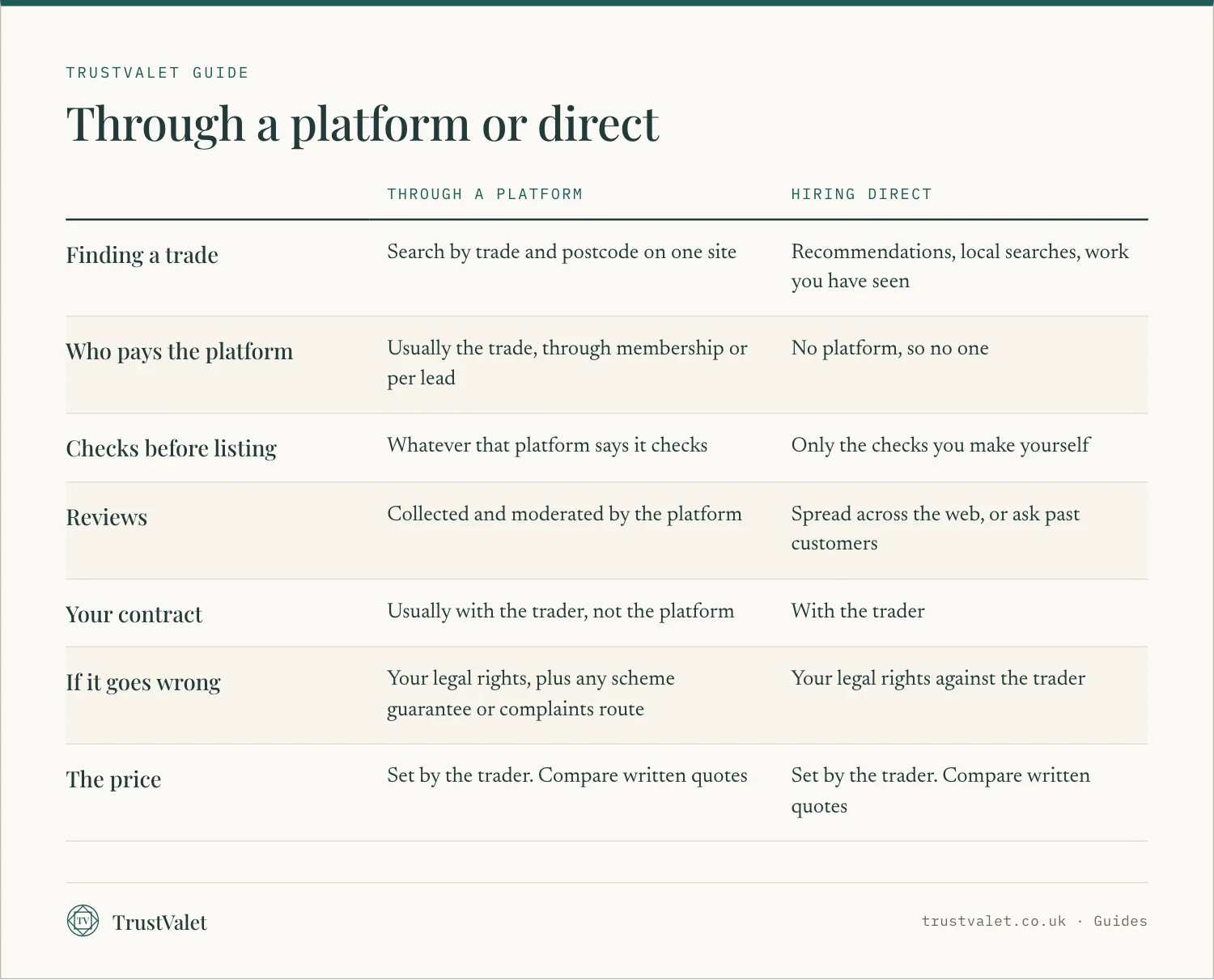
"Trade platform" covers several different kinds of service. They share a website where you search by trade and postcode, but they differ in who pays, what they check and what they offer if a job goes wrong.
Who pays
For homeowners, searching the main platforms is generally free. The platform earns its money from trades. Some charge a membership fee, some charge for each lead or customer enquiry, and some do both. Which? Trusted Traders, for example, says that traders who pass its assessment agree to its code of conduct and pay membership fees, while the service is free for the public.
A membership fee is a business cost, like advertising or a van. Whether any of it reaches your quote depends on the trader, and there is no reliable way to tell from the outside. What you can compare is written quotes from several trades for the same job.
What they say they check
This is where platforms differ most, and where a badge can mean very different things.
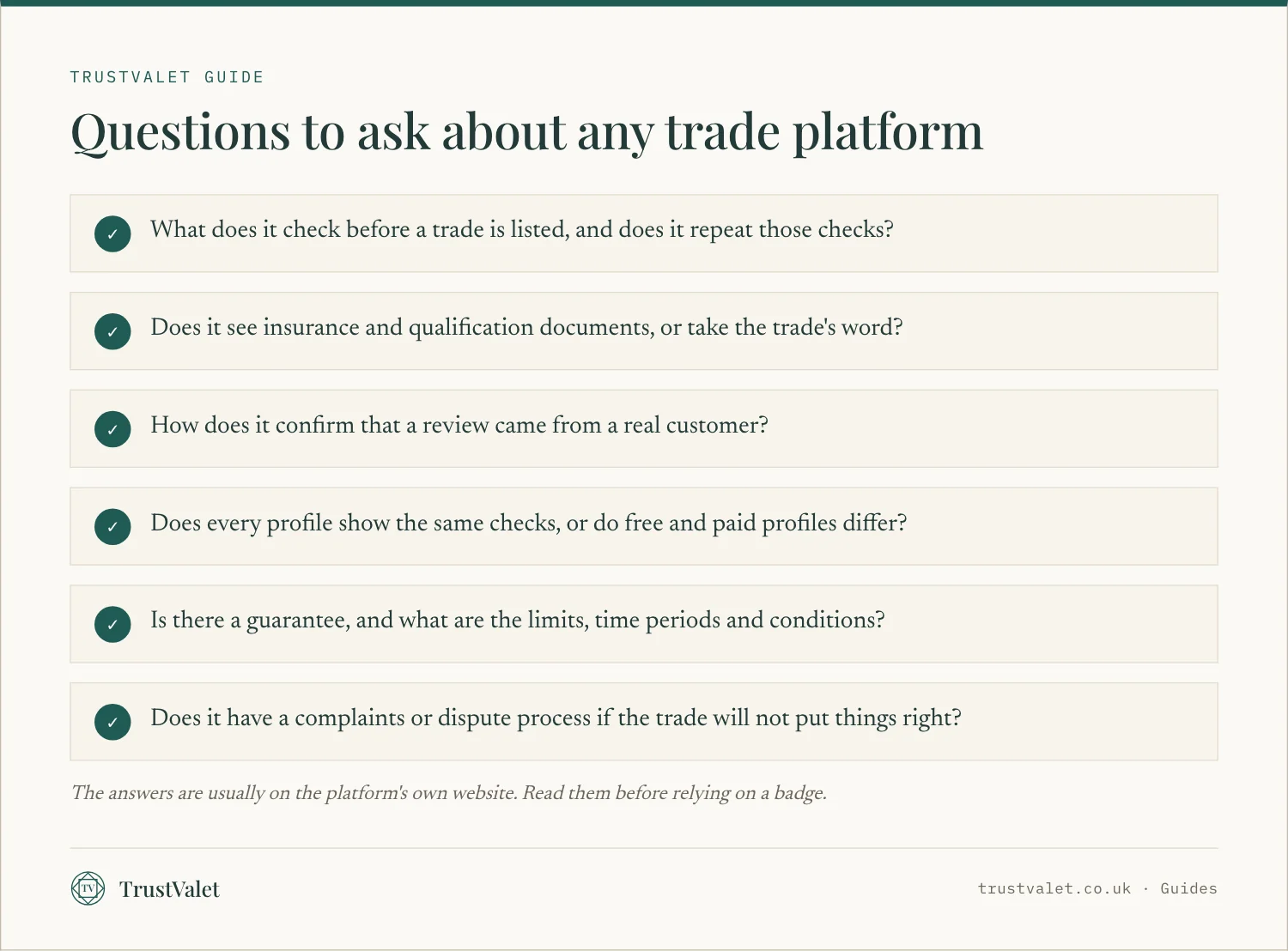
Checkatrade says on its website that it carries out a set of checks on trades, such as identity and address, and, where they apply, qualifications and insurance, and that it repeats some checks over time. Which? Trusted Traders describes an assessment that includes a credit report, contact with a selection of recent customers to check references, a review of business procedures, and an interview carried out by a Which? trading standards professional. It also states that it does not carry out site visits to assess the trader's work. TrustMark describes itself as the Government Endorsed Quality Scheme for work a consumer chooses to have carried out in or around their home, with businesses vetted by the scheme providers that register them.
None of these checks is a promise that a particular job will be done well. They tell you something about the business at the time it was checked. Read each platform's own description of its checks, because the details change, and some platforms host more than one kind of profile.
How reviews work
Platforms collect reviews from customers and publish them on the trade's profile. Most say they take steps to confirm reviews are genuine. Which? Trusted Traders, for example, says it moderates every review, which can involve checking IP addresses, speaking to the reviewer and asking for documents such as proof of purchase.
Since April 2025, the Digital Markets, Competition and Consumers Act 2024 has banned fake reviews, and businesses that publish consumer reviews must take reasonable and proportionate steps to prevent and remove fake ones. The Competition and Markets Authority has published guidance on what that means. This applies to platforms and to trades publishing reviews on their own websites.
Guarantees and complaints
Some platforms and schemes offer help if a job goes wrong. Checkatrade publishes a guarantee for work by its members, which comes with its own limits and conditions. Read the terms on Checkatrade's website as they apply on the date you book the job, because any guarantee only covers what its terms say. Which? Trusted Traders sets out a complaints route: you raise the complaint with the trader in writing, the trader has 28 days to respond, and if the matter is not settled within eight weeks you can notify Which? Trusted Traders and take it to an independent dispute resolution provider. Which? says this service is free for customers of its endorsed traders. TrustMark publishes its own complaints process.
These routes sit on top of your legal rights. They do not replace them, and each has limits. Read the terms before you rely on one.
How hiring direct works
Hiring direct means there is no platform between you and the trade. You find them yourself, check them yourself and agree terms with them directly.
What you gain
- A wider choice. Many good trades do not list on any platform, often because they have enough work from recommendations.
- Recommendations you can test. A neighbour who used a roofer last year can show you the roof.
- A direct relationship. You deal with the business from the first call, with no platform rules in between.
What you lose
- Checks done for you. Any check a platform would have made, you now make yourself.
- A platform's review history. Reviews may be scattered or missing, so you rely more on speaking to past customers.
- Any platform guarantee or complaints route. If a dispute arises, you rely on your legal rights and, where the trade belongs to one, a trade association or scheme.
Your rights are the same either way
In most cases your contract for the work is with the trader, not the platform that introduced you. The Consumer Rights Act 2015 applies to that contract whichever route you took: the trader must carry out the service with reasonable care and skill, and, where nothing was agreed, within a reasonable time and for a reasonable price. If the work falls short, you can ask the trader to put it right, and if that is not possible, you may be entitled to a price reduction.
If you agree a contract in your home, the Consumer Contracts Regulations 2013 usually give you 14 days to cancel, and the trader must tell you about that right in writing. If you pay part of the cost by credit card, for an item or service priced over £100 and up to £30,000, Section 75 of the Consumer Credit Act 1974 can make the card provider jointly liable if the trader breaches the contract.
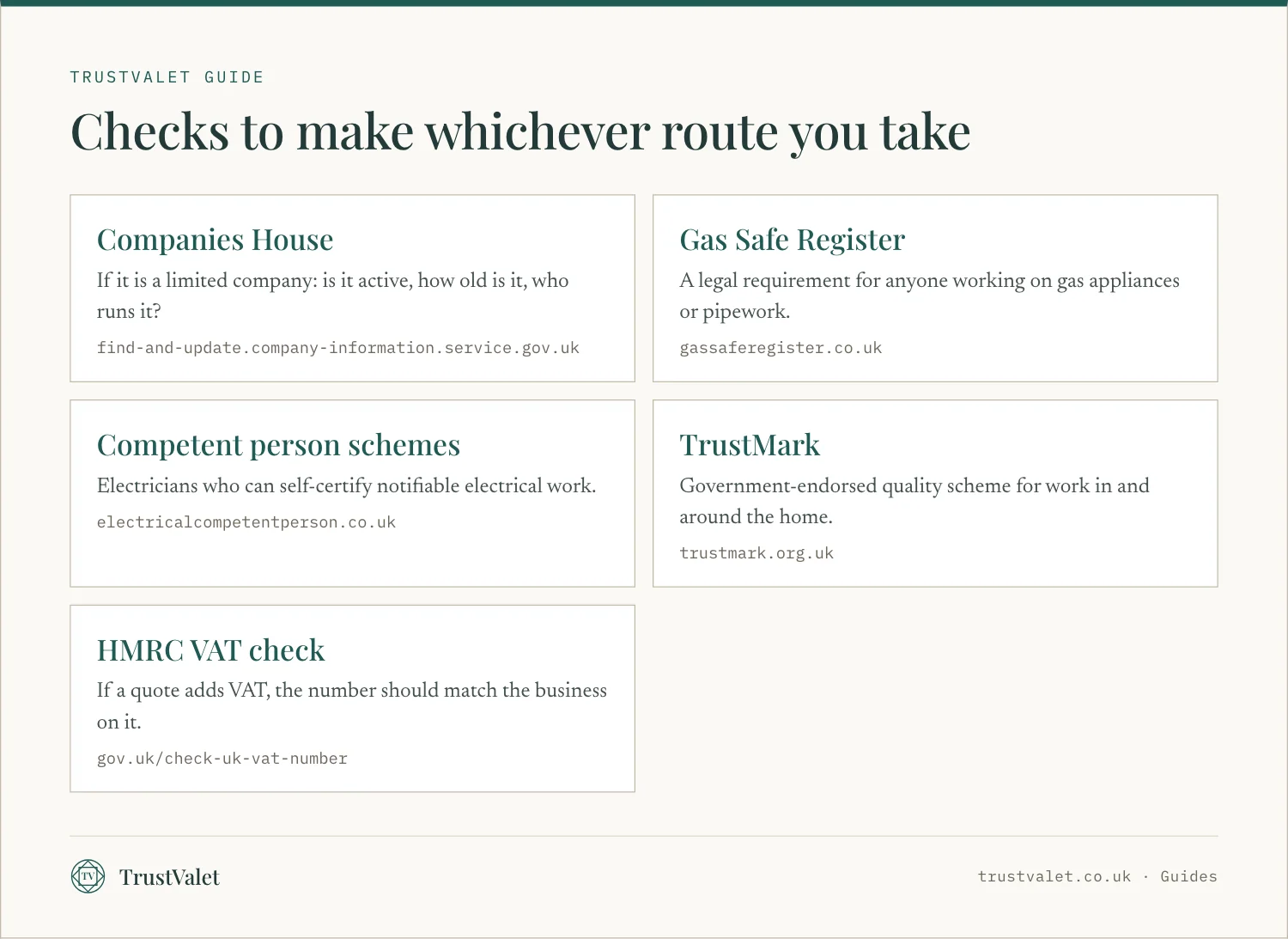
The checks to make either way
A platform badge is a starting point, not the end of your checks. Whichever route you take:
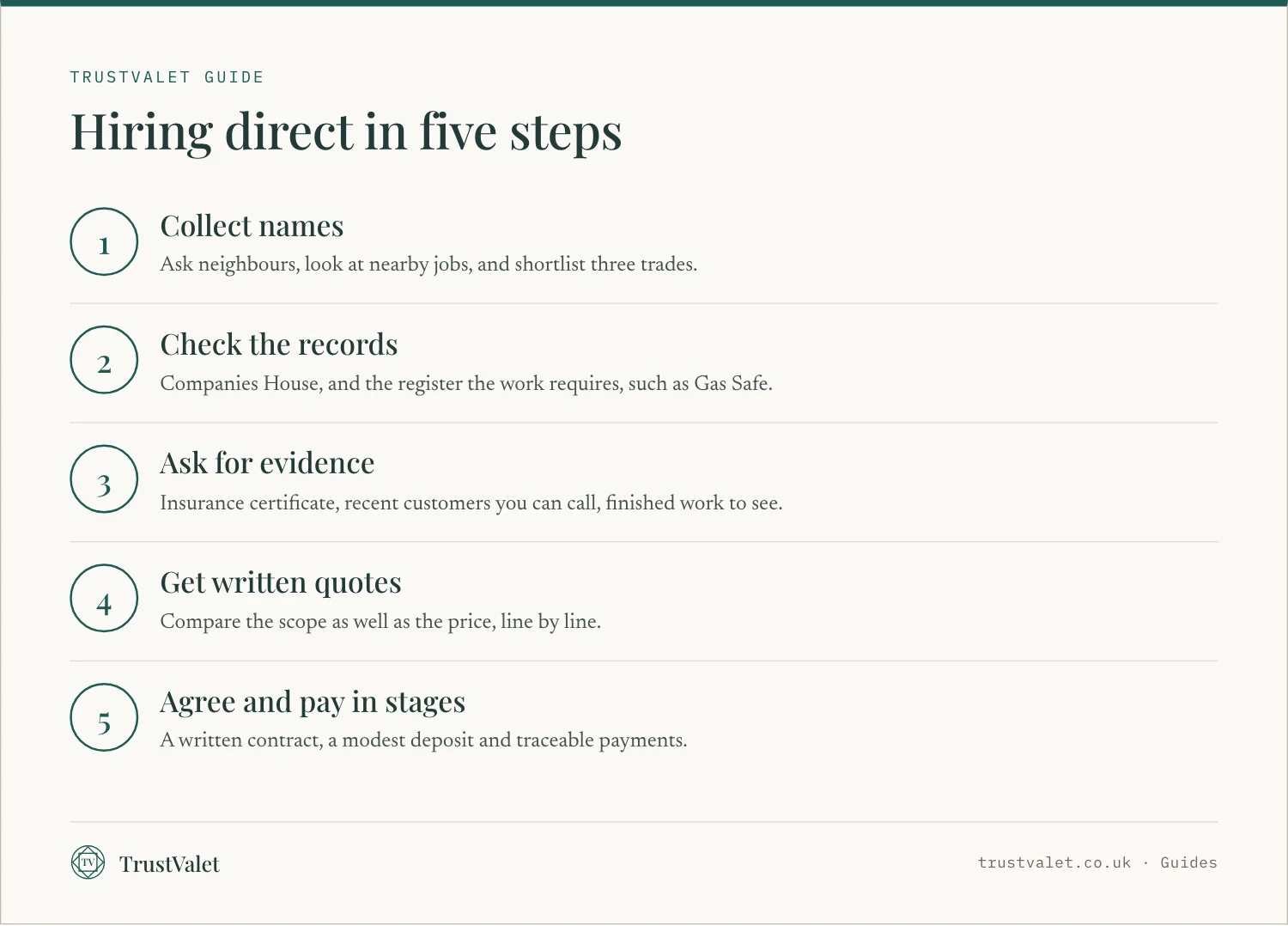
- Get at least three written quotes and compare what each one includes.
- If the trade is a limited company, look it up on Companies House and check it is active and that the name matches the quote.
- Check the register the work requires, such as the Gas Safe Register for gas work, or a competent person scheme for notifiable electrical work.
- Ask to see a current public liability insurance certificate, and check the name on it.
- Speak to two recent customers and, if you can, see finished work.
- Put the scope, price, dates and payment stages in writing, keep the deposit modest and pay traceably.
Our guide to checking whether a tradesperson is qualified goes through each trade's registers, and how to avoid cowboy builders covers the warning signs that apply whether a trade came from a platform or a recommendation. For a script for the first visit, see ten questions to ask before hiring any tradesperson.
So which saves you more?
Neither route is reliably cheaper. The price of a job is set by the trade, and the best protection for your money is a clear written quote, staged payments and a trade you have checked. A platform can save you time by doing some checks and giving you a complaints route. Hiring direct can widen your choice and put you in touch with trades who never list anywhere. What costs money, on either route, is skipping the checks.
How TrustValet can help
TrustValet is not a trade platform and does not check workmanship, rate trades or recommend anyone. It is a register built from public records. For every company in our register, we show what Companies House holds, including status, incorporation date, who controls the company, filing deadlines and how many directors have verified their identity, each with its source and the date we read it. That makes it a quick way to check a limited company before you hire, whichever route you found it through.
Some companies choose to be verified: 14 checks against public registers and their own website, decided by a person, with a dated certificate you can look up. Our guide to what "verified" really means explains what those checks do and do not prove, and how we verify lists them in full. Browse trades, painters and decorators in London, or companies in Birmingham and other cities.
Questions
Is Checkatrade free for homeowners?
Searching Checkatrade is free for homeowners. Like most trade platforms, it earns its money from the trades that use it. Its website sets out its current plans and terms.
Is a trade from a platform cheaper or more expensive than hiring direct?
There is no reliable rule. The price is set by the trader, whichever way you found them. Get at least three written quotes for the same scope of work and compare what each includes.
Who is my contract with if I find a trade on a platform?
In most cases your contract is with the trader, not the platform. Your rights under the Consumer Rights Act 2015 apply to that contract. Any platform guarantee is extra and has its own terms.
Do platforms check the quality of a trade's work?
Platforms describe different checks, such as identity, insurance, qualifications or customer references. Which? Trusted Traders, for example, states that it does not carry out site visits to assess the work. Read each platform's own description.
What checks should I make if I hire direct?
Look the company up on Companies House, check any register the work requires such as Gas Safe, see a current insurance certificate, speak to recent customers, and get a written quote and contract before any work starts.
Check the company first
Before you pay anyone, look the company up. Every page in the register shows what Companies House says, with the date we read it.
Ala Ciobanu · Ala Ciobanu edits the TrustValet guides. Every guide names its sources.
- Checkatrade
- Why use Which? Trusted Traders (Which?)
- FAQs for consumers (Which? Trusted Traders)
- TrustMark, Government Endorsed Quality Scheme
- Fake reviews guidance, CMA208 (GOV.UK)
- Consumer Rights Act 2015, services (legislation.gov.uk)
- Consumer Contracts Regulations 2013 (legislation.gov.uk)
- Consumer Credit Act 1974, section 75 (legislation.gov.uk)