
In short: a person with significant control (PSC) is someone who owns or controls a company, usually through more than 25% of its shares or voting rights. Every UK company must identify its PSCs, tell Companies House who they are, and report any change within 14 days of confirming it. If there is no PSC, the company must file a statement saying so, because its PSC information can never be blank. PSCs must also verify their identity.
This guide explains who counts, what goes on the public register and what stays private, how to report a PSC, and how to read PSC information when you check another company. It covers the common cases. For complex structures, Companies House points you to its full statutory guidance and to professional advice.
What a person with significant control is
Companies House describes a PSC as someone who owns or controls your company. They are sometimes called beneficial owners. A company can have one PSC or several, and a director can be a PSC too.
The register exists for transparency. GOV.UK says it helps investors, and supports law enforcement in money laundering investigations. For anyone checking a business, it answers a basic question: who is really behind this company?
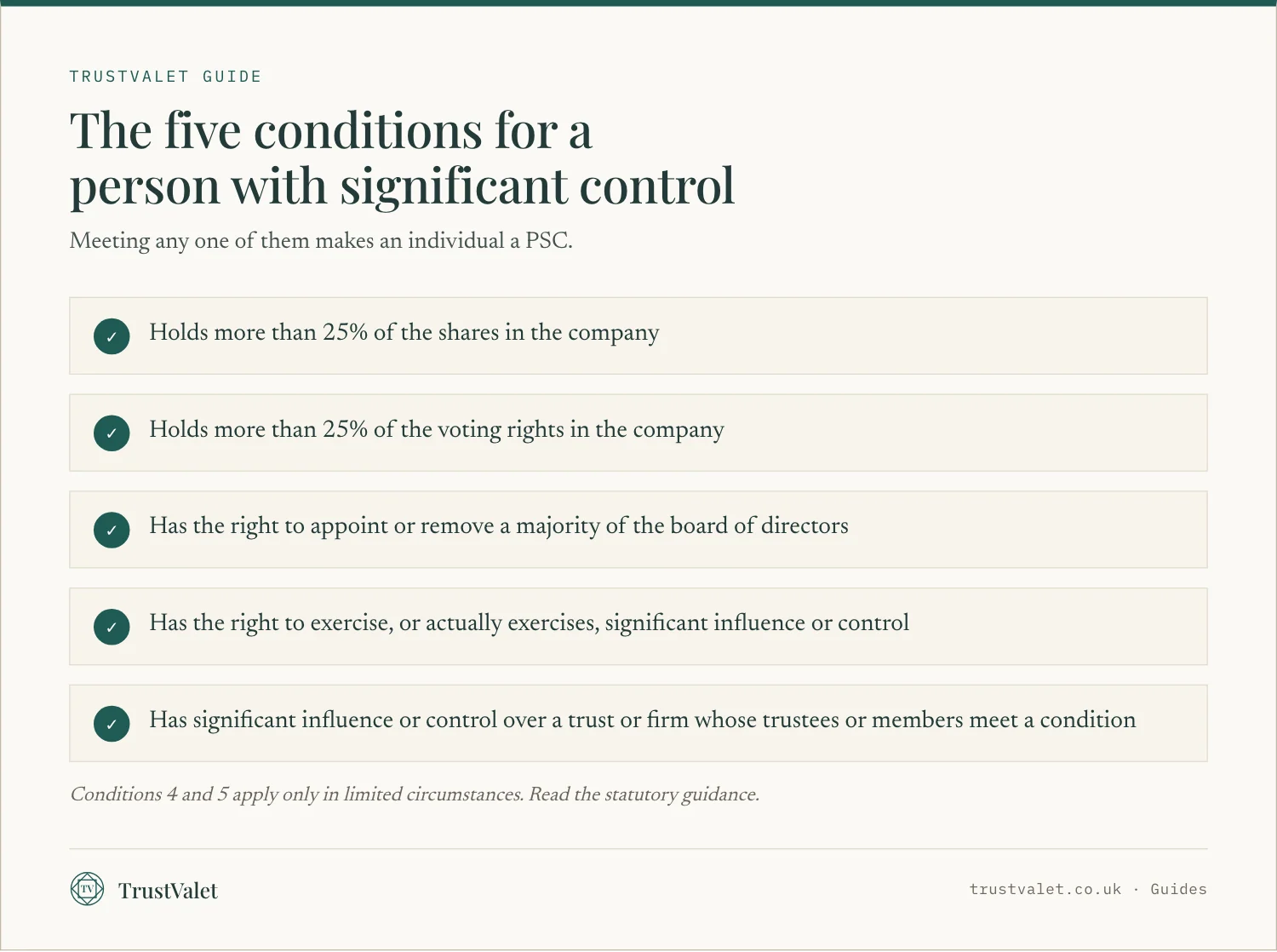
The five conditions
A PSC is an individual who meets one or more of five conditions, called the "nature of control". When you register a PSC, you tell Companies House which conditions they meet.
- Shares: they hold more than 25% of the shares in the company.
- Voting rights: they hold more than 25% of the voting rights.
- The board: they hold the right to appoint or remove the majority of the board of directors. If there is only one director and someone has the right to appoint them, they meet this condition.
- Significant influence or control: they have the right to exercise, or actually exercise, significant influence or control over the company.
- Trusts and firms: a trustee of a trust, or a member of a firm, meets one of the first four conditions, or would if they were an individual. Anyone who has significant influence or control over that trust or firm is then a PSC.
The first three are the common ones. Your register of members and your articles of association will usually tell you who meets them. Conditions 4 and 5 apply only in limited circumstances, and there is separate statutory guidance on what "significant influence or control" means.
Control can be direct or indirect. Someone meets a condition indirectly when they hold their rights through, for example, another company.
Size of control
For shares and voting rights, you also report which band the PSC falls into:
- over 25% up to and including 50%
- more than 50% and less than 75%
- 75% or more
A company only has to say whether someone meets condition 4 if they do not already control it through conditions 1 to 3.
Individuals and relevant legal entities
Not every owner is a person. If your company is owned by another company, such as a parent company, different rules apply.
Under section 790C of the Companies Act 2006, a legal entity is a "relevant legal entity" if it would have been a PSC had it been an individual, and it is subject to its own disclosure requirements. In practice, that means a company that keeps its own PSC register, or one with voting shares on a UK or EU regulated market.
A relevant legal entity is recorded on your register in place of the people behind it. Those people then appear on the parent company's own register. Where a chain has several such entities, only the first one above your company is usually registrable.
What is public and what is protected
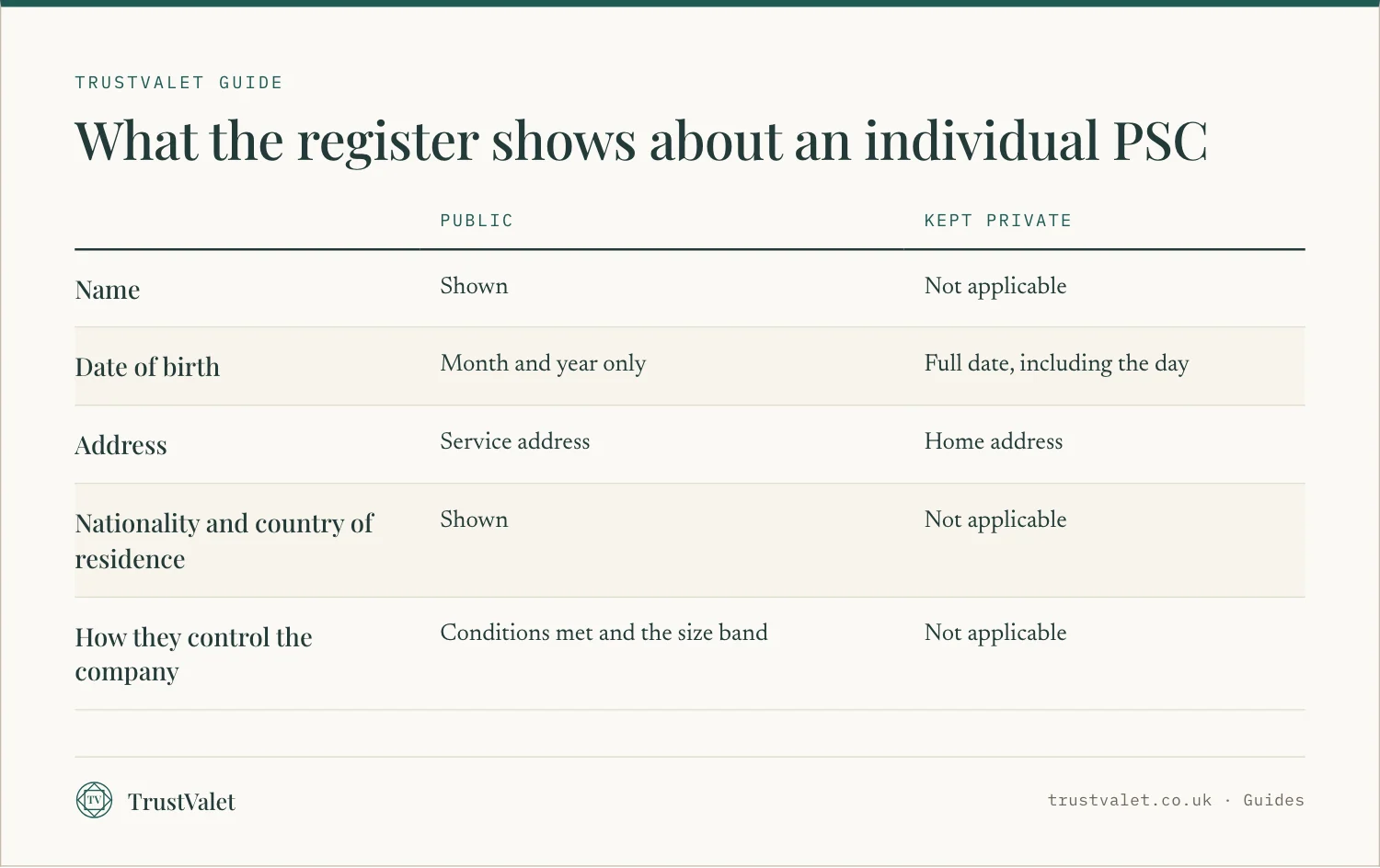
Before you report a PSC, you must confirm their details with them. For an individual, you need their name, date of birth, nationality, the country where they usually live, a service address, their home address, the date they became a PSC, and every condition they meet.
Most of this is public. Companies House says two things are not: the home address and the full date of birth. Only the month and year of birth appear on the register. The home address goes on a private register, shared only with bodies such as credit reference agencies and the police.
If a PSC does not want their home address shown, they should use a different address as their service address. People at serious risk of violence or intimidation because of the register can apply to have their information protected.
Reporting a new PSC or a change
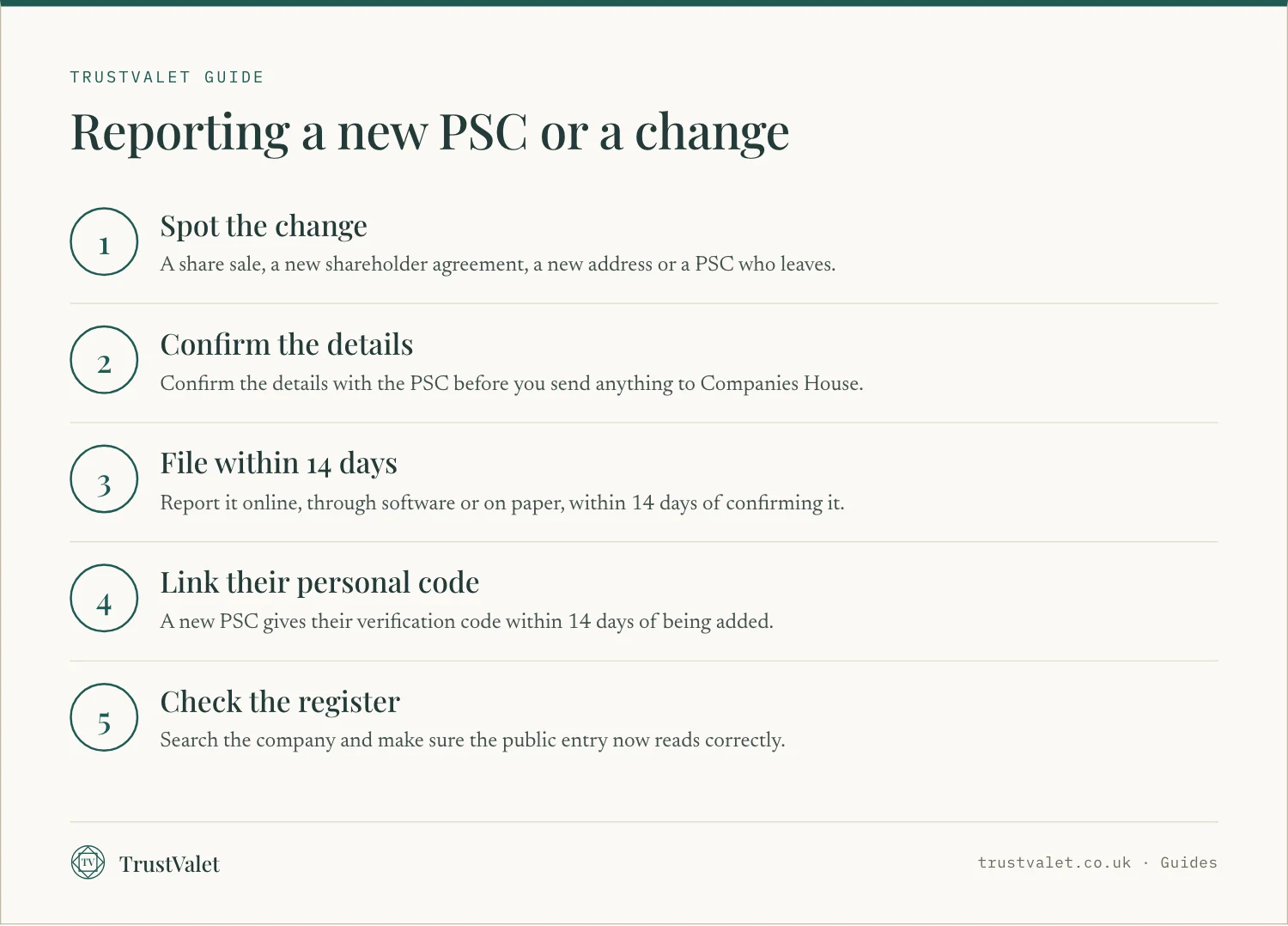
PSC details go to Companies House when a company is set up. After that, the company must keep them up to date.
You must tell Companies House about any change to your PSC information, such as a change of personal details or nature of control, within 14 days of confirming the change. The same 14 day limit applies when a new PSC appears, and when a company learns it no longer has one.
You can report online, through filing software, or on paper. Our guide to your first year as a limited company puts these 14 day rules next to your other deadlines.
You must also take reasonable steps to find your PSCs. If someone refuses to give their details, or gives false information, they commit a criminal offence. Failing to provide accurate PSC information to Companies House without a reasonable excuse is an offence too, with a fine, up to 2 years in prison, or both.
Every year, in the confirmation statement
Your PSCs are also part of the yearly check. You must report PSC changes before you file your confirmation statement, not in it. Our guide to the confirmation statement explains what can and cannot go in the statement itself.
PSC statements: when there is no PSC
Some companies have no one who meets any condition, for example when shares are spread thinly among many holders. Others know they have a PSC but cannot confirm who it is.
Either way, the company must tell Companies House. It files a PSC statement explaining why there is no PSC, or why their details have not been confirmed. This can be done online or on form PSC08. A company's PSC information cannot be blank.
Identity verification for PSCs
PSCs must verify their identity with Companies House and give their personal code, using the "Provide identity verification details for a PSC" service. Each PSC has a 14 day period to do it.
When that period falls depends on whether you were registered before 18 November 2025, and on whether you are also a director of the company. A new PSC gives the code when added to the register, or within 14 days. If you cannot make it, you can ask for a 14 day extension before your deadline passes.
Our guide to identity verification for directors covers every case, including existing PSCs, and how to verify for free.
How to read PSC information when you check a company
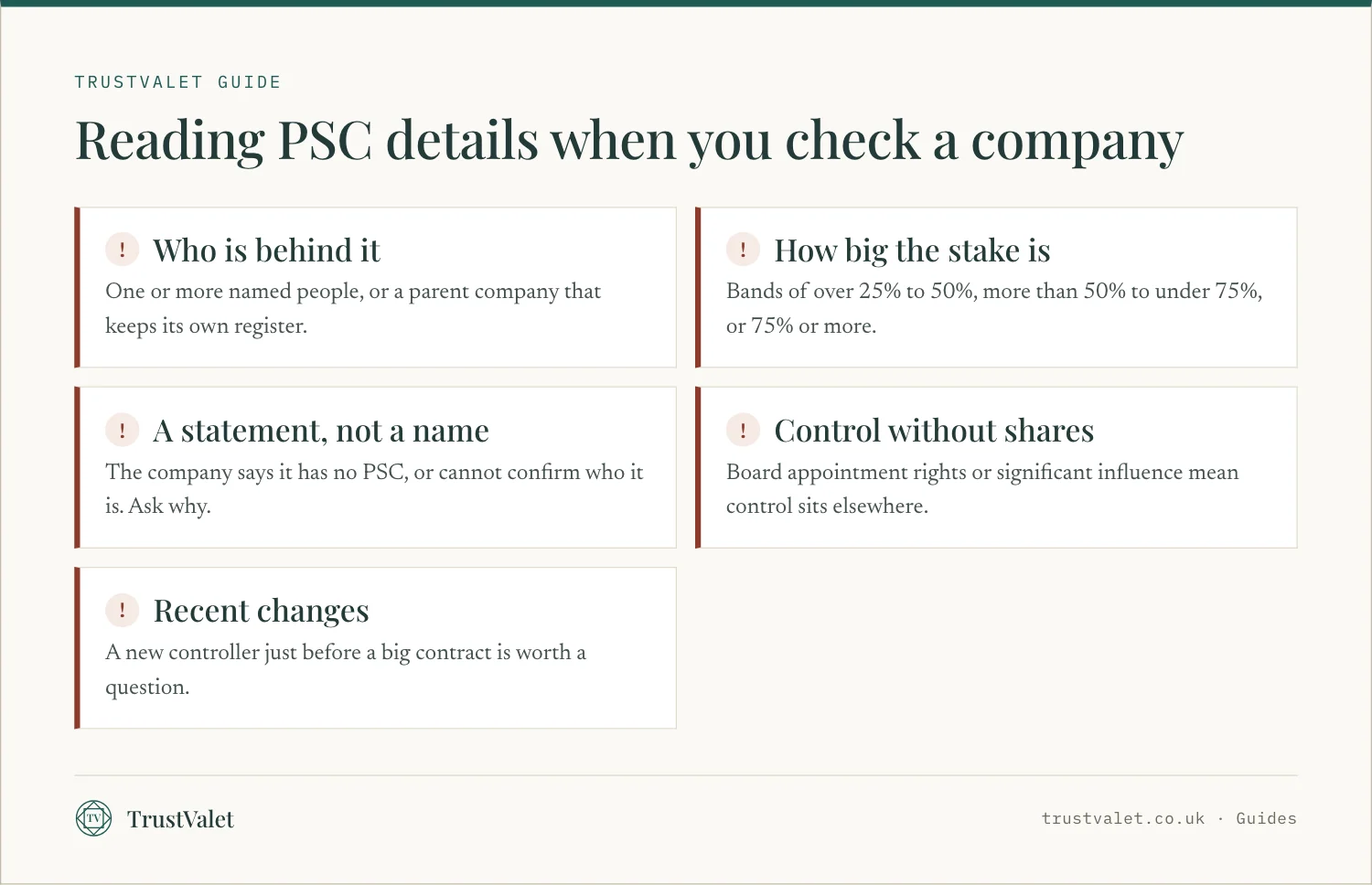
The PSC section is one of the most useful parts of a company record. It tells you who you are really dealing with.
Look at who is listed, how they control the company, and how recently it changed. A company controlled through board appointment rights or significant influence, rather than shares, is worth understanding before you sign. A PSC statement in place of a name is not wrong in itself, but it is a fair question to ask.
Our guides on how to find out who owns a UK company and how to check if a UK company is legit show where PSC details fit among other checks.
PSC details on TrustValet
Each company page in our register shows who controls the company by kind and size of control, for example "Holds 25 to 50% of the shares". Where the controller is a company, we name it. We never show an individual PSC's name on our pages. Each fact shows its source and the date we read it.
How TrustValet can help
TrustValet is a register built from public records. A company page shows what Companies House holds: status, incorporation date, accounts and confirmation statement deadlines and whether either is overdue, how many active directors have verified their identity, who controls the company by kind and size of control, charges and filing history. We re-read published companies about monthly, so a PSC change you file shows up after our next read.
If you run a company, search for it and claim the page for free. You can add your website, phone number, description and logo.
You can also apply to get verified. A person checks your company against 14 public registers and your website, and you get a dated certificate and a live badge, free while you show that badge on your website, or £19 a year (£49 once for five years) without it (see pricing). How we verify lists every check. We never vet workmanship, collect reviews or rate companies.
If your ownership is not simple, an accountant, a solicitor or a business support adviser can help. Browse them in our professional services category.
Questions
Who counts as a person with significant control?
An individual who holds more than 25% of the shares or voting rights, can appoint or remove a majority of the board, has significant influence or control, or controls a trust or firm that meets one of these conditions.
How long do I have to report a PSC change to Companies House?
14 days from confirming the change. That covers a new PSC, a change of personal details or nature of control, and learning that the company no longer has a PSC.
Is a PSC's home address public?
No. The home address and full date of birth are kept private. The register shows a service address and only the month and year of birth.
What if my company has no person with significant control?
You must still tell Companies House by filing a PSC statement explaining why there is no PSC, or why their details have not been confirmed. A company's PSC information cannot be blank.
Do PSCs have to verify their identity?
Yes. Every PSC must verify with Companies House and give their personal code in a 14 day period. When it falls depends on when they became a PSC and whether they are also a director.
Check the company first
Before you pay anyone, look the company up. Every page in the register shows what Companies House says, with the date we read it.
Ala Ciobanu · Ala Ciobanu edits the TrustValet guides. Every guide names its sources.
- People with significant control (PSCs) (GOV.UK)
- Summary guidance for companies: register of people with significant control (GOV.UK)
- Your personal information on the Companies House register (GOV.UK)
- Provide identity verification details for a PSC (GOV.UK)
- Running a limited company: company information you must report (GOV.UK)
- Give notice of PSC statements, form PSC08 (GOV.UK)
- Companies Act 2006, section 790C (legislation.gov.uk)