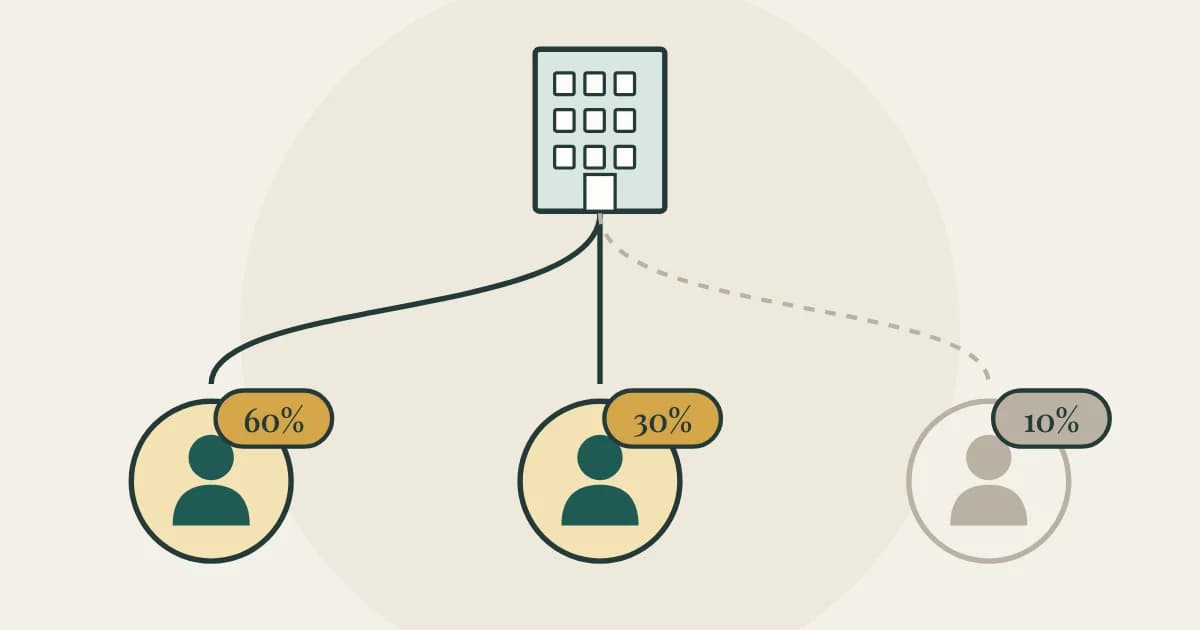
To find out who owns a UK company, search it free on Companies House and open the People tab. The "Persons with significant control" list shows who owns or controls it, usually anyone with more than 25% of the shares or voting rights, or the power to appoint or remove most of the directors. The "Officers" list shows the directors who run it. For the shareholders themselves, look in the filing history for the confirmation statement. If the owner is another company, open that company's record and keep going until you reach people.
This guide explains the difference between owning, controlling and running a company, where each is recorded, and how to follow the trail. It also covers overseas owners, LLPs, sole traders and what is never made public. If you want the wider picture of whether a business is genuine, start with how to check if a UK company is legit.
Owners, controllers and managers are not the same
Three different groups of people can stand behind a company, and they are often the same people in a small firm. In a larger one they can be very different.
- Shareholders own the shares. They own the company in the legal sense.
- People with significant control (PSCs) are the people who own or control it in a meaningful way. They are sometimes called beneficial owners.
- Directors run the company day to day. They may or may not own shares.
A PSC is usually anyone who holds more than 25% of the shares or voting rights, or who can appoint or remove a majority of the directors. In limited cases it can also be someone who has significant influence or control by other means.
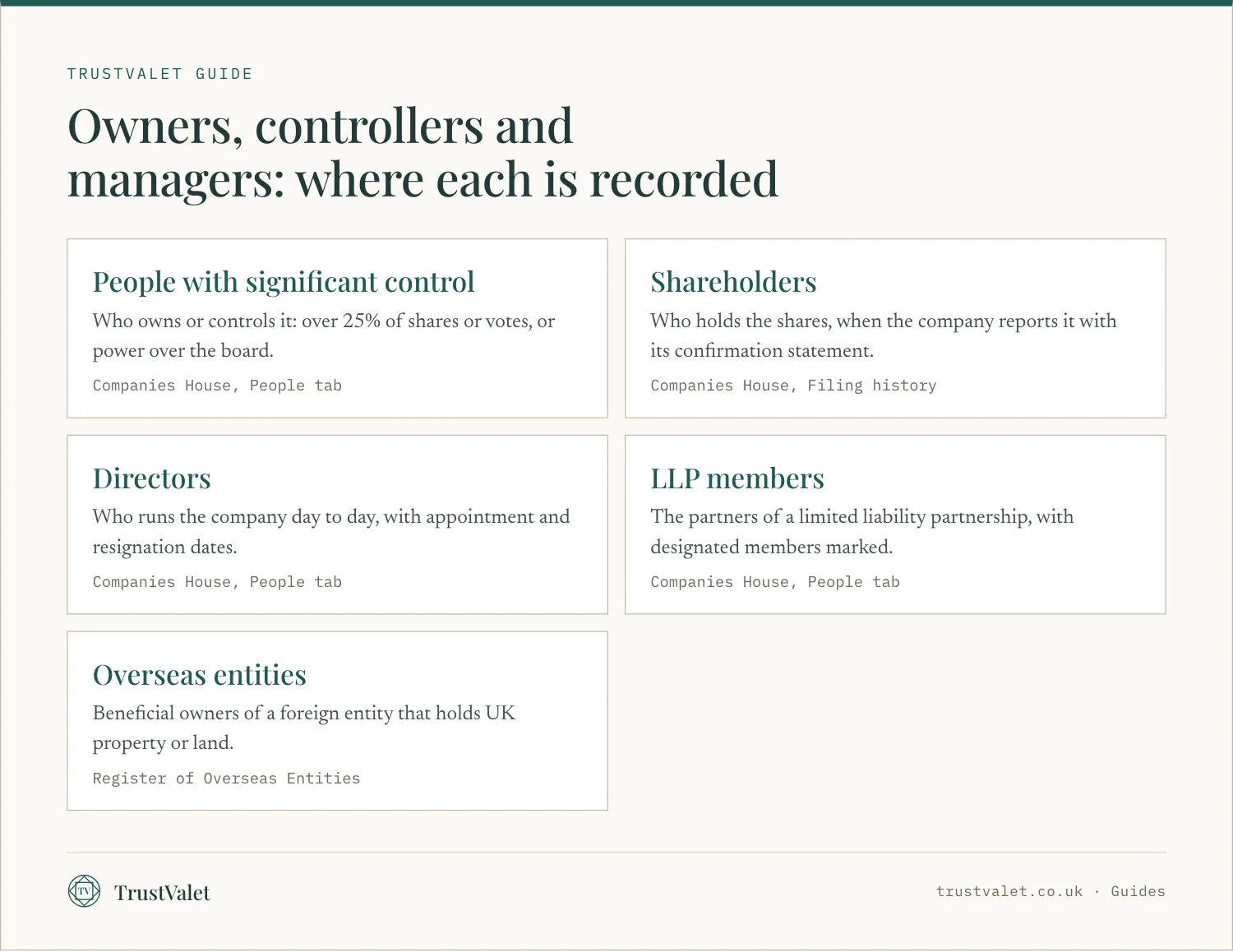
Where each one is recorded
Companies House holds all three, and searching it is free. You can see the company's registered address, date of incorporation, current and resigned officers, filed documents, charges and insolvency information.
The PSC register. Companies must identify their PSCs, give their details to Companies House and report changes within 14 days. The register can never be blank. If a company has no PSC, or cannot identify one, it must file a statement saying so.
Shareholder lists. Every company files a confirmation statement at least once a year. It can include a statement of capital and shareholder information when those have changed. Our guide to the confirmation statement explains what it confirms. New shares issued after incorporation are reported on form SH01, the return of allotment of shares.
Officers. The directors, and the company secretary if there is one, are listed with the dates they were appointed and resigned.
How to search, step by step
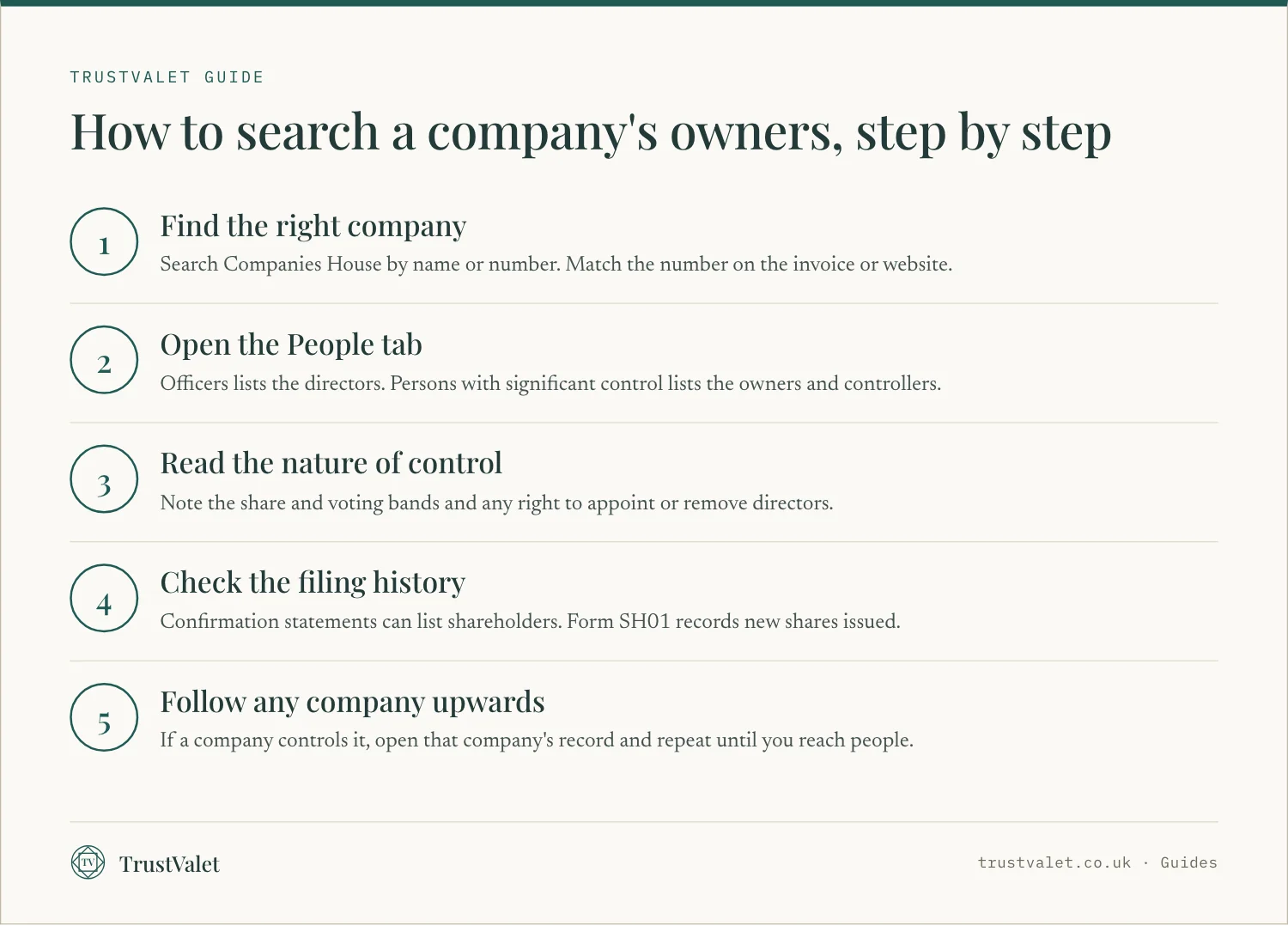
Start by finding the right company. Many names are similar, so match the company number from the invoice, contract or website footer. You can also search every company in our register.
A company must show its registered number and registered office on its website, so the footer or contact page is a good place to find it. Check the status while you are there. You want Active, because a dissolved company no longer exists in law.
On the People tab, open Persons with significant control. For each entry you will see a "nature of control". Share and voting holdings are shown in bands: more than 25% up to 50%, more than 50% and less than 75%, and 75% or more. You may also see the right to appoint or remove directors.
Then open Officers to see the directors. Compare the two lists. In a one-person company the same name often appears in both.
Click a director's name to see their other appointments. Someone who has run many companies that were later dissolved in quick succession deserves a closer look. You can also search Companies House by officer name, not just by company.
Finally, check the Filing history. Look for the most recent confirmation statement and any SH01 forms. These can show who holds the shares, and when new shares went to new people.
Some companies show no PSCs for a good reason. A company whose voting shares trade on a UK regulated market is exempt, and its page says so.
When the owner is another company
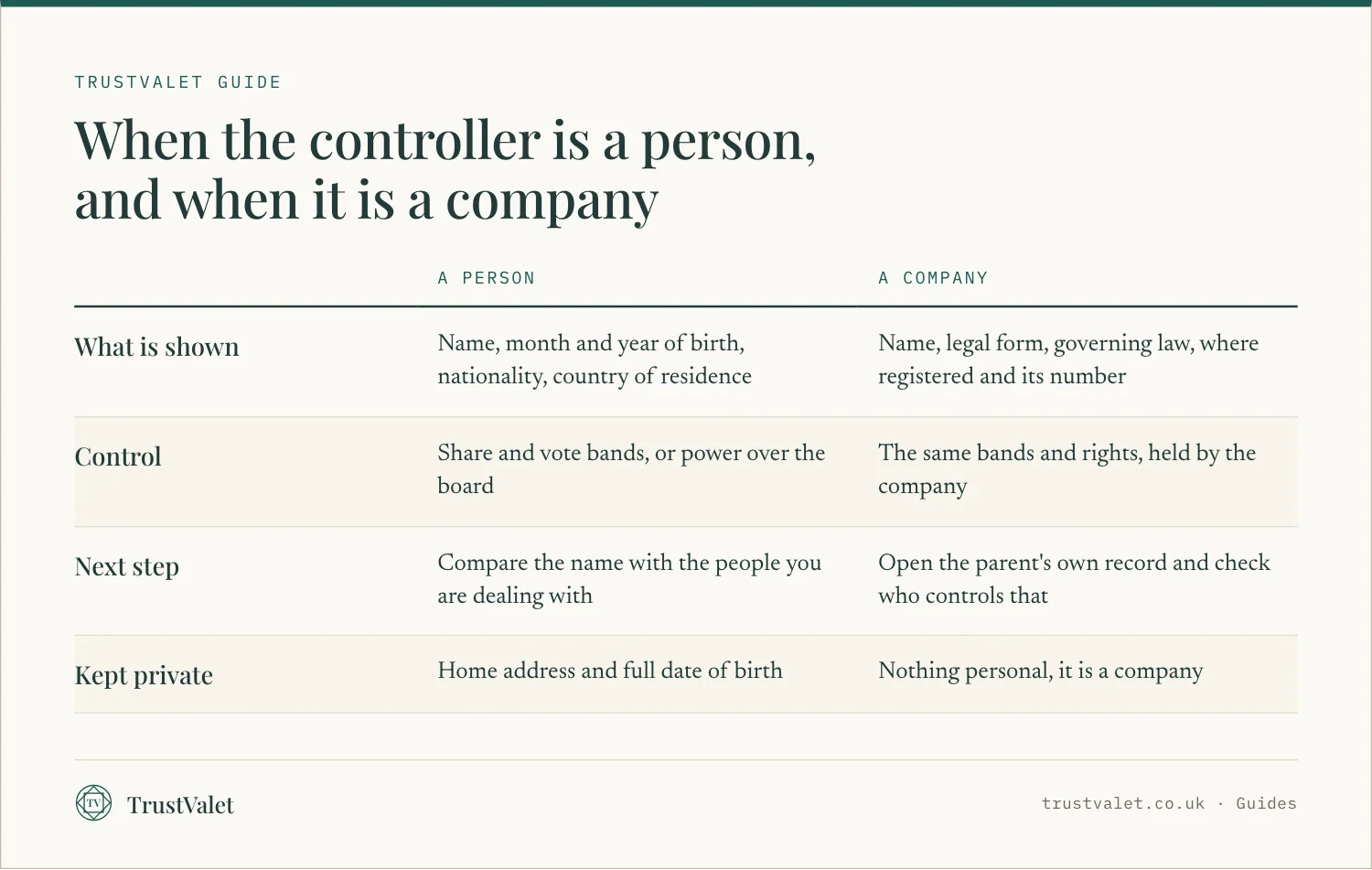
A PSC entry does not always name a person. When a company is owned or controlled by another company, such as a parent company, the register names that company instead. The law calls it a "relevant legal entity".
The entry shows the parent's legal form, governing law, where it is registered and its registration number. Open that company's own record and read its PSC list. Repeat until you reach real people, or a company listed on a stock market.
A long chain is not wrong in itself. Groups often hold trading companies through a holding company. But if the chain ends abroad, in a place with no public register, you may not be able to see who is at the top.
Overseas entities that own UK property
Foreign companies that buy, sell or transfer property or land in the UK must register with Companies House on the Register of Overseas Entities. They must name their registrable beneficial owners, or their managing officers if no beneficial owner can be identified.
This applies to property bought on or after 1 January 1999 in England and Wales, 8 December 2014 in Scotland, and 5 September 2022 in Northern Ireland. Most of the information is public. It helps if you are dealing with a property developer or a landlord that turns out to be a foreign company.
The register covers ownership of UK land. It is not a register of every foreign company that trades in the UK.
LLPs, sole traders and partnerships
A limited liability partnership has members, not shareholders and directors. Companies House lists them on the People tab, with designated members marked. LLPs must also identify their PSCs, so the same register applies.
Sole traders and ordinary partnerships are different. GOV.UK's set-up steps register them with HMRC, not Companies House, so there is no company record to search. The owner is simply the person, or the partners, trading under that name. Ask for their full name and address in writing before you pay.
What is not public
Most of what is filed at Companies House is public, but some personal details are not. Home addresses and full dates of birth are not published on the register. For a person, you see the month and year of birth and a correspondence address.
People at serious risk of violence or intimidation because of their company's work can apply to protect more of their details. So an entry with little information is not always a warning sign.
Remember too that Companies House says it does not check the accuracy of what is filed. The register records what a company declares.
What to do with what you find
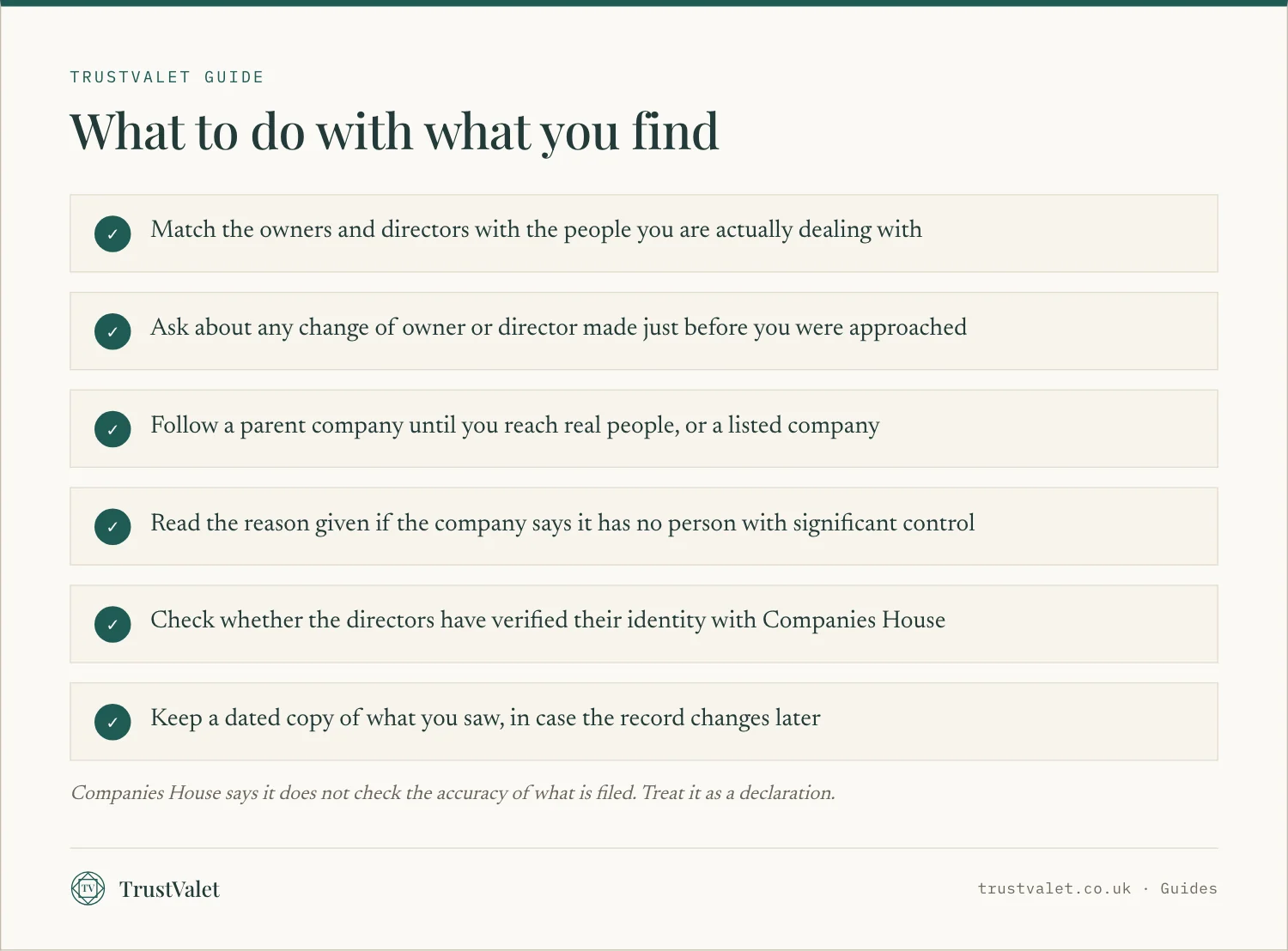
The point is to check that the people behind a company match the story you were told. If the person you are dealing with is not a director and is not named as a PSC, ask what their role is.
Companies House also offers free email alerts when a company updates its details, for example a change of director or address. If you are about to sign a long contract or pay a large deposit, it is worth following the company for a while.
Watch the dates. A new owner or a full change of directors just before you were approached deserves questions. Directors and PSCs must now also verify their identity with Companies House, and our guide to director identity verification explains what that proves.
If the company has been struck off, read what dissolved means. For firms that handle your money or property, such as solicitors or estate agents, knowing who controls the business matters more than usual.
How TrustValet can help
TrustValet is a register built from public records. Each company page shows what Companies House holds, including who controls the company. It shows the kind and size of control for each entry. A controlling company is named, with a link to its own record, and the companies it controls are listed. An individual is never named, only described by the kind of control they hold. Every fact shows its source and the date we read it, and our sources page explains where each comes from.
Some companies also choose to be verified: 14 checks against public registers, decided by a person, giving a dated certificate anyone can check. How we verify explains each check. It does not vet workmanship, reviews or ratings. If something on a company page looks wrong, you can report it.
Questions
How can I find out who owns a company in the UK for free?
Search the company on Companies House and open the People tab. The persons with significant control list shows who owns or controls it, and the officers list shows the directors. Shareholder details can appear in the confirmation statements in the filing history.
What is a person with significant control?
Usually someone who holds more than 25% of a company's shares or voting rights, or who can appoint or remove a majority of its directors. In limited cases it is someone with significant influence or control by other means.
What if a company is owned by another company?
The register names the parent company, with its legal form and registration number. Open the parent's own record on Companies House and read its persons with significant control, then repeat until you reach people.
Can I see a director's home address or date of birth?
No. Home addresses and full dates of birth are not published on the Companies House register. You can see a correspondence address and the month and year of birth.
How do I find who owns a sole trader business?
Sole traders and ordinary partnerships register with HMRC, not Companies House, so there is no company record. The owner is the person or partners trading under that name. Ask for their full name and address in writing.
Check the company first
Before you pay anyone, look the company up. Every page in the register shows what Companies House says, with the date we read it.
Ala Ciobanu · Ala Ciobanu edits the TrustValet guides. Every guide names its sources.
- People with significant control (PSCs) (GOV.UK)
- Summary guidance for companies: register of people with significant control (GOV.UK)
- Get information about a company (GOV.UK)
- Filing your company's confirmation statement (GOV.UK)
- Register an overseas entity and its beneficial owners (GOV.UK)
- Apply to protect your details on the Companies House register (GOV.UK)
- Companies Act 2006, section 790C (legislation.gov.uk)
- Set up a business partnership (GOV.UK)