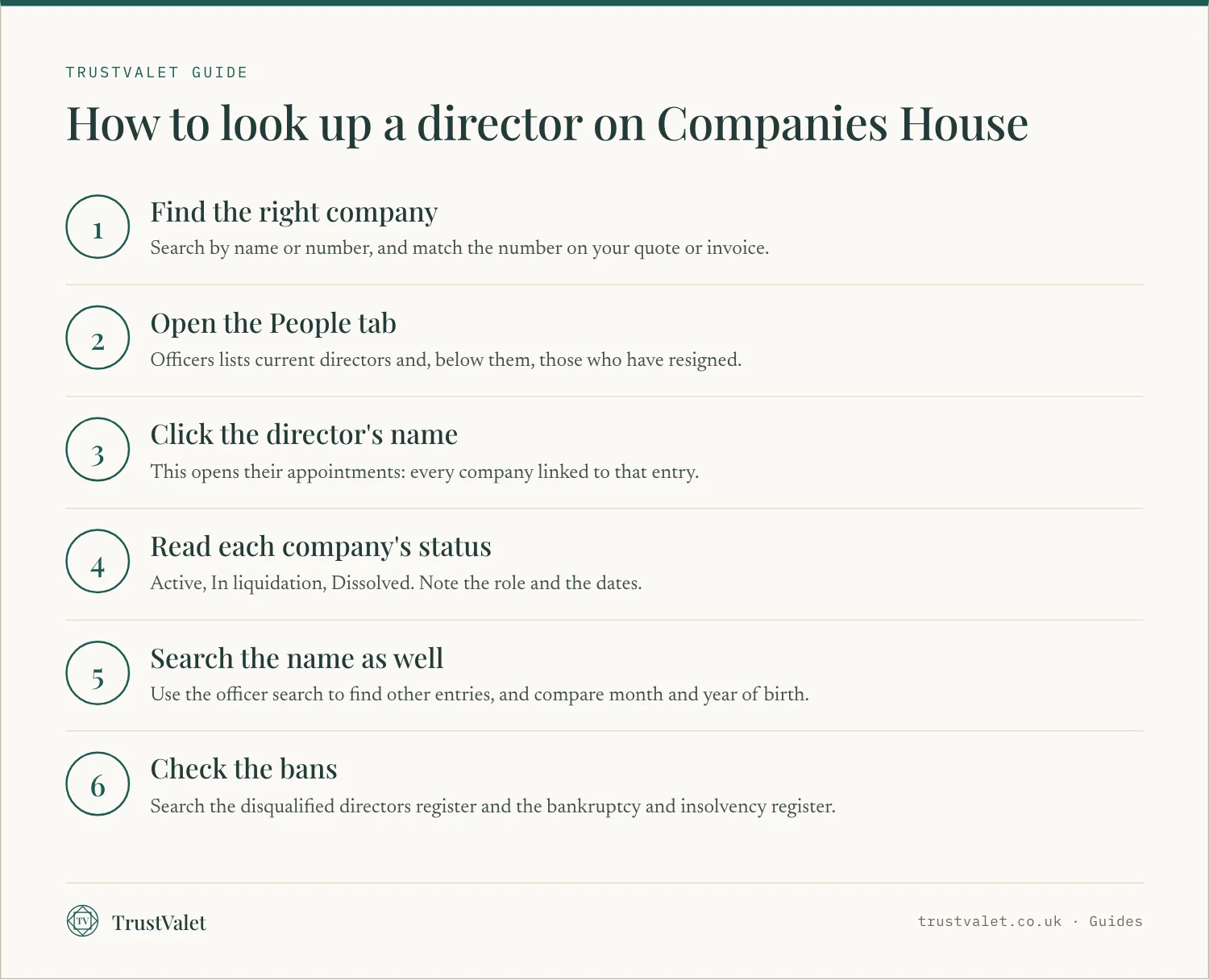
In short: to check a company director, search the company on Companies House, open the People tab and click the director's name. You will see every appointment linked to that entry, current and resigned, with each company's status. The public record shows the director's name, month and year of birth, nationality, a correspondence address and whether they have verified their identity. Then search the disqualified directors register and the bankruptcy and insolvency register. All of it is free.
This guide explains how to find a director, how to read what you find, and the patterns that deserve a question before you pay a deposit or sign a contract. It also sets out the limits: a clean record does not make someone good at their job, and people share names.
Two ways to find a director
Companies House makes its public data free to view, with no need to register. Its officer search covers current and resigned officers, and disqualified directors.
From the company
Search the company by name or number, then open the People tab and choose Officers. The page counts the officers and the resignations, and lists each director with their role, the date they were appointed and, for those who left, the date they resigned.
Always start from the company number on your quote or invoice, not only the name. Our guide on how to check if a UK company is legit covers the other company checks.
From the person
Click a director's name to open their appointments page. It shows the total number of appointments and, for each one, the company name, its status, the role and the dates. You can filter it to current appointments only.
You can also search Companies House by officer name. This is useful when you know the person but not the company, and it can show more than one entry under the same name.
What the record shows, and what it does not
Companies House says that the public details of a director include their name, nationality and the month and year of their date of birth. A director must also give a service address, which is a correspondence address for the public register. It can be the company's registered office.
Two things stay private. The director's home address is kept on a private register, and so is the full date of birth. Companies House shares them only with credit reference agencies and specified public authorities, such as the police. For directors appointed after 10 October 2015, only the month and year of birth are public.
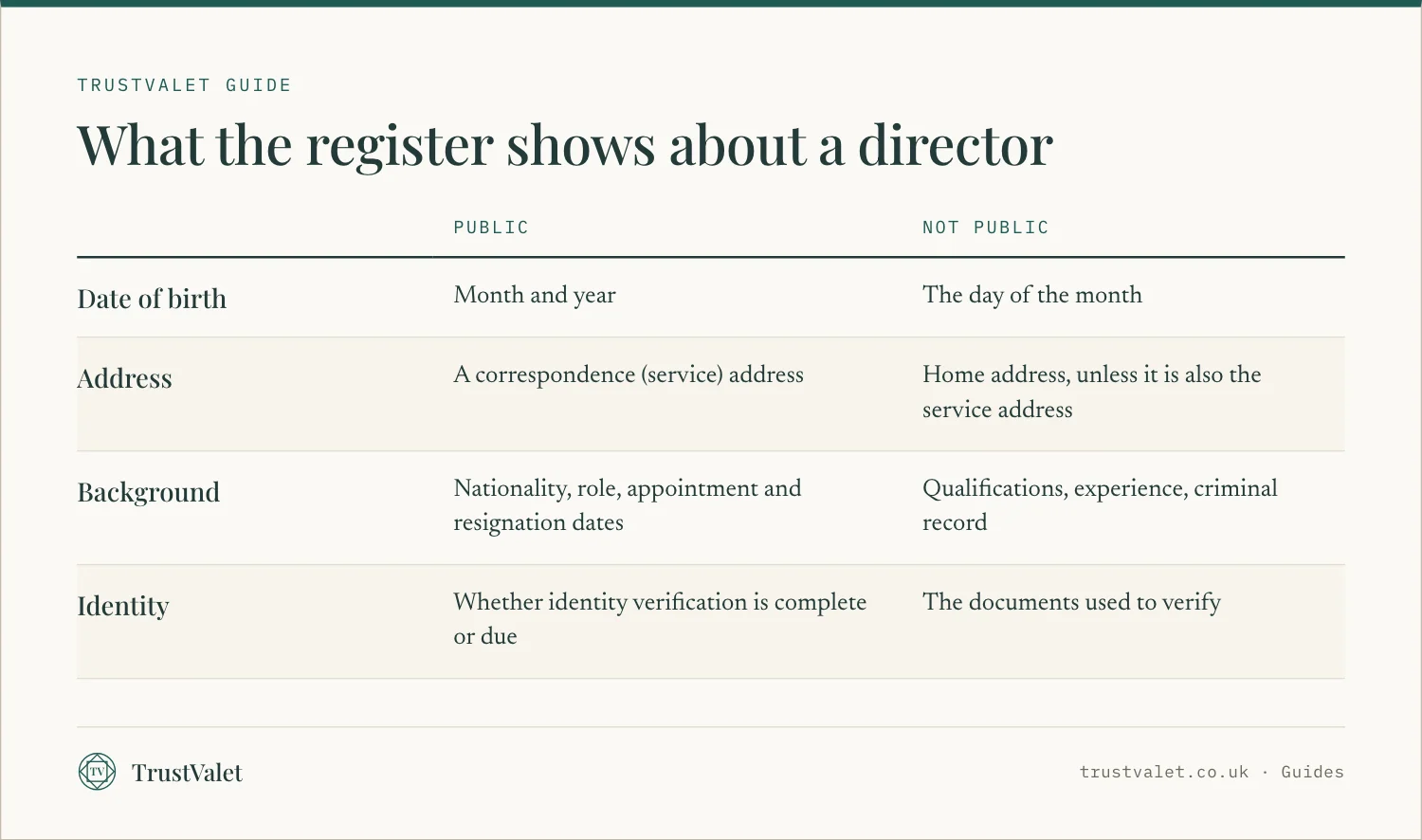
The register says nothing about qualifications, experience or criminal convictions. If a trade needs a licence or a scheme membership, that is a separate check, covered in our guide to checking if a tradesperson is qualified.
Identity verification status
Every director must now verify their identity with Companies House. The officers list shows each director's status. You may see that verification is complete, that it was carried out by an Authorised Corporate Service Provider, or the date by which it is due.
A verified director is a real, identified person. It does not tell you whether they run the company well. Our guide to Companies House identity verification explains the rules and deadlines.
Directors run a company, but they do not always own it. To see who controls it, read our guide to persons with significant control.
Disqualified directors and bankruptcy
A person can be banned, or disqualified, from being a company director for up to 15 years. A disqualified director cannot be a director of a UK company, or take part in forming, promoting or running one, without the court's permission. Breaking a disqualification can lead to a fine or up to 2 years in prison.
The disqualified directors register
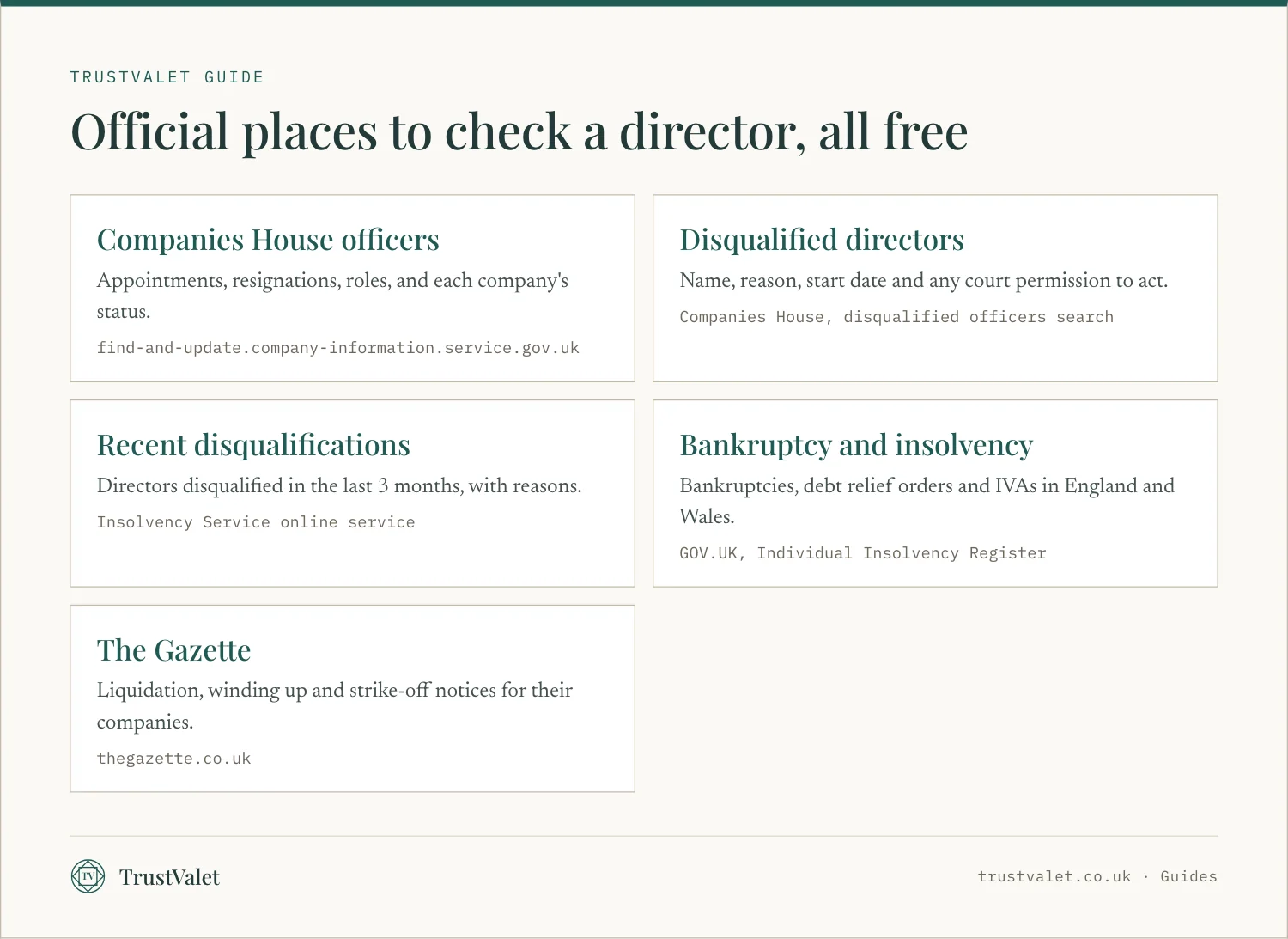
Companies House keeps a register of disqualified directors, which you can search for free. It includes disqualifications by the courts, the Insolvency Service, the Competition and Markets Authority, the Foreign, Commonwealth and Development Office and HM Treasury through OFSI. An entry shows:
- the person's name
- why they were disqualified
- when the disqualification began
- how many disqualifications they have had
- whether they have permission to act as a director
Details are removed automatically when the disqualification ends. For people disqualified in the last 3 months in England, Scotland or Wales, the Insolvency Service also publishes the reasons in its own online service. For a disqualification in Northern Ireland, GOV.UK points you to the Insolvency Service in Northern Ireland.
Bankruptcy and debt relief
Anyone who is currently bankrupt is automatically disqualified from being a director without the court's permission. The same applies to anyone subject to a debt relief order, or to a bankruptcy or debt relief restrictions order or undertaking. You can check this on the Individual Insolvency Register on GOV.UK, which covers bankruptcies, debt relief orders and individual voluntary arrangements in England and Wales.
Patterns worth a question
One failed company is not a warning sign. Businesses fail for many reasons, and the Insolvency Service says so plainly. What deserves attention is a pattern.
Look through the appointments list and ask:
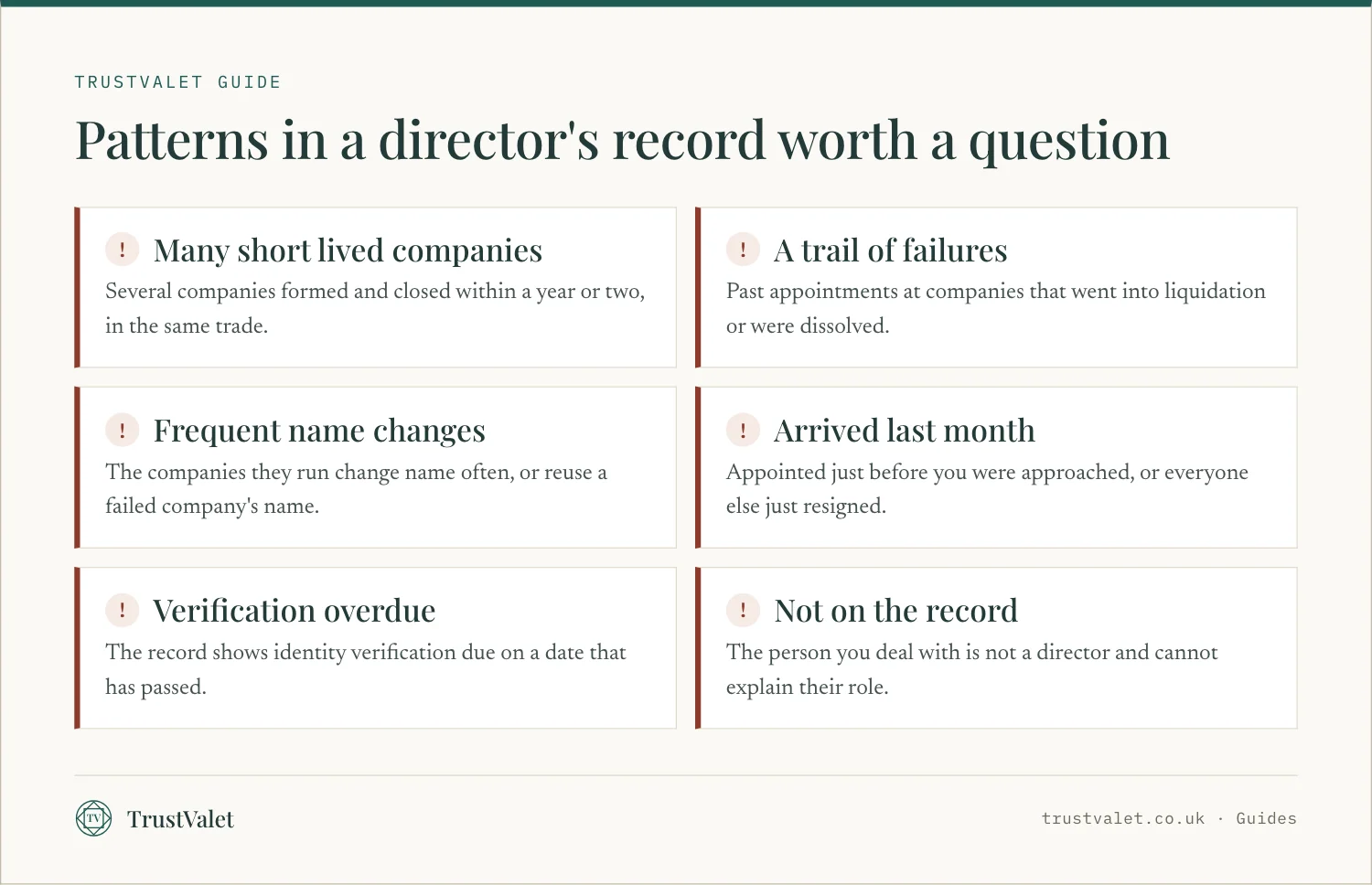
- How many companies, and how long did they last? Many companies opened and closed within a short time, in the same trade, is worth asking about.
- How did they end? Several past companies in liquidation or dissolved, especially with debts left behind, is the pattern behind phoenix companies.
- Do the names keep changing? The company page lists previous names. Frequent changes, or a new company with a failed one's name, deserve an explanation.
- When did they arrive? A director appointed just before you were approached, or a board that changed all at once, is worth a question.
Ask the director directly. An honest one can explain a failed company, a sale or a restructure. If you are about to pay a large deposit to builders or roofing contractors, it is worth ten minutes.
For a long contract, keep watching after you sign. Companies House has a free Follow service: once you register an email address and follow a company, it emails you as soon as a new filing is accepted, such as a change of director or address, with a link to the document. A sudden change of board part way through a job is worth a phone call.
The limits of a director check
A record is only a record. It shows appointments and events, not skill, honesty or how customers were treated. A long list of active companies can simply mean a group structure, or a family business with several companies.
People also share names. Before you draw any conclusion, compare the month and year of birth and the correspondence address across entries. If they differ, you may be looking at two different people.
The free service also has gaps. Companies House keeps the records of companies dissolved since January 2010 there, so older appointments may not appear. It also says the information is not intended to be comprehensive and that it cannot closely review every document it registers. If something matters, ask for it in writing.
If something looks wrong
If you think a disqualified person is running a company, use the GOV.UK service to report a disqualified director. For fraud or serious misconduct by a company, use the GOV.UK service to complain about a limited company. If the problem is a contract dispute, a solicitor can advise, and the accountants who run many small companies' filings can often explain what a record means.
How TrustValet can help
TrustValet is a register built from public records. We do not publish directors' names. Each company page in our register instead shows how many active directors the company has and how many have verified their identity, next to its status, incorporation date, previous names, filing deadlines and whether they are overdue, who controls it by kind of control, charges and filing history. Each fact carries its source and the date we read it, and published companies are re-read about monthly.
For names and appointments, go to Companies House. You can browse firms by trade and town, such as accountants in London, or across professional services.
Companies can apply to get verified: a person checks 14 things, including that the company has directors on record, and issues a dated certificate that anyone can check. How we verify lists every check. We do not check qualifications, insurance or workmanship, and a listed company is not an endorsed one. If a page looks wrong, please report it.
Questions
How do I check a company director in the UK?
Search the company on Companies House, open the People tab and click the director's name. You will see all their appointments, current and resigned, with each company's status. Then search the disqualified directors register and the bankruptcy and insolvency register.
Can I see a director's home address or full date of birth?
No. Companies House publishes a correspondence address and the month and year of birth. The home address and full date of birth are kept on a private register and shared only with credit reference agencies and bodies such as the police.
How do I know if a director is disqualified?
Search the disqualified directors register on Companies House, which is free. It shows the reason, when the disqualification began and whether the person has court permission to act. Anyone currently bankrupt is also disqualified automatically.
Is it a red flag if a director had a company that failed?
Not on its own. Companies fail for many reasons. A pattern is different: several short lived companies in the same trade, each ending in liquidation or dissolution, deserves a direct question before you pay.
Does TrustValet show directors' names?
No. TrustValet shows how many active directors a company has and how many have verified their identity, with the source and the date read. For names and appointments, use Companies House.
Check the company first
Before you pay anyone, look the company up. Every page in the register shows what Companies House says, with the date we read it.
Ala Ciobanu · Ala Ciobanu edits the TrustValet guides. Every guide names its sources.
- Searching the Companies House register (GOV.UK)
- Your personal information on the Companies House register (GOV.UK)
- Search for disqualified company directors (GOV.UK)
- Company director disqualification (GOV.UK)
- Search the bankruptcy and insolvency register (GOV.UK)
- Reporting misconduct by companies, directors and bankrupts to the Insolvency Service (GOV.UK)
- Report a disqualified director (GOV.UK)