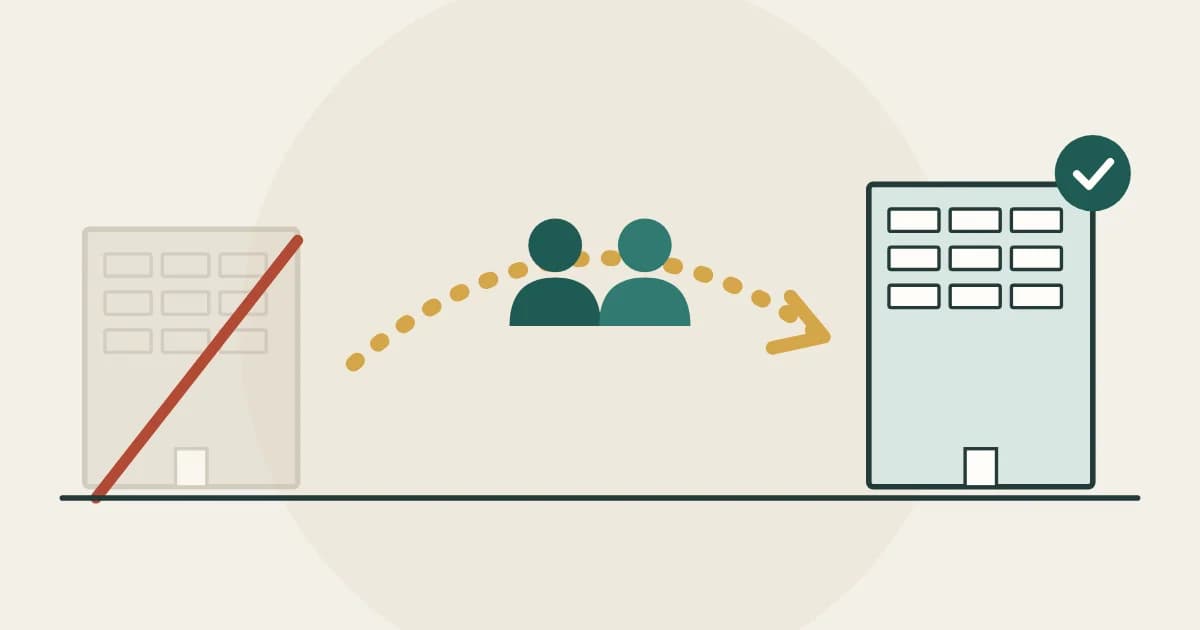
In short: a phoenix company is a new company that carries on the business of one that has failed, usually with the same people and often with a similar name or the same premises. Starting again after a failure is legal. It becomes abusive when companies are used again and again to leave debts behind. There is also a specific rule: after an insolvent liquidation, its directors cannot reuse the company's name for 5 years unless an exception applies.
This guide explains what phoenixing is, where the legal line sits, how to spot the pattern in free public records and what to do before you pay a deposit. It describes patterns only. A company that fits some of them may have a perfectly good explanation, so ask before you judge.
What a phoenix company is
The Insolvency Service describes phoenixing as the same business or directors trading one after another through a series of companies that liquidate or dissolve, leaving debts unpaid. The new company rises from the old one, hence the name.
It separates this from abusive phoenixism, where people use companies repeatedly to evade debts or for fraudulent purposes. That distinction matters. Plenty of honest businesses fail, and the people behind them often start again in the same trade.
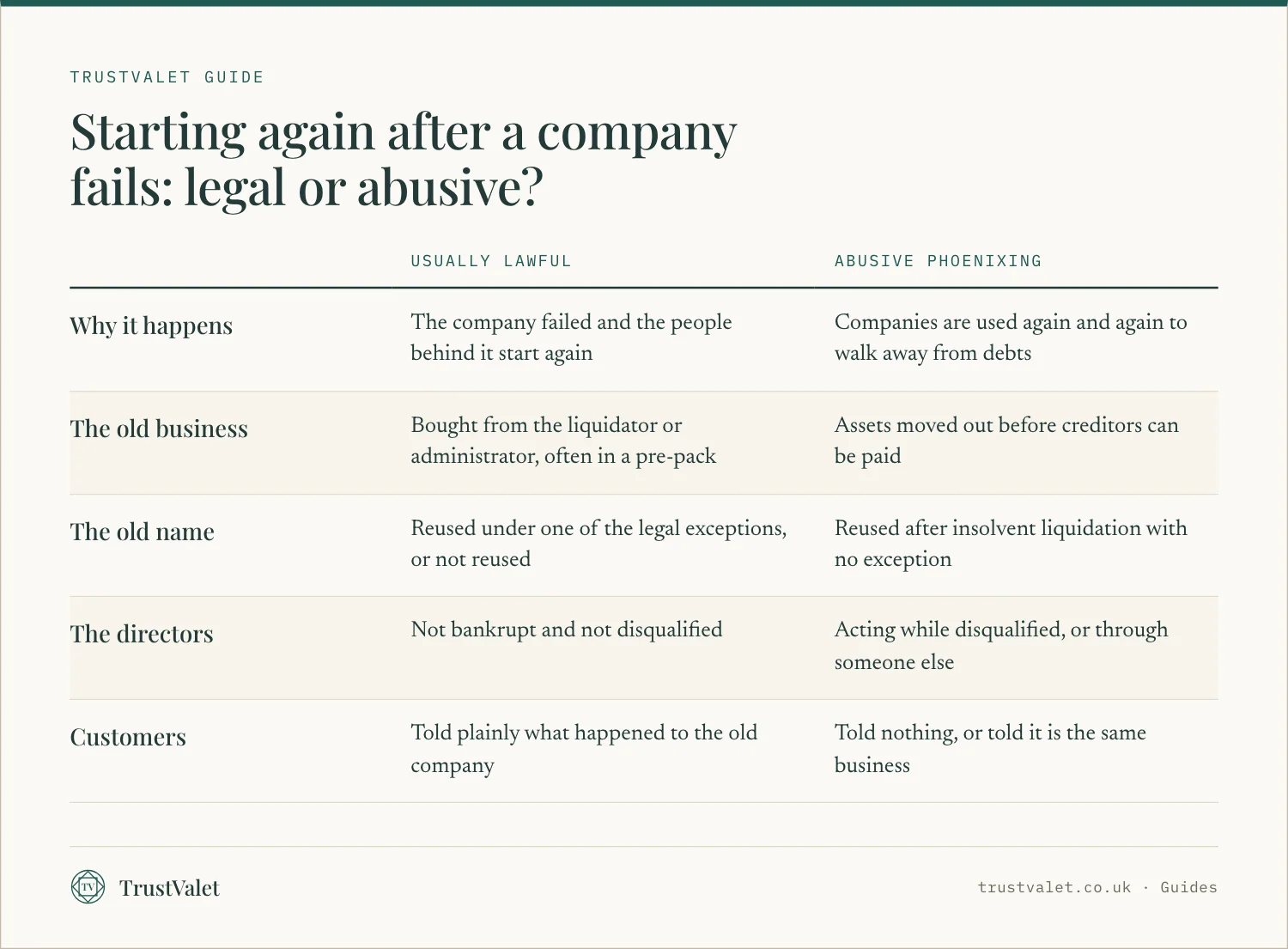
When phoenixing is legal
The Insolvency Service is clear that companies fail for many reasons besides misconduct. The law therefore lets owners, directors and employees of an insolvent or dissolved company set up a new company to carry on a similar business, as long as they are not bankrupt or disqualified from running a company.
When a company goes into administration or liquidation, the insolvency practitioner tries to raise as much money as possible for creditors. Sometimes the best offer for the business, including its name, comes from the former directors, who buy back part or all of it. This is sometimes called a pre-pack administration, and the law allows it.
The rule on reusing a failed company's name
Section 216 of the Insolvency Act 1986 limits who can reuse a name after an insolvent liquidation, that is, a liquidation in which the assets do not cover the debts and the costs of winding up. It applies to anyone who was a director or shadow director at any time in the 12 months before the company went into liquidation.
The banned name, called a prohibited name, covers:
- the company's registered name in those 12 months
- any trading name it used in that period
- any name so similar that it suggests an association with the old company
For 5 years from the start of the liquidation, that person must not be a director of a company known by a prohibited name, take part in forming or managing one, or carry on a business under that name in any other way. The Insolvency Service notes that the ban follows liquidation, not administration.
Breaking the rule is a criminal offence, punishable by a fine, imprisonment or both. Under section 217, the person also becomes personally liable, together with the company, for its debts run up while they were in breach. So does anyone managing the company who knowingly acts on that person's instructions. Section 216 applies in England, Wales and Scotland.
The exceptions
The court can give permission to reuse a name. In England and Wales, the Insolvency Rules 2016 also set out three exceptions:
- The business is bought from an insolvency practitioner. The whole, or substantially the whole, of the business is bought from the liquidator, or from an administrator, administrative receiver or CVA supervisor. The director must write to every creditor they know of and publish a notice in The Gazette, no later than 28 days after the purchase completes.
- The director applies to court quickly. If they apply within seven business days of the liquidation, they can use the name for up to six weeks, or until the court decides, whichever comes first.
- The other company already had the name. It must have been known by that name for the whole 12 months before the liquidation, and not been dormant in that time.
The first exception is useful to you as a customer. A director relying on it must publish a notice in The Gazette, so a search there can show that a name was reused openly and by the rules.
Why it matters to you as a customer
A new company is a separate legal person. If you paid a deposit to the old company, your claim is against the old company, and once it is in liquidation you are one creditor among many. The same goes for a guarantee on work the old company did. The new company did not give that promise, so do not assume it will honour it.
The Insolvency Service cannot sort out individual disputes, such as a customer who paid a deposit and never received the goods or service. It may take such cases into account only as part of a wider pattern of unfit conduct. Getting your money back is usually a matter for the liquidator, your card provider or legal advice from a solicitor.
How you pay makes a difference. Citizens Advice explains that if you pay by credit card for a single item costing more than £100 and no more than £30,000, you can ask the card provider for your money back under Section 75 of the Consumer Credit Act. For a debit card, you can ask for a chargeback.
How to spot a phoenix pattern
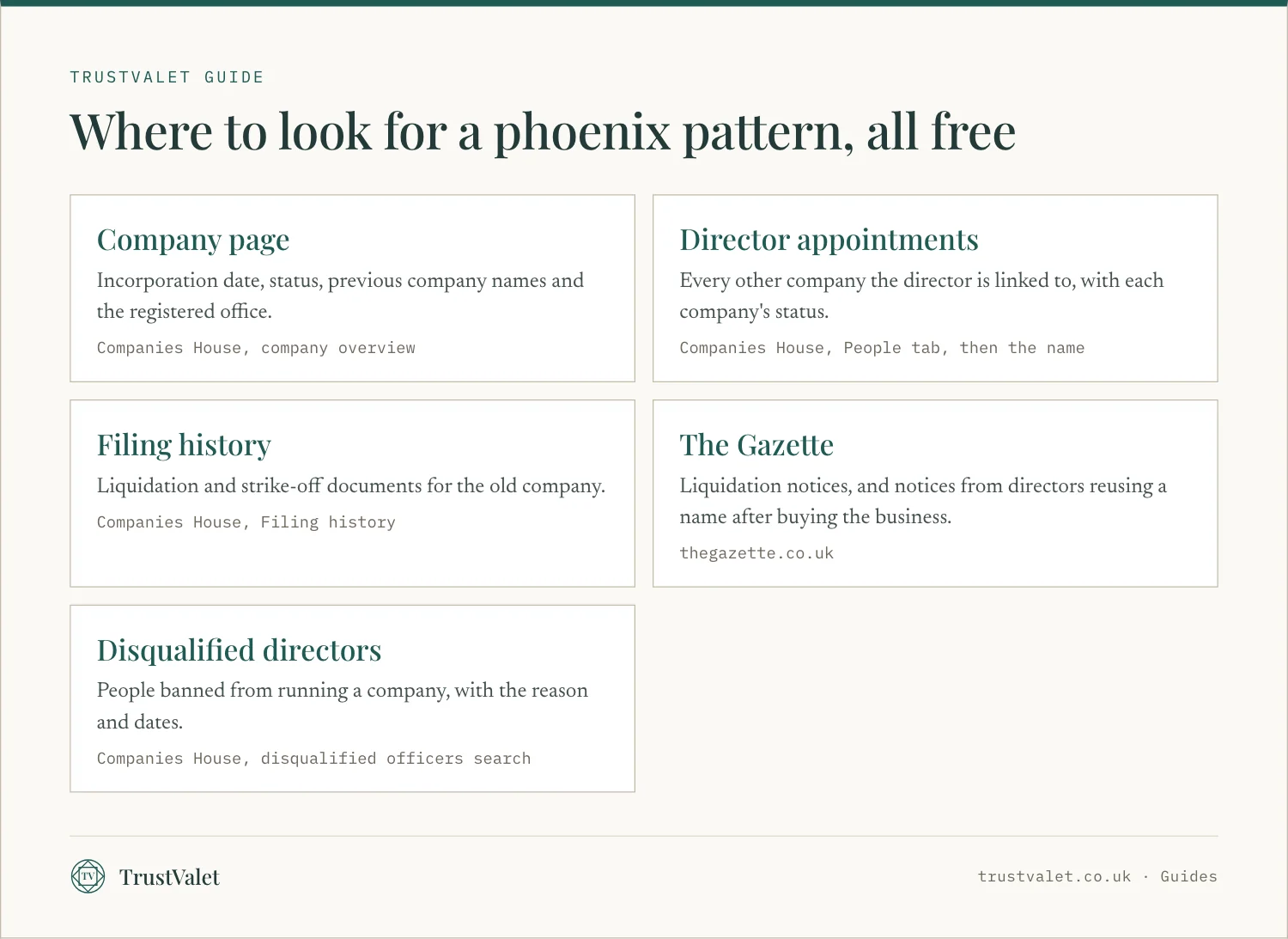
You can check most of this in ten minutes, for free. Start with the company you are about to pay, in our register or on Companies House.
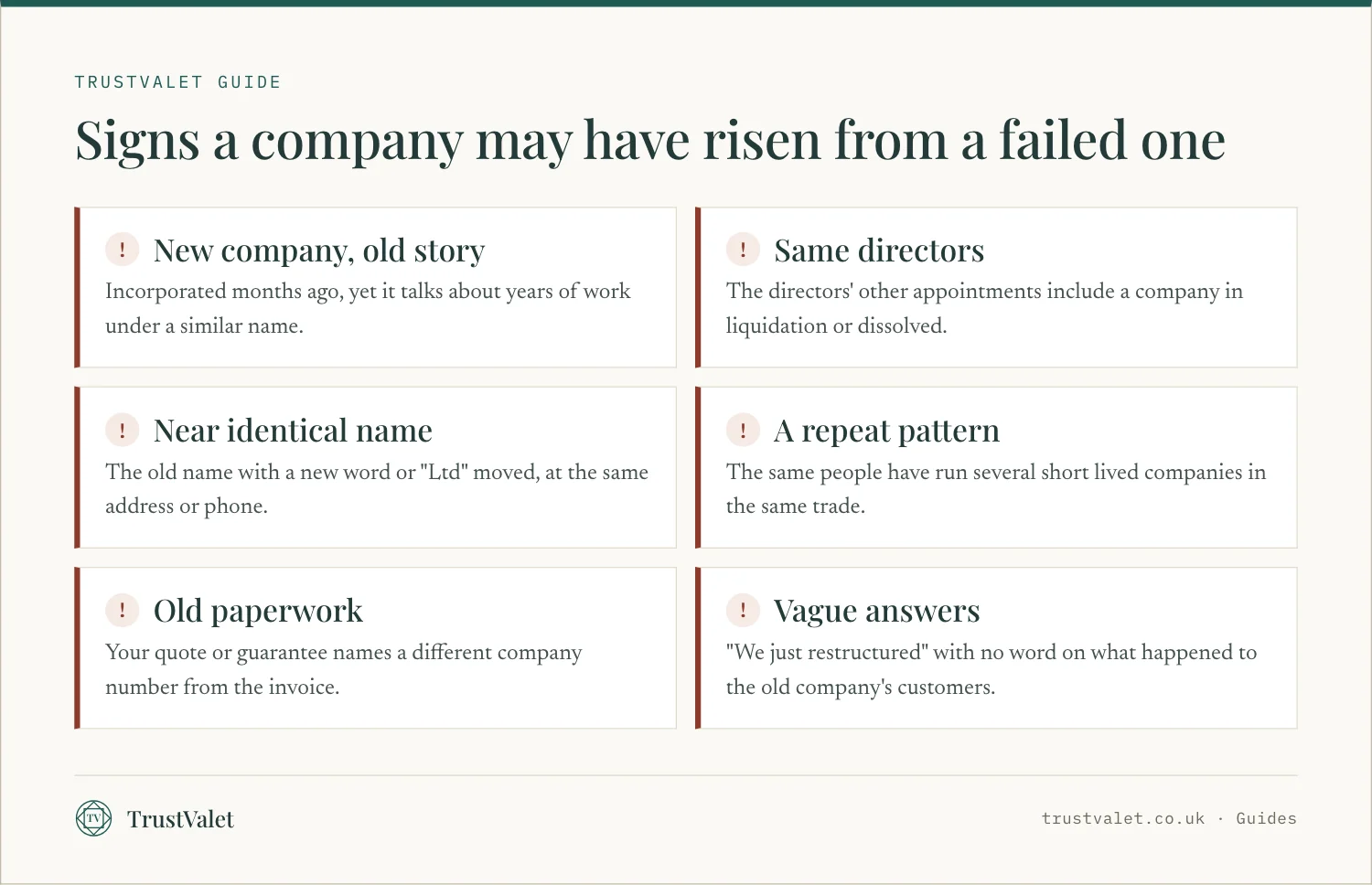
- Look at the incorporation date. A company formed a few months ago that describes a long history is worth a question. Our list of new companies shows recent incorporations.
- Read the previous names. The company page lists any earlier names. A company that has changed its name several times deserves a closer look.
- Open the directors' appointments. On the People tab, click each director's name. The list shows every other company they are linked to, with its status. Look for companies in liquidation or dissolved in the same trade.
- Check the old company. Open its filing history for liquidation or strike-off documents, and search The Gazette by its name and number.
- Compare the details. The same address, phone number, website or trading name across the old and new companies is the classic phoenix signature.
Companies House now keeps the records of companies dissolved since January 2010 on its free service, so older failures may not show up there. Our guide to finding out who owns a UK company explains the People tab in detail.
One earlier failure proves nothing. What deserves attention is a repeated pattern: several short lived companies in the same trade, each ending in liquidation or dissolution, with the next one starting as the last one stops.
What to do before you pay
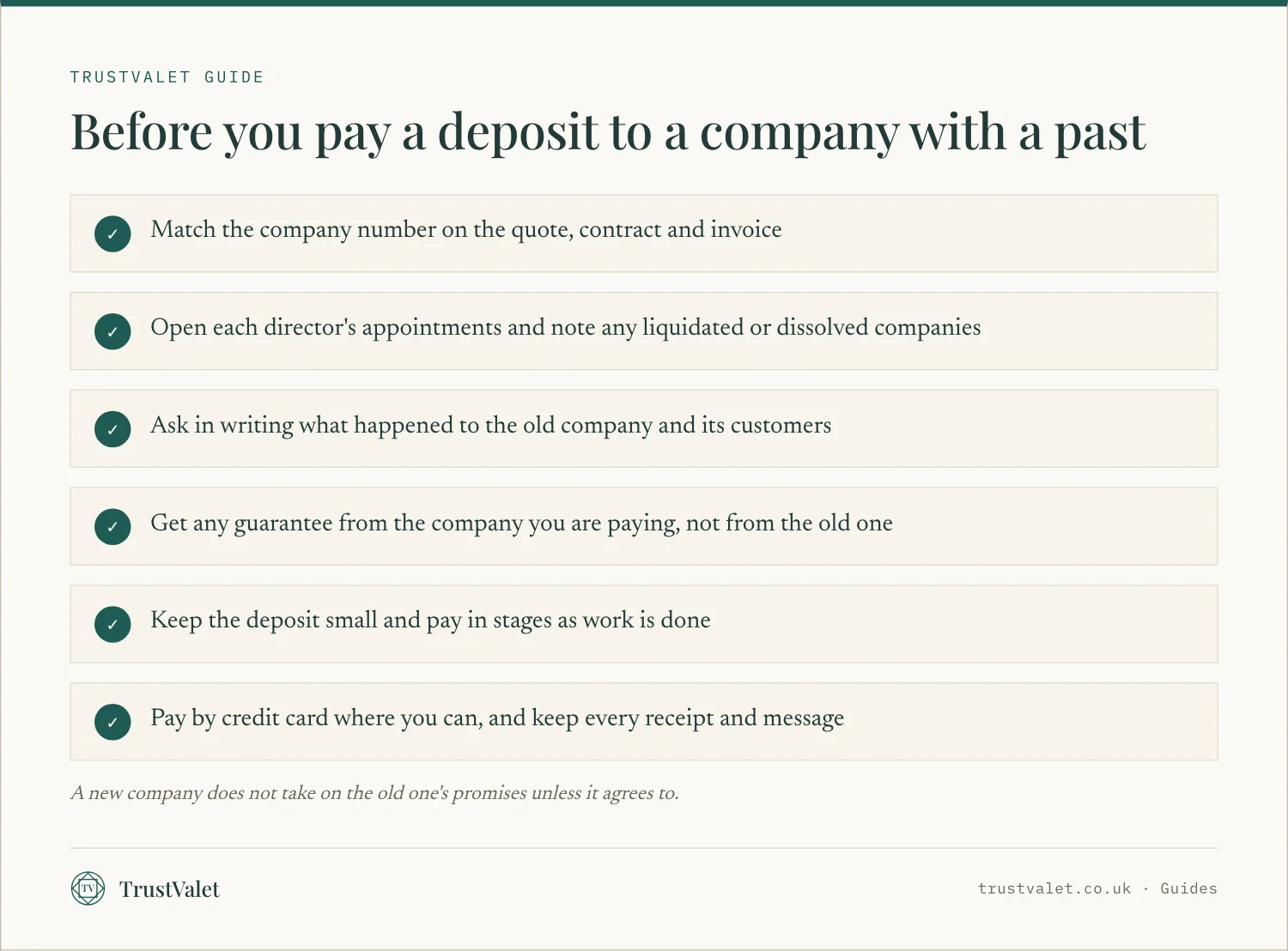
Ask directly. "Is this the same business as the old company? What happened to its customers?" An honest director can explain a failure, a pre-pack or a new start. Evasive answers are a signal in themselves.
Then make sure every document names the company you are actually paying, by its number. If you are hiring builders or roofing contractors, where deposits can be large, stage the payments so you never pay far ahead of the work. Our guides to red flags of a bad contractor and how to check if a UK company is legit cover the wider checks.
If the old company is still being struck off and owes you money, you may be able to object. Our guide on what dissolved means explains how.
Where to report misconduct
The Insolvency Service investigates suspected misconduct by directors of companies in liquidation, in administration or dissolved, and in some cases live companies. Its reporting guidance says:
- Reuse of a prohibited name: use its online complaints form, call 0303 003 1744 to ask for a form, or write to it. Where appropriate it will remind the director of the rules and ask them to put things right.
- Other misconduct: use the GOV.UK "complain about a limited company" service, which asks for the company's status first.
- A disqualified director at work: use the separate "report a disqualified director" service.
It does not usually investigate a live company when the only complaint is that it is a phoenix company. Its focus is a deliberate pattern of misconduct, not a single failure. For fraud, you can also contact Companies House or the Serious Fraud Office.
How TrustValet can help
TrustValet is a register built from public records. Each company page shows its status, incorporation date, previous names, accounts and confirmation statement deadlines and whether they are overdue, how many active directors have verified their identity, who controls it by kind of control, charges and filing history. Every fact shows its source and the date we read it, and published companies are re-read about monthly.
We do not publish directors' names, so to follow a director's other appointments, use the People tab on Companies House. You can browse companies by city or by trade, for example building finishing in London.
Companies can choose verification, where a person checks 14 things, including that there are no Gazette insolvency notices, no overdue filings and no strike-off action. How we verify lists every check, and anyone can check a certificate. We do not check insurance, qualifications or workmanship, and a listed company is not an endorsed one. If a page looks wrong, please report it.
Questions
What does phoenix company mean?
It is a new company that carries on the business of one that has failed, usually run by the same people and often with a similar name or premises. The Insolvency Service calls it abusive when companies are used repeatedly to evade debts or for fraud.
Is phoenixing illegal in the UK?
Not in itself. Directors of a failed company can start a new one, and can even buy the old business back from an insolvency practitioner, as long as they are not bankrupt or disqualified. Reusing the name after an insolvent liquidation is restricted.
Can a director reuse the name of a liquidated company?
Not for 5 years after an insolvent liquidation, if they were a director in the 12 months before it, unless the court allows it or an exception applies. Breaking the rule is an offence and can make them personally liable for the new company's debts.
Does a phoenix company have to honour the old company's guarantee or deposit?
Not automatically. The new company is a separate legal person, and your claim is against the old one. Ask the new company in writing whether it will honour the promise, and take advice if the amount is large.
How do I report a phoenix company?
Report suspected misuse of a prohibited name to the Insolvency Service through its online complaints form or by phone on 0303 003 1744. Other misconduct goes through the GOV.UK complain about a limited company service.
Check the company first
Before you pay anyone, look the company up. Every page in the register shows what Companies House says, with the date we read it.
Ala Ciobanu · Ala Ciobanu edits the TrustValet guides. Every guide names its sources.
- Phoenix companies and the role of the Insolvency Service (GOV.UK)
- Restrictions on reusing an insolvent company name, director information hub (GOV.UK)
- Insolvency Act 1986, section 216 (legislation.gov.uk)
- Insolvency Act 1986, section 217 (legislation.gov.uk)
- Insolvency (England and Wales) Rules 2016, rule 22.4 (legislation.gov.uk)
- Reporting misconduct by companies, directors and bankrupts to the Insolvency Service (GOV.UK)
- Searching the Companies House register (GOV.UK)
- Getting your money back if you paid by card or PayPal (Citizens Advice)