
In short: a registered office is your company's official address. Companies House, HMRC and anyone serving legal papers send post there, and it is shown on the public register. Since 4 March 2024 it must be an "appropriate address": a physical UK address where post will reach someone acting for the company and deliveries can be signed for, which rules out a PO Box. It does not have to be your home, and if you want your home kept off the register, it should not be.
This guide covers what the address is for, the rules it must meet, how to keep your home private, how to change it, and what the warnings you sometimes see on a company's record mean.
What a registered office is for
Every UK limited company must have a registered office from the day it is formed. It is where official post goes. Companies House posts your authentication code for online filing there, and HMRC sends Corporation Tax letters, including your activation code, to the same address.
It is also the address the law uses. Under section 1139 of the Companies Act 2006, a document can be served on a company by leaving it at, or posting it to, its registered office. If nobody reads the post, the company can miss a claim, a penalty or a strike off warning.
You must also show your registered office address, along with your company number, on business letters, order forms and your website. So the address is not just an entry on a register. It is part of how people identify and contact your company.
The appropriate address rule
The Economic Crime and Corporate Transparency Act 2023 tightened the rules. Section 86 of the Companies Act 2006 now says a company must make sure its registered office is at an appropriate address at all times. This has been in force since 4 March 2024.
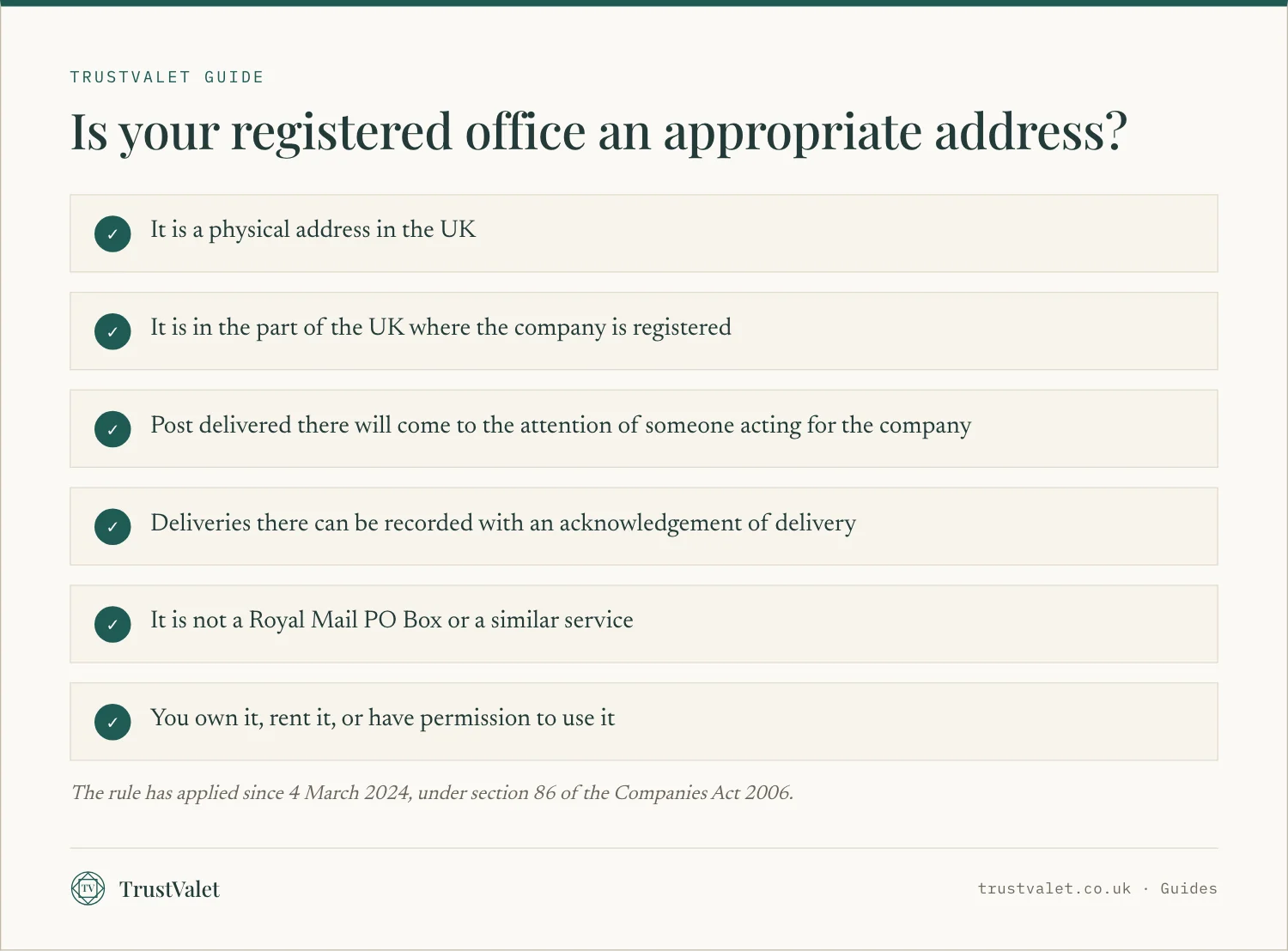
An address is appropriate if, in the ordinary course of events:
- a document delivered there by hand or post would be expected to come to the attention of someone acting for the company, and
- delivery there can be recorded by getting an acknowledgement of delivery
GOV.UK adds that the address must be a physical address in the UK, in the same part of the UK where the company is registered. A company registered in Scotland needs a Scottish registered office, and one registered in England and Wales needs an address in England or Wales.
No PO boxes
You can no longer use a Royal Mail PO Box as a registered office, and the same applies to similar services from other companies.
Failing to keep an appropriate address without a reasonable excuse is an offence by the company and every officer in default. GOV.UK also warns that a company can be struck off if its registered office does not meet the requirements.
Using your home address
You can use your home as the registered office if it meets the rules. The catch is privacy: the registered office is published on the online register, and anyone can see it.
GOV.UK's advice is simple. If you do not want an address to be public, such as your home, do not use it as your registered office. Instead you can:
- use another address, such as your accountant's or solicitor's, with their permission
- appoint an agent who provides a registered office service
GOV.UK keeps a list of formation and secretarial agents, and notes that all registered office services charge a fee. Whoever you use, the address must still meet the appropriate address test. Set it up before you incorporate, because you need the address in place to register.
Many accountants and solicitors offer their address as a registered office for clients. If you are in the capital, you can browse accountants in London, or any town we cover.
Service addresses for directors
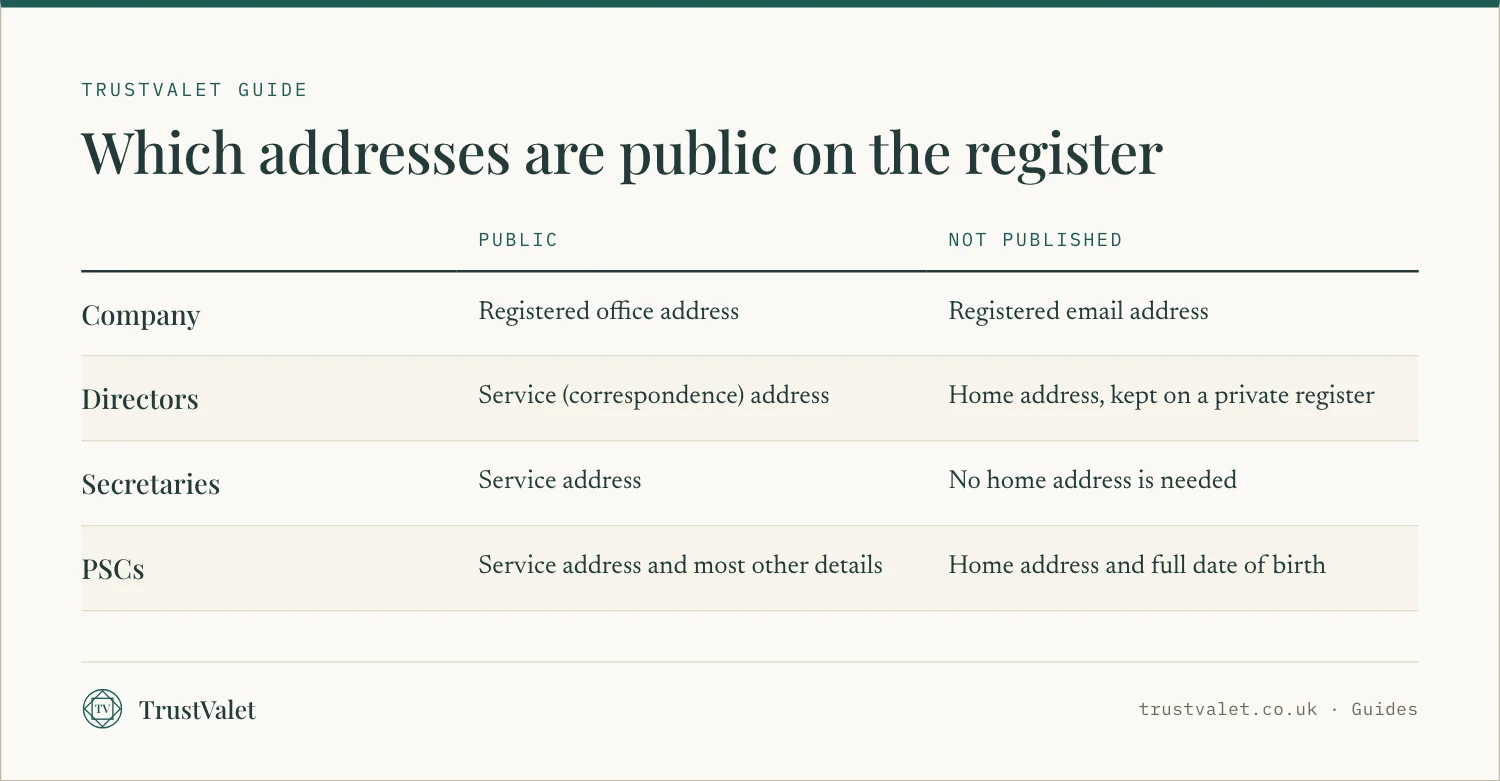
Directors have two addresses on file. The service address, sometimes called the correspondence address, is public. The usual residential address, your home, must be given to Companies House but is kept on a private register.
Your service address can be the same as the registered office, or somewhere else. If you use your home as your service address, it becomes public. That is why many directors use the company's registered office instead.
Company secretaries give only a service address. People with significant control also give a service address: most of their details are public, but their home address and full date of birth are not. Our guide to people with significant control explains what the register shows about them.
Removing a home address that is already public
If your home was used as a registered office or service address in the past, you can apply to have it removed from documents on the register using form SR01. It costs £34 per document, and you pay for each document listed in your application.
There are limits. Companies House cannot remove a home address that is still the company's current registered office, so an active company must change its registered office first. If the company is dissolved, you must wait 6 months before applying to remove an address used as its registered office. Where a removed address was a former registered office, Companies House hides part of it, showing only the first half of the postcode.
Changing your registered office
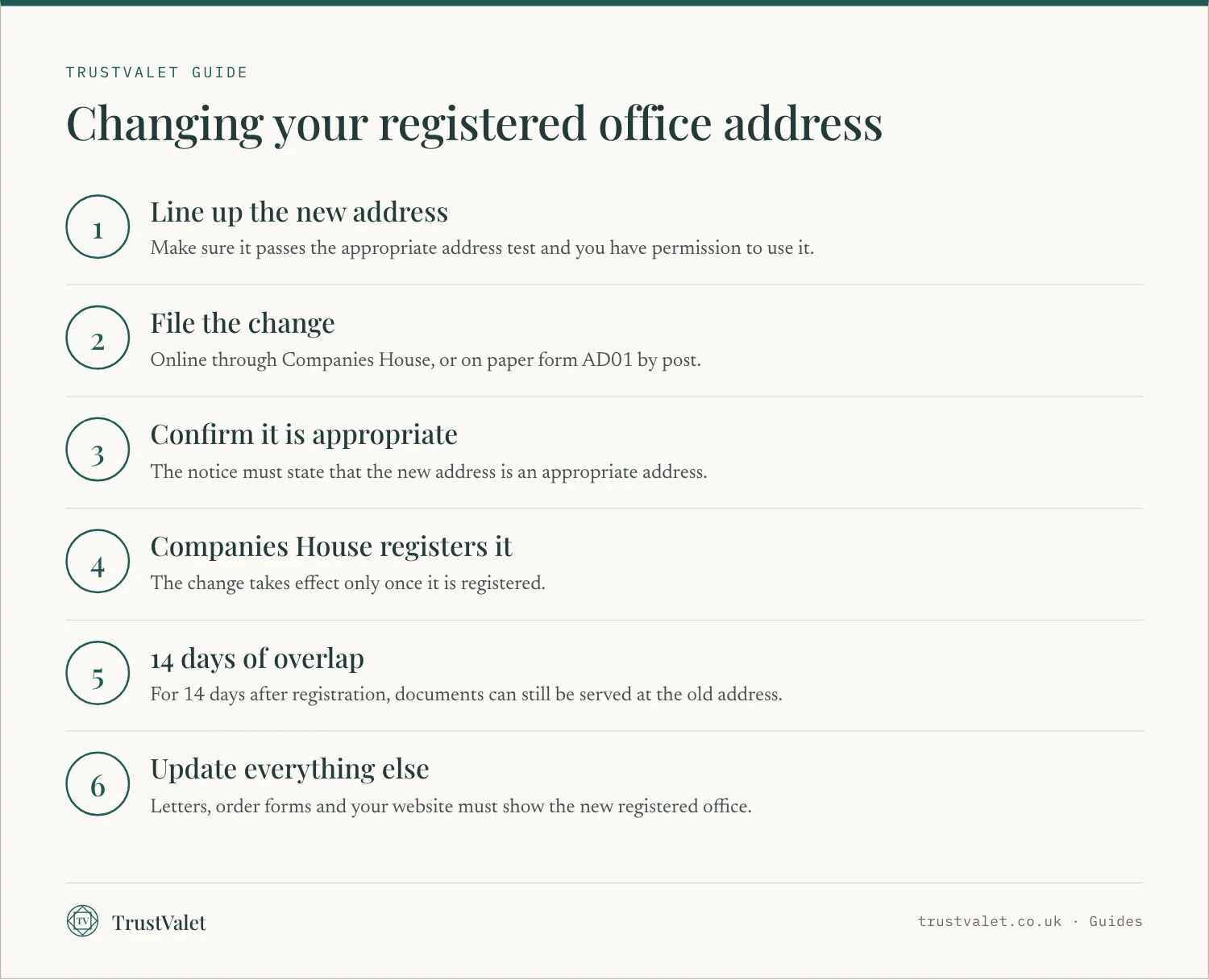
To change the address, file the change with Companies House online, or on paper form AD01. There is a separate process for the registered email address, covered below.
The notice must include a statement that the new address is an appropriate address. The new address must also be in the same part of the UK where the company was registered. You cannot move a company registered in England and Wales to a Scottish registered office.
When it takes effect
Under section 87 of the Companies Act, the change takes effect when Companies House registers it, not when you send it. For 14 days after that, anyone can still validly serve documents at the old address. So keep checking the old post for at least two weeks.
If the change is approved, Companies House tells HMRC, so you do not need to report it to HMRC separately. You do need to update your letterheads, invoices and website.
The registered email address
Since 4 March 2024, every company must also have a registered email address. New companies give one when they register. Existing companies give theirs in their next confirmation statement, if they have not already.
It must be an appropriate email address: one where emails from Companies House would be expected to reach someone acting for the company. It is not published on the public register. You change it through its own Companies House process, not with AD01.
What "undeliverable" and "in dispute" mean on a record
Two warnings about a registered office can appear in Companies House's data.
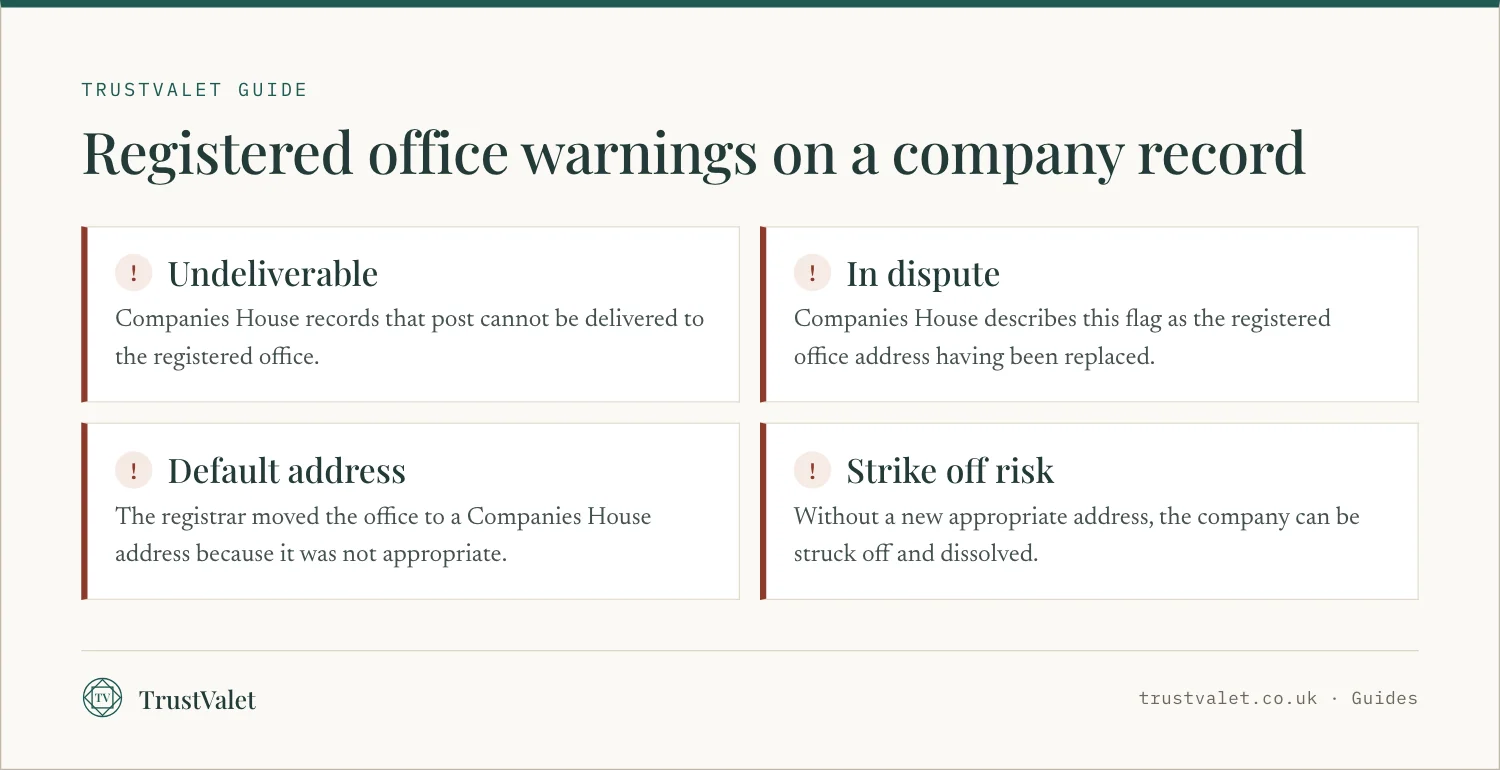
Undeliverable means Companies House records that post cannot be delivered to the registered office. In practice, official letters to the company are coming back.
In dispute is the other. Companies House's own data description says this flag indicates the registered office address has been replaced. One way that happens is a challenge to the address, set out below.
How an address gets challenged
Anyone who thinks a company's registered office is not an appropriate address can apply to Companies House on form RP07. A common case is a company using someone's address without permission.
If the registrar agrees, it can move the registered office to a default address held at Companies House, either straight away or after giving the company 14 days to object or move. The company then has 28 days to give a new appropriate address, with evidence it has permission to use it. If it does not, the registrar can start striking it off. An unsuccessful applicant, or the company, can appeal to the court within 28 days.
Neither flag proves wrongdoing. But a company whose official post is not reaching it is harder to hold to account, which is worth knowing before you pay one. Our guide on how to check if a UK company is legit shows where this fits among the other checks.
Your registered office in the first year
Getting the address right at the start saves trouble later. Official post about the deadlines in your first year as a limited company arrives at the registered office, so someone needs to read it from day one. If you plan to use the registered office as your directors' service address too, decide that before incorporation, when each director also has to verify their identity.
How TrustValet can help
TrustValet is a register built from public records. Each company page in our register shows what Companies House holds, including its status, filing deadlines and whether any are overdue. If Companies House flags the registered office as undeliverable or in dispute, the page says so, with the source and the date we read it. We re-read published companies about monthly, so once the problem is fixed at Companies House, the warning clears after our next read.
The registered office also decides where you appear. We place a company in a town list, such as London, from the postcode of its registered office. If that address is shared by a large number of companies, as formation agent addresses often are, we do not place the company in a town at all. A registered office at an accountant's is fine, but your listing will show that town.
If you run a company, search for it and claim the page for free. You can add your website, phone number, description and logo. To show more, you can apply to get verified: a person checks your company against 14 public registers and your own website, free while you show our badge on your website, or £19 a year (£49 once for five years) without it (see pricing). How we verify lists every check. We never vet workmanship, collect reviews or rate companies.
Questions
Can I use my home address as my company's registered office?
Yes, if it is a physical UK address where post will reach someone acting for the company. But the registered office is public on the Companies House register, so if you want your home kept private, use an accountant, solicitor or registered office service instead.
Can a registered office be a PO Box?
No. Since 4 March 2024 the registered office must be an appropriate address, and GOV.UK says you can no longer use a Royal Mail PO Box or a similar service from another company.
How do I change my registered office address?
File the change with Companies House online or on paper form AD01. The change takes effect when Companies House registers it, and documents can still be served at the old address for 14 days after that.
How much does it cost to remove my home address from Companies House?
An application on form SR01 costs £34 for each document you want your details removed from. If the address is still the company's registered office, you must change the registered office first.
What does registered office in dispute mean?
Companies House's data description says the flag indicates the registered office address has been replaced. One way this happens is a challenge on form RP07, after which the registrar can move the office to a Companies House default address.
Check the company first
Before you pay anyone, look the company up. Every page in the register shows what Companies House says, with the date we read it.
Ala Ciobanu · Ala Ciobanu edits the TrustValet guides. Every guide names its sources.
- Set up a limited company: company address (GOV.UK)
- Companies Act 2006, section 86: registered office at an appropriate address (legislation.gov.uk)
- Companies Act 2006, section 87: change of address of registered office (legislation.gov.uk)
- Your personal information on the Companies House register (GOV.UK)
- Removing your home address from the Companies House register (GOV.UK)
- Registrar of Companies: rules and powers (Companies House)
- Running a limited company: company information you must report (GOV.UK)
- Running a limited company: signs, stationery and promotional material (GOV.UK)