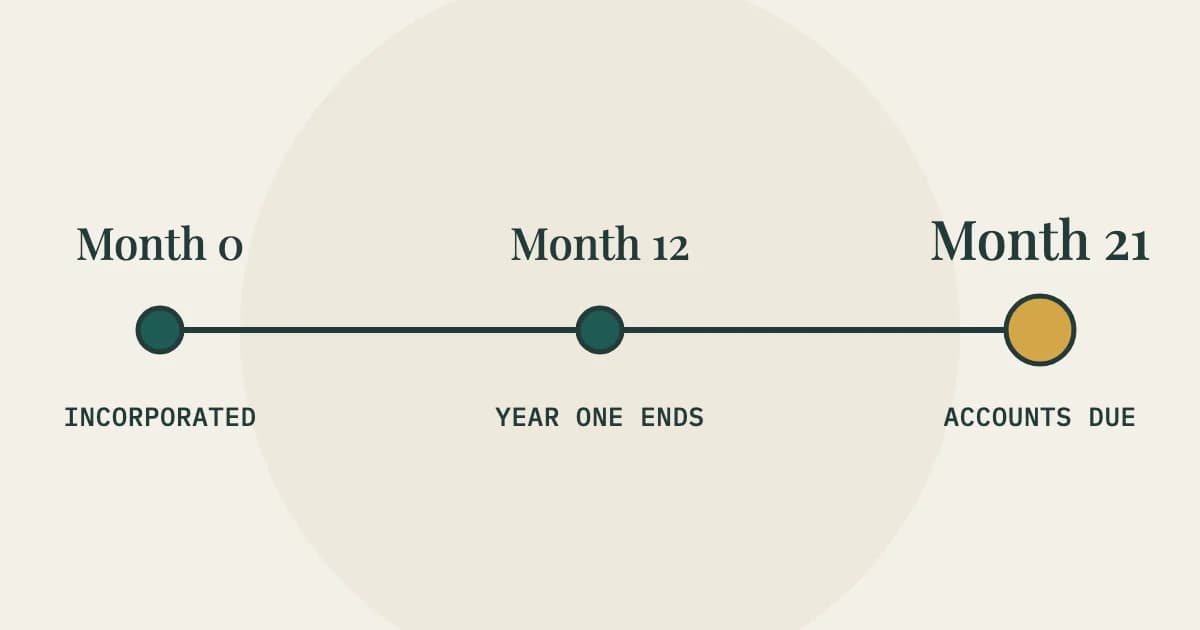
In short: a new private limited company must file its first accounts at Companies House within 21 months of the date it was incorporated, or 3 months after its first accounting reference date if that is later. The first period starts on the day of incorporation and ends on the last day of the month in which the first anniversary falls, so it usually runs a little over 12 months. After that, accounts are due 9 months after each year end. Late accounts get an automatic penalty, starting at £150.
This guide explains how the first period is set, how to work out the deadline, what a small, micro or dormant company files, and how the Corporation Tax side fits in. For the full first-year picture, including the confirmation statement and VAT, see our first-year deadlines calendar.
Your first accounting reference date
Companies House sets your company's year end automatically. It is called the accounting reference date, or ARD.
For every new company, the first ARD is the last day of the month in which the first anniversary of incorporation falls. Later ARDs fall on the same date each year. You may make up your accounts to the ARD or to a date up to 7 days either side of it.
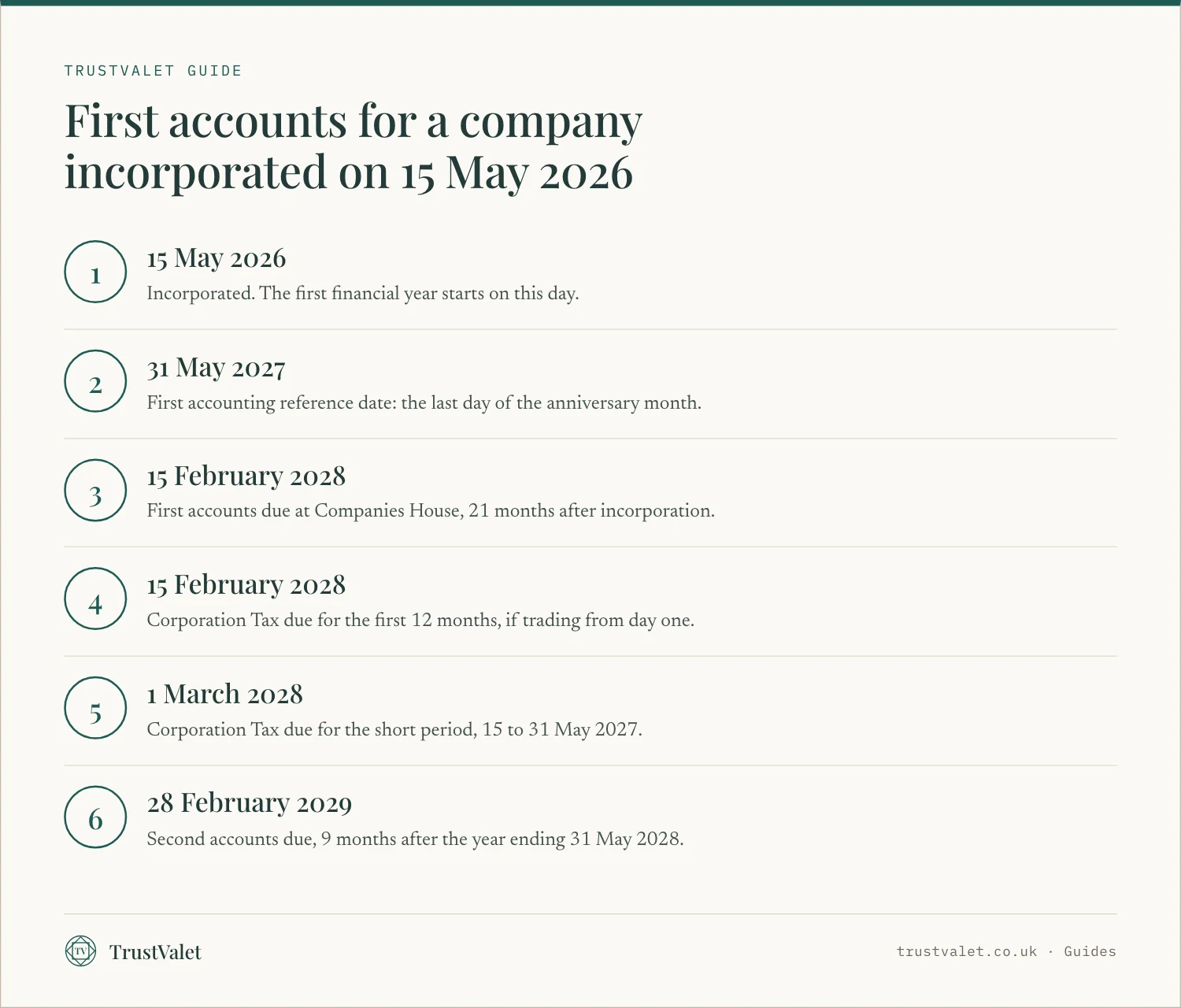
So a company incorporated on 15 May 2026 has a first ARD of 31 May 2027. Its first accounts run from 15 May 2026 to 31 May 2027, just over 12 months and 2 weeks.
Changing the year end
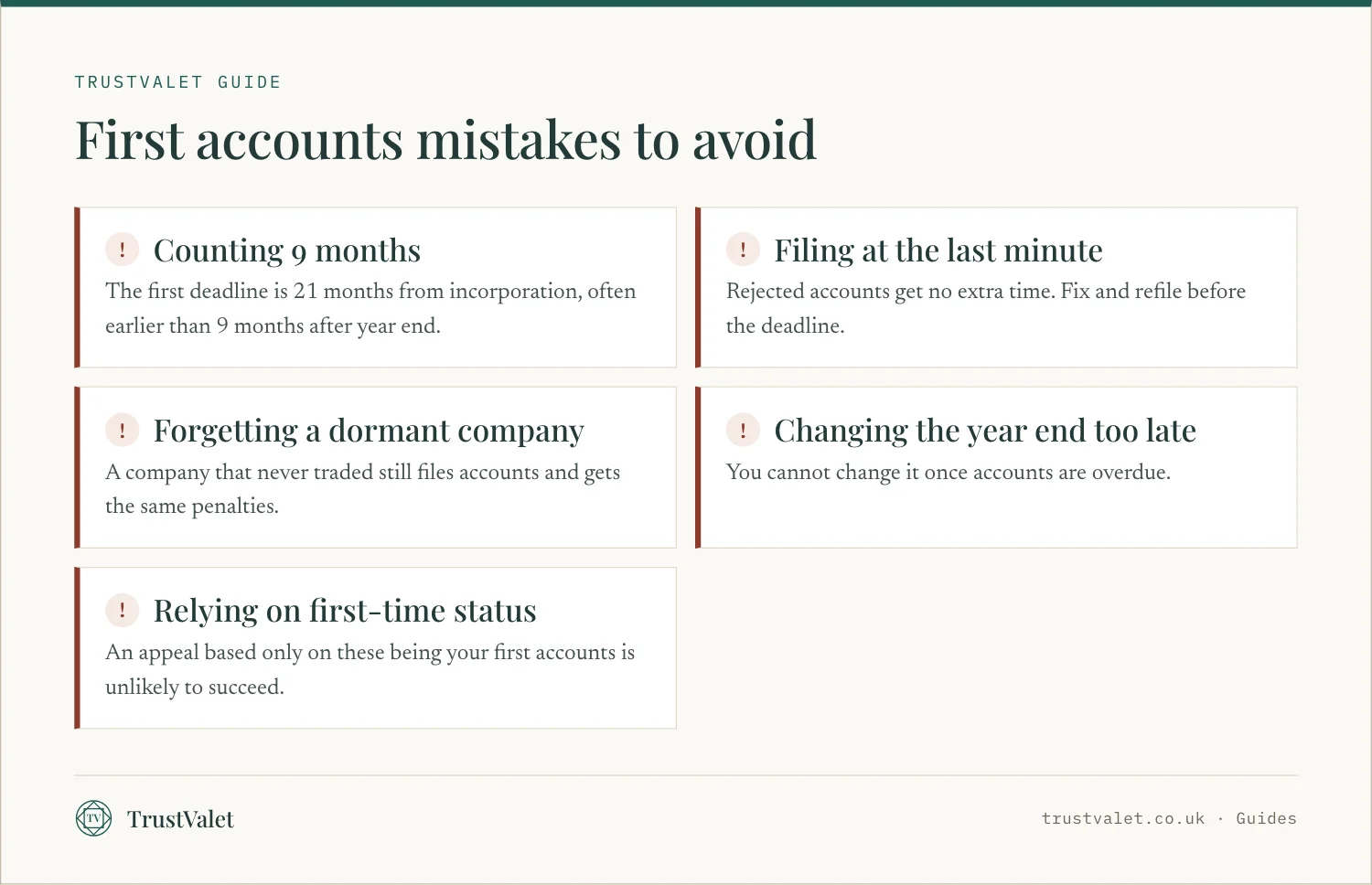
You can change the ARD for the current financial year or the one immediately before it. You do this online, through software, or on paper form AA01, and it must be done before the accounts for that period are due. Once accounts are overdue, it is too late.
The rules are:
- Shortening: you can shorten a period as often as you like, by as little as 1 day.
- Extending: a period cannot be longer than 18 months, and you can normally extend only once every 5 years.
- First period: there are no extra restrictions on changing the first ARD. If you extend the first period to the full 18 months, count the date of incorporation as day one.
Companies House plans a change from 1 April 2028: shortening more than once in 5 years will need a business reason. Any change also moves your Corporation Tax dates, so tell HMRC and speak to your accountant first.
When your first accounts are due
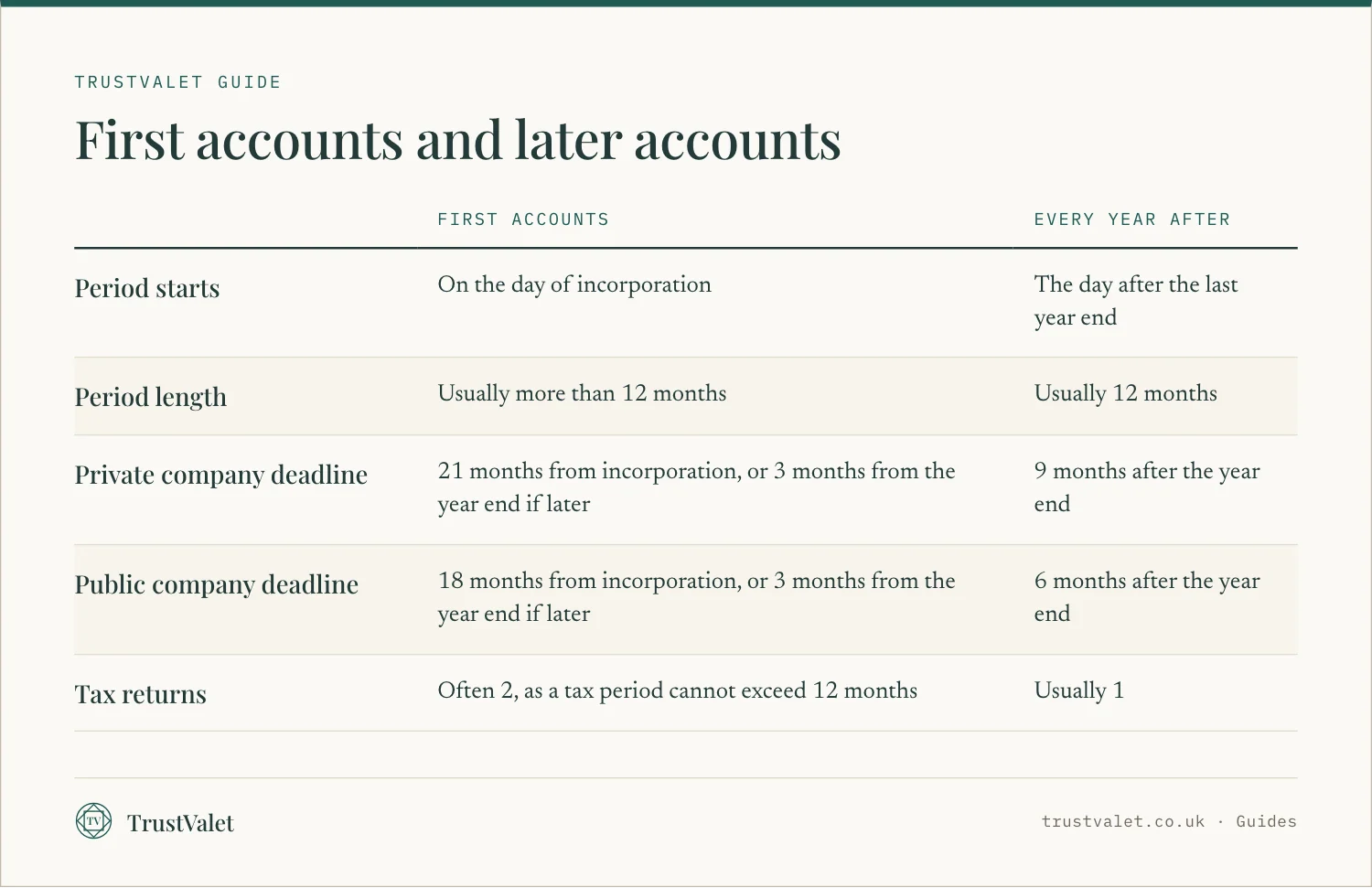
The first deadline follows its own rule. If the first accounts cover more than 12 months, a private company must deliver them within 21 months of incorporation, or 3 months from the ARD, whichever is longer. A public company has 18 months, or 3 months from the ARD.
For our company incorporated on 15 May 2026, that is 15 February 2028. Nine months after the year end would be 29 February 2028, so assuming the usual rule would leave you two weeks late.
If you shorten your first period so it is 12 months or less, the normal time limit applies. When you shorten, the new deadline is the longer of 9 months from the new ARD, or 3 months from the date Companies House receives your AA01.
Every year after
From the second year, a private company has 9 months after its ARD to deliver its accounts, and a public company has 6. Your deadlines are shown on your company's page on the Companies House register, so you never need to guess.
What accounts you file
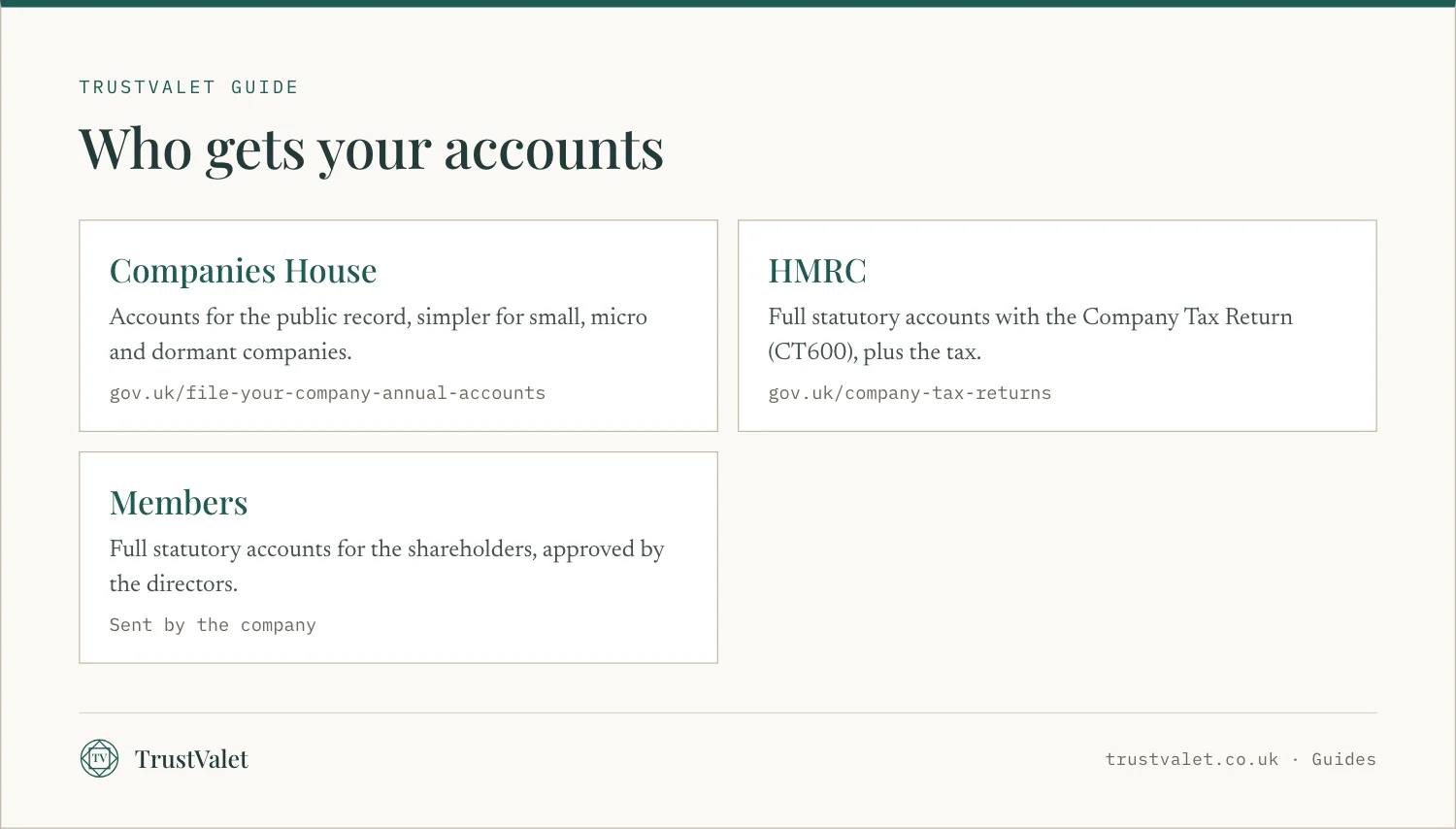
Every company prepares full statutory accounts for its members and sends them to HMRC with the Company Tax Return. What goes to Companies House, and so onto the public record, depends on the company's size.
Small companies
For accounting periods beginning on or after 6 April 2025, a company is small if it meets at least 2 of these:
- turnover of £15 million or less
- balance sheet total of £7.5 million or less
- 50 employees or fewer on average
Before that date the limits were £10.2 million turnover and £5.1 million balance sheet. A small company can usually skip an audit and can choose not to file its profit and loss account or directors' report. It can also file abridged accounts, if all the members agree.
Micro-entities
For periods beginning on or after 6 April 2025, a company is a micro-entity if it meets at least 2 of these:
- turnover of £1 million or less
- balance sheet total of £500,000 or less
- 10 employees or fewer on average
The earlier limits were £632,000 and £316,000. A micro-entity can prepare simpler accounts and file only a balance sheet with less information. Generally, in its first year a company qualifies on that year's figures alone.
Changes coming in 2028
Companies House has said that from 1 April 2028, small companies will no longer be able to file abridged accounts, and micro-entities must deliver a profit and loss account, with an option to keep it off the public register. Accounts will also have to be filed with commercial software. Check the Companies House guidance before your filing date, because the details are still being confirmed.
Dormant companies
A company is dormant for Companies House if it has had no significant accounting transactions. Filing fees, late filing penalties and money paid for shares at incorporation do not count.
A dormant company still files accounts, on the same deadline, and gets the same late filing penalties. Its accounts are much simpler: a balance sheet with a statement, above a director's signature, that the company was dormant throughout the period. A company that has never traded can file them online, or on paper form AA02. A company that becomes dormant after trading cannot use form AA02.
Being dormant for Companies House is not the same as being dormant for Corporation Tax. HMRC has its own test, and you must tell HMRC separately.
The separate Corporation Tax return
Companies House and HMRC work on different clocks. A Corporation Tax accounting period cannot be longer than 12 months, so first accounts covering more than 12 months often need 2 Company Tax Returns, each with its own payment date.
If our example company traded from 15 May 2026, its first tax period is 15 May 2026 to 14 May 2027, with tax due on 15 February 2028. The short second period, 15 to 31 May 2027, has tax due on 1 March 2028. Each return is due within 12 months, and you must file one even if the company made a loss.
Our first-year deadlines guide covers telling HMRC you have started trading and the rest of the tax calendar.
How to file
Your directors must approve the accounts before they are filed. At present you can file:
- Online, with the Companies House service. This works for micro-entity, abridged and dormant accounts, among others. You need the company's password and authentication code.
- Through commercial software. Many accountants file this way, and it is the route Companies House is moving everyone to.
- On paper, by post. This is slower. If paper accounts are rejected close to the deadline, you do not get extra time.
Filing early gives you room to fix a rejection. Companies House returns accounts that do not meet the Companies Act, for example an unsigned balance sheet, and a corrected set that arrives late still gets a penalty.
What the public can see
Everything in the accounts you file with Companies House goes on the public record. Anyone can look it up for free, which is why small and micro companies often file the shorter versions.
The register also shows when your accounts are due and whether they are overdue. Customers, suppliers and lenders check this, so an overdue flag can cost you more than the penalty. Our guide on how to check if a UK company is legit shows what people look for.
Late filing penalties in brief
If your accounts arrive late, Companies House issues an automatic penalty to the company. For a private company it is £150 up to 1 month late, rising to £375, £750 and £1,500 for more than 6 months. It doubles if accounts are late 2 years in a row.
Appeals rarely succeed, and Companies House lists "these are your first accounts" as a reason that alone is unlikely to work. If something outside your control happens before the deadline, you can apply for more time, but only before the deadline passes.
Not filing is also a criminal offence for the directors, and a company that keeps missing filings can be struck off. The same risks apply to the confirmation statement, which runs on a separate yearly clock.
Getting help
The directors stay legally responsible for filing, even when someone else prepares the accounts. Many new companies use an accountant or bookkeeper, and some use business support advisers. You can browse firms in our professional services category or by city, for example accountants in London.
How TrustValet can help
TrustValet is a register built from public records. If your company is new, it may already appear among our new companies. Each page shows what Companies House holds, including your accounts and confirmation statement deadlines and whether either is overdue, with the source and the date we read it. We re-read published companies about monthly, so once you file, the overdue flag clears on our page too.
Search for your company and claim your page for free, then add your website, phone, description and logo. If you want to show customers more, you can get verified: a person runs 14 checks against public registers and your website, including that you have no overdue filings, free while you show our badge on your website, or £19 a year (£49 once for five years) without it (see pricing). How we verify lists every check. It does not check your accounts, insurance or workmanship.
Questions
When are a new limited company's first accounts due?
If the first accounts cover more than 12 months, a private company must file them within 21 months of incorporation, or 3 months after its accounting reference date if that is later. A public company has 18 months.
What period do a company's first accounts cover?
They start on the day of incorporation and end on the first accounting reference date, the last day of the month in which the first anniversary falls. So they usually cover a little over 12 months.
Can I change my company's first year end?
Yes, before the accounts are due. You can shorten the period as often as you like, or extend it to a maximum of 18 months from incorporation. You cannot change it once the accounts are overdue.
Does a dormant company have to file first accounts?
Yes. A dormant company files accounts on the same deadline and faces the same late filing penalties. Its accounts are simpler: a balance sheet with a statement that it was dormant throughout the period.
What is the penalty for filing first accounts late?
For a private company, £150 if up to 1 month late, £375 up to 3 months, £750 up to 6 months and £1,500 after that. The penalty doubles if accounts are late 2 years in a row.
Check the company first
Before you pay anyone, look the company up. Every page in the register shows what Companies House says, with the date we read it.
Ala Ciobanu · Ala Ciobanu edits the TrustValet guides. Every guide names its sources.
- Life of a company: annual requirements, part 1 accounts (Companies House)
- Micro-entities, small and dormant companies (GOV.UK)
- Change your company's year end (GOV.UK)
- Your limited company's first accounts and Company Tax Return (GOV.UK)
- File your company's annual accounts with Companies House (GOV.UK)
- Penalties for late filing of accounts (GOV.UK)
- Dormant for Corporation Tax (GOV.UK)